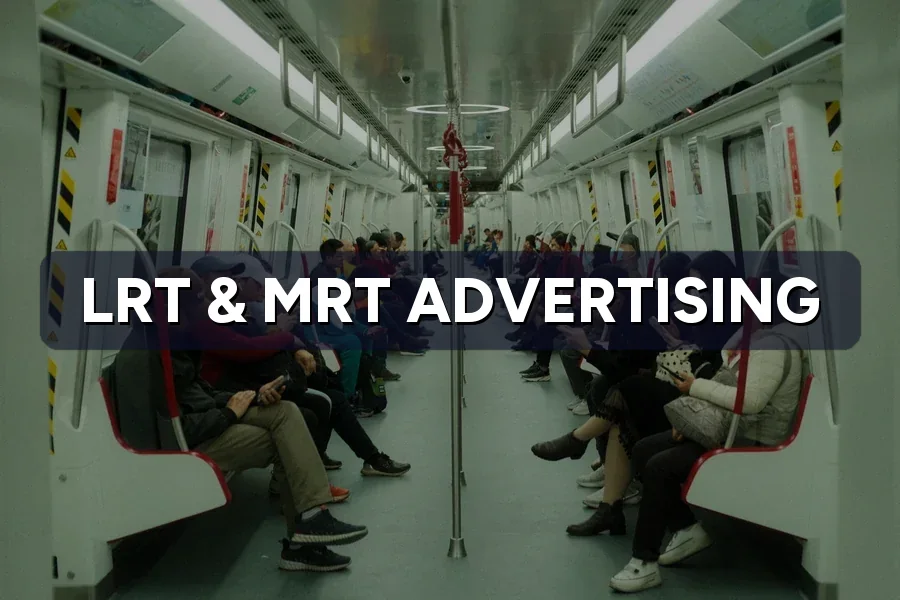
Every working day, hundreds of thousands of people in the Klang Valley stand on a platform, wait two to five minutes, then ride for twenty more. They look at the walls, the screens and the panels above the seats. That waiting time is what LRT advertising sells.
This guide is for business owners weighing LRT and MRT ads in 2026. It covers the formats on offer, indicative ringgit rates, how many people ride each line, when trains are busiest, how to book, and how to measure results. At ZenWeb, a Google Partner agency working with 500+ Malaysian businesses, we judge offline media by the enquiries it brings, next to search and social.
Rail is one part of the wider out-of-home market. For every format side by side, see our outdoor advertising costs guide. The short video below, from MRT Corp itself, shows how brands use stations and trains.
Source video: Watch on YouTube
Quick Answer: LRT advertising in Malaysia covers three spaces: inside stations, inside trains and outside on trains or viaduct pillars. Station formats include lightboxes, wall panels, digital screens, stair and gate wraps, and full station takeovers. Train formats include interior panels and exterior wraps. The biggest deal is station naming rights, sold on multi-year terms.
Each format suits a different goal and budget:
Station screens work like other place-based screens, such as digital billboards beside highways, condo and office lift screens and mall screens and roadshows. Many stations link straight into malls, so LRT advertising and mall media often reach the same shoppers.
Quick Answer: Indicatively, LRT advertising in Malaysia costs RM 3,000–15,000 a month for a station panel package and RM 5,000–20,000 for four weeks of station screen spots. Train interior panels run RM 5,000–25,000 a month, a station takeover RM 20,000–80,000, and a train wrap RM 60,000–200,000 for three months. Rates vary by media owner.
| Format | How It Is Sold | Indicative Cost | Usual Minimum |
|---|---|---|---|
| Station lightbox or wall panel package | Per package per month | RM 3,000–15,000 | 1 month |
| Station digital screens (15-sec spot in a loop) | Per screen network per 4 weeks | RM 5,000–20,000 | 4 weeks |
| Train interior panels | Per line package per month | RM 5,000–25,000 | 1 month |
| Station takeover (stairs, pillars, gates, walls) | Per station per month | RM 20,000–80,000 | 1–3 months |
| Full train wrap (exterior) | Per train set, incl. production | RM 60,000–200,000 | 3 months |
| Station naming rights | Per year, negotiated | Six figures and up | Multi-year |
| Production: printed panel | One-off, per panel | RM 300–2,500 | None |
Source: Indicative planning ranges estimated by ZenWeb, 2026. Not published rate cards; rates vary by media owner, station, line and booking length, and exclude SST.
Rail media owners in Malaysia rarely publish rate cards, so treat these as planning numbers. Four things move the price:
For a sense of scale, compare these figures with our guides to TV advertising rates, radio advertising rates and newspaper print and ePaper rates.
What would RM 15,000 a month do online?
Before you book a station package, see how the same budget performs in search and social ads around the same stations. See ZenWeb’s digital marketing pricing →
Quick Answer: In 2025, the MRT Kajang line averaged about 254,000 trips a day and the LRT Kelana Jaya line about 246,000, per data.gov.my’s daily ridership dataset. LRT Ampang, MRT Putrajaya and the Monorail followed. Together, the five lines carried about 330 million trips in 2025.
| Line | Relative Ridership | Average Trips a Day |
|---|---|---|
| MRT Kajang line | 254,075 | |
| LRT Kelana Jaya line | 245,568 | |
| LRT Ampang and Sri Petaling lines | 194,574 | |
| MRT Putrajaya line | 152,521 | |
| KL Monorail | 57,812 |
Source: data.gov.my, Daily Public Transport Ridership (Prasarana Malaysia and Ministry of Transport, CC BY 4.0), calendar year 2025. Averages calculated by ZenWeb from the daily figures. Counts are trips, not unique people.
Read these numbers with care when planning LRT advertising. They count trips, not people, so a commuter who rides to work and back counts twice. Riders also spread across dozens of stations, so what matters is footfall at the stations you book. Ask each media owner for station-level figures.
The new LRT Shah Alam line adds another corridor, averaging about 38,000 trips a day in August 2026 in the same dataset. For riders who switch to buses, see our bus wraps and panels guide. For those who take an e-hailing car home, Grab ads reach the same commuter in the app.
Quick Answer: Yes. Average daily trips on Prasarana’s LRT, MRT and Monorail lines rose from about 647,000 in 2019 to 905,000 in 2025, up about 40%, per data.gov.my. Growth slowed from 26% in 2024 to 10% in 2025, and January to August 2026 is running about 4% higher again.
| Year | Average Trips a Day | Change vs Previous | Lines Included |
|---|---|---|---|
| 2019 | 647,380 | Pre-pandemic base | LRT Ampang, LRT Kelana Jaya, MRT Kajang, Monorail |
| 2022 | 436,523 | Recovery year | Plus MRT Putrajaya from June |
| 2023 | 653,477 | +49.7% | Five lines |
| 2024 | 823,595 | +26.0% | Five lines |
| 2025 | 904,550 | +9.8% | Five lines |
| 2026 (Jan–Aug) | 937,816 | +3.7% | Plus LRT Shah Alam from late June |
Source: data.gov.my, Daily Public Transport Ridership (Prasarana Malaysia and Ministry of Transport, CC BY 4.0). Yearly averages and changes calculated by ZenWeb; 2020 and 2021 left out because of pandemic movement controls. 2026 covers data to 31 August 2026 only.
More riders now see each panel than a few years ago, and media owners know it, so expect LRT advertising rates to keep rising. Weigh that against roadside options, such as billboards versus digital ads or e-hailing and fleet car wraps, which reach drivers rather than riders.
Quick Answer: Weekdays are busiest on every line. In 2025, weekend ridership on the LRT Kelana Jaya line was only 56% of its weekday level, per data.gov.my. The KL Monorail held 87%, because it runs through Bukit Bintang’s shopping and tourist belt. Commuter lines suit work-related offers; the Monorail suits leisure.
| Line | Weekday Average | Weekend Average | Weekend as % of Weekday |
|---|---|---|---|
| KL Monorail | 60,082 | 52,113 | 87% |
| MRT Kajang line | 277,840 | 194,436 | 70% |
| LRT Ampang and Sri Petaling lines | 213,555 | 146,938 | 69% |
| MRT Putrajaya line | 173,102 | 100,870 | 58% |
| LRT Kelana Jaya line | 281,053 | 156,517 | 56% |
Source: data.gov.my, Daily Public Transport Ridership (Prasarana Malaysia and Ministry of Transport, CC BY 4.0), 2025. Weekday = Monday to Friday, including public holidays; weekend = Saturday and Sunday. Calculated by ZenWeb.
This shapes the message. On commuter lines, the same office worker passes your panel ten times a week, which suits courses, banking, recruitment and lunch deals near stations. Screens also let you run a weekday message and a weekend message in one booking.
Leisure audiences behave differently. If you sell to weekend shoppers or families, the Monorail and mall-linked stations hold up better, and cinema advertising reaches the same people at leisure. For commuters with earphones in, podcast advertising is the audio partner to a station panel.
Quick Answer: LRT advertising suits businesses whose customers commute by rail in the Klang Valley. Think outlets near a station, colleges and training centres, banks and telcos, recruiters, property launches and event organisers. It suits small neighbourhood shops less, because most riders pass through a station rather than live beside it.
Rail ads work well when:
They fit poorly if your customers drive, live outside the Klang Valley or need to buy this week. Forecourt screens reach drivers instead; see our petrol station advertising guide. If your budget is under about RM 5,000 a month, Google Ads location targeting can reach the same neighbourhoods around your station for less.
Quick Answer: Rail operators usually sell advertising through concession holders, not directly. Find out who holds the concession for your line, shortlist stations near your customers, compare quotes, get the creative approved, and set up tracking before launch. Allow two to six weeks, longer for wraps, which need printing and installation slots.
Concessions change hands, so check first. In 2016, MRT Corp awarded three 10-year advertising concessions for the Kajang line. Titanium Compass took station interior and train advertising; a Big Tree Outdoor and Seni Jaya consortium took exterior advertising. Those terms run to about 2026, so confirm who holds each line today.
Naming rights are a separate, longer deal. Manulife, for example, took five-year naming rights to the Semantan MRT station in 2017, including route maps and two branded train interiors.
Quick Answer: LRT advertising builds repeated recall among commuters, but nobody can click a station panel. Google Ads captures people already searching, Meta Ads targets riders by area and interest on their phones, and SEO earns free search traffic over time. Rail ads work best when online channels catch the search or message that follows.
A rider who sees your panel at Bukit Bintang may search your brand that evening. If a competitor’s ad tops that search, your rail spend has helped them. Pair rail with:
Planning a rail campaign this year?
We build the search, social and tracking around your station panels so every scan and search gets counted. Plan it with ZenWeb’s digital marketing team →
Quick Answer: Measure LRT advertising by giving each station its own QR code, short link or promo code, then counting scans, WhatsApp chats and sales against a four-week baseline. Also watch branded searches and direction requests near your outlets. Ridership figures and play reports show how many people could see the ad, not how many acted.
LRT advertising has one edge over roadside media: riders stand still for a few minutes, so QR codes get scanned. Use it:
For softer signals, read how to measure brand awareness. To see where rail sits among all your options, compare every digital advertising channel.
Quick Answer: LRT and MRT advertising in Malaysia reaches a growing commuter audience of about 905,000 trips a day, with tests from roughly RM 3,000–15,000 a month. Pick stations near your customers, compare quotes per station, track each station with its own code, and pair the campaign with search and social ads.
LRT advertising works best as one part of a commuter plan, not the whole plan. Before you book, compare the cost with what search and social could do with the same money. A clear digital marketing budget makes that choice simple.
Indicatively, RM 3,000–15,000 a month for a station panel package, RM 5,000–25,000 for train interior panels and RM 60,000–200,000 for a three-month train wrap. Rates vary by media owner, station and booking length.
In 2025, the MRT Kajang line averaged about 254,000 trips a day and the LRT Kelana Jaya line about 246,000, per data.gov.my. The KL Monorail had the smallest but most weekend-heavy audience.
Usually, yes. Many media owners sell LRT advertising station by station, though some only sell line packages. Ask which formats are free at the stations nearest your outlet.
Run it for at least four weeks. Rail ads work through repeated sightings by the same commuters, and a shorter test rarely shows a clear change in enquiries.
Give each station its own QR code or promo code, link it to WhatsApp or a mobile page, and compare enquiries with a four-week baseline taken before launch.
Cite this page: ZenWeb (2026). LRT and MRT Advertising Malaysia: Formats and Rates 2026. https://zenweb.my/blog/lrt-mrt-advertising/
You may quote our data with this credit and a link. See our Terms of Use.
Not sure if rail ads suit your business?
Book a free 30-minute strategy session. We’ll check which stations sit near your customers, review your online presence and show you how to split spend between rail, search and social.
Get A Free Proposal
Complete the form and our team will contact you to discuss your goals. Let’s grow your business.
Chat with us on WhatsApp
Tell us a little about what you need. We'll open WhatsApp with your message ready to send.