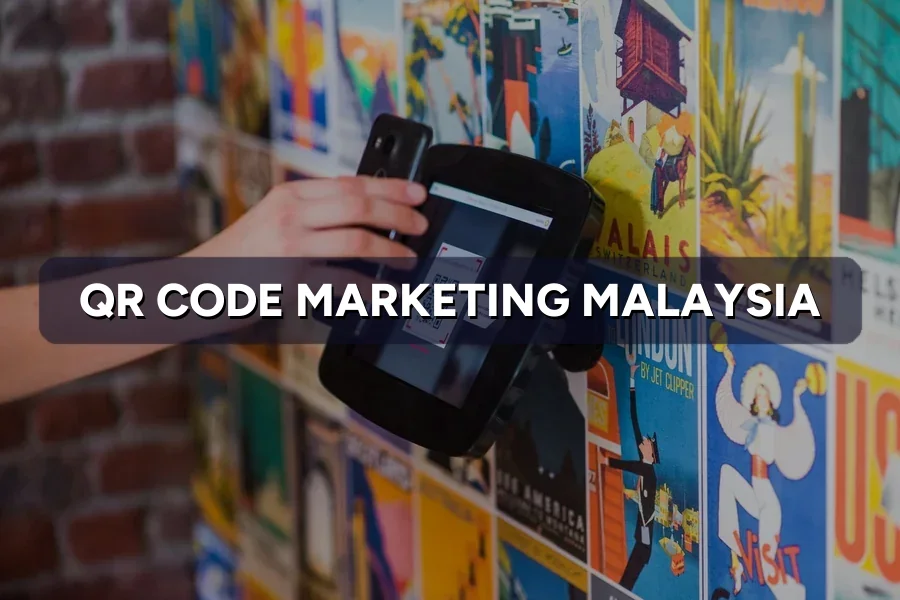
Malaysians scan without thinking now. The mamak, the parking machine, the pasar malam stall with a printed code taped to a cardboard box — the habit is settled. PayNet added 681,250 new DuitNow QR acceptance points in 2025, taking the country past three million touchpoints. Nobody needs to be taught what the little square does.
Which is exactly why so many business owners get QR code marketing wrong. They assume the hard part is done, print a code onto a banner, point it at their homepage, and then wonder why the scan report shows eleven scans in two months.
The code was never the problem. This guide covers where a code earns scans, what should sit behind it, whether to print static or dynamic, and how to track the whole thing back to a sale. The video below is a solid overview before we get into the Malaysian specifics.
Source video: The QR Code Generator on YouTube
Quick Answer: QR code marketing in Malaysia works today because payment killed the friction. Scanning is a daily reflex, phone cameras read codes natively, and nobody has to download an app first. The behaviour was paid for by the banks; marketers just borrow it.
The 2012 version of QR codes failed everywhere, Malaysia included, for one boring reason: you needed a separate reader app. That single step was enough to kill it.
Two things changed. Phone cameras started reading codes straight from the viewfinder, and then DuitNow QR turned scanning into a payment habit repeated several times a week. Cross-border QR transactions alone grew 2.5 times to 29.7 million in 2025, which tells you how normal the gesture has become even outside the country.
That inherited habit is the whole opportunity. A Malaysian customer will point a phone at your code without deciding to — the decision only happens after the page loads. So every argument about QR code marketing in Malaysia should really be an argument about the destination, not the square.
Still running everything offline?
A code is only worth printing once there is somewhere useful for it to land. Read our first steps for offline SMEs going online →
Quick Answer: Scan rate follows dwell time, not audience size. A code on a table where someone sits for forty minutes beats a code on a billboard seen by fifty thousand cars. Print where hands are free and the person is already waiting.
This is the finding that surprises owners most. The placements with the biggest reach perform worst, because a driver at 80km/h has no hands, no time, and no reason. Meanwhile a diner waiting for food has all three.
| Where the code sits | Scans per 100 people who saw it |
|---|---|
| Table tent in a dine-in outlet | 34 |
| Printed receipt or invoice | 12 |
| Flyer handed over by a person at a booth | 9 |
| Parcel insert or packaging sticker | 8 |
| Staff lanyard or name tag | 6 |
| Shop window or door decal | 3 |
| Roadside banner or billboard | 0.4 |
Source: ZenWeb client tracking across Malaysian SME accounts, 2024–2026.
Read the table as a rule about posture. Seated and waiting beats standing. Standing beats walking. Walking beats driving, by a mile. Booth staff who hand a flyer over beat a window decal too, because a person asking you to scan is a social prompt rather than a passive one. That is much of why event marketing in Malaysia pays for itself.
Quick Answer: One code, one job. A page built for the exact thing the code promised converts around seven times better than the homepage. Pointing a code at a homepage or a social profile wastes the scan you just earned.
The scan is the expensive part. Someone stopped, aimed a phone, and gave you their full attention for a few seconds. Landing them on a homepage means they now have to find what the poster promised, on a phone, while their food arrives.
| Code points to | Action being asked for | Completed it |
|---|---|---|
| Single-purpose landing page | Book, claim or enquire | 41% |
| Pre-filled WhatsApp chat | Send the first message | 38% |
| Google review link | Leave a review | 27% |
| PDF menu or brochure | Read past page one | 14% |
| Instagram or Facebook profile | Follow the account | 9% |
| Website homepage | Anything at all | 5% |
Source: ZenWeb client tracking across Malaysian SME accounts, 2024–2026.
Three practical rules come out of that spread:
WhatsApp deserves a special mention because it performs almost as well as a proper landing page and costs nothing to build. A code that opens a chat with the message already typed removes every remaining step, which is why it beats a Facebook group or page as a scan destination for most SMEs.
Quick Answer: Print dynamic for anything that goes to volume or lives longer than a week. Dynamic codes let you change the destination after printing and count every scan. Static codes are free and permanent, which is fine only if the URL will never change.
A static code has the URL baked into the pattern itself. A dynamic code carries a short redirect link, so the provider can point it anywhere later. That single difference decides whether a printing mistake costs you RM 30 or a whole reprint.
| Decision factor | Static code | Dynamic code |
|---|---|---|
| Change destination after printing | No — reprint everything | Yes, in seconds |
| Scan counts, times and devices | Only what the landing page records | Built in, per code |
| Typical cost | Free | Roughly RM 0–120 a month by volume |
| Pattern density when scanned | Denser on long URLs, harder to read small | Short link, cleaner and easier to scan |
| If the provider shuts down | Nothing happens — it points at your URL | Every printed code stops working |
Illustrative comparison compiled by ZenWeb from provider documentation and client implementations, 2026.
That last row is the real risk and almost nobody plans for it. If a redirect provider closes or you stop paying, thousands of printed codes turn into dead squares overnight. Two habits remove the danger: use a provider that lets you point the redirect at a domain you own, and keep a record of which code maps to which destination.
Printing before you have a landing page?
We build the destination, the tracking and the code as one job, so the first scan already counts. See our digital marketing services →
Quick Answer: Give every code its own UTM-tagged URL so scans appear as a named source in your analytics. Then you can compare a table tent against a flyer against packaging using the same numbers you judge your ads by.
Scan counts from a QR provider only tell you the code was read. They cannot tell you whether anyone bought. UTM tags close that gap by labelling the visit before it ever reaches your site.
Tag each code separately, following the pattern in our explainer on how UTM tracking works:
table-tent, receipt, parcel-insert.qr, so every printed code groups together in one report.raya-set-2026.Once that is in place, QR becomes a channel you can judge honestly against everything else you run. If a code drives calls or walk-ins rather than online orders, pair it with the methods in our guide to measuring marketing when you sell offline. This is the same accountability that performance marketing applies to paid media, only pointed at print.
Quick Answer: Codes that stay in place keep producing almost the same weekly scans for months, because new people keep meeting them. Codes distributed once spike in week one and are effectively dead by week eight.
Owners usually judge QR code marketing on the first fortnight, which flatters the wrong format. A flyer drop looks brilliant on day three and worthless by month two. A table tent looks unremarkable all the way through and quietly outperforms it.
| Week after launch | Table tents in one outlet | One-off drop of 5,000 flyers |
|---|---|---|
| Week 1 | 96 | 214 |
| Week 2 | 88 | 61 |
| Week 4 | 81 | 18 |
| Week 8 | 79 | 6 |
| Week 12 | 77 | 2 |
| Week 24 | 74 | 1 |
Modelled projection built on ZenWeb client scan patterns, Malaysian SME campaigns, 2024–2026.
Over 24 weeks the table tents deliver roughly 1,900 scans and the flyer drop roughly 400 — from a much larger print run. The placed code wins because your outlet keeps supplying it with fresh people, while the flyers have already met everyone they will ever meet.
The practical move is to keep permanent placements running quietly in the background and save one-off distribution for moments that genuinely have a deadline, such as a year-end festive campaign or a launch weekend.
Quick Answer: Most failed codes fail physically, not strategically. Printed too small, placed too high, no reason to scan, or pointed at a page that never loads. Fix those four and scan rates usually double without any new spend.
Every one of these shows up in Malaysian print jobs more often than you would expect:
One more is specific to Malaysia, and it costs more scans than any of the above. Do not print a marketing code that looks like a DuitNow QR. Customers assume it is a payment code, hesitate, and skip it. Keep the branding and layout clearly different from the payment standee on the counter.
Codes already printed but barely scanned?
We audit placement, destination and tracking, then fix the destination without touching the print. See what a performance engagement covers →
Quick Answer: QR is a bridge, not a channel. It converts physical attention you already have into a contact you can reach again. Its real value is what it feeds — your review count, your WhatsApp list, your remarketing audience.
Judged on its own, a code looks small. Judged as an entry point, it feeds nearly everything else you run:
So QR code marketing in Malaysia belongs inside a wider plan, not as its own line item. If you are weighing up channels, our guides on hiring a performance marketing agency and on newer formats like virtual influencers put the trade-offs side by side. QR keeps earning long after the novelty options stop, and it never needs an opt-in prompt to work.
Quick Answer: QR code marketing in Malaysia comes down to three decisions. Put the code where people are already still, send them to a page built for one promise, and tag every code so you know which placement paid.
The scan habit is free and already national. Placement, destination and measurement are the parts you control, and they are where almost every disappointing campaign goes wrong.
Start with one placement, one offer and one tagged landing page. Give it twelve weeks, then add the second placement if the numbers hold. That beats printing codes onto everything at once, and it is how ZenWeb runs QR code marketing for clients across the country.
Yes, more than ever. Payment is what settled the habit — Malaysia passed three million registered DuitNow QR touchpoints in 2025, and phone cameras read codes without any extra app. The gesture is routine across age groups and states, including non-urban areas.
The code itself is free or a small monthly fee, roughly RM 0 to RM 120 depending on how many dynamic codes you need. The real cost is the landing page and the printing. Most SMEs can launch a first campaign for well under RM 1,000.
Dynamic, for anything printed in volume or meant to last. It lets you change the destination without reprinting and reports scans per code. Static is fine only for a permanent URL you already track, such as your Google review link.
Not directly — analytics only sees the visit, not the scan. Add UTM parameters to the URL behind each code and the visits appear as a named source and medium, so you can compare placements and see which ones convert.
At least 2cm × 2cm for anything held in the hand. For codes read from a distance, use roughly one-tenth of the scanning distance — about 30cm wide for three metres. Always keep clear white space around the square.
No. A DuitNow QR is issued for payment and points to your merchant account, not a web page. Print a separate marketing code, and make it look clearly different so customers do not mistake it for the payment standee.
Want your printed codes to actually produce leads?
ZenWeb builds the landing page, the tracking and the codes as one job, then reports which placement earned the business. Tell us what you are printing and we will tell you what to change first.
Complete the form and our team will contact you to discuss your goals. Let’s grow your business.



Meowketing Specialist
Online