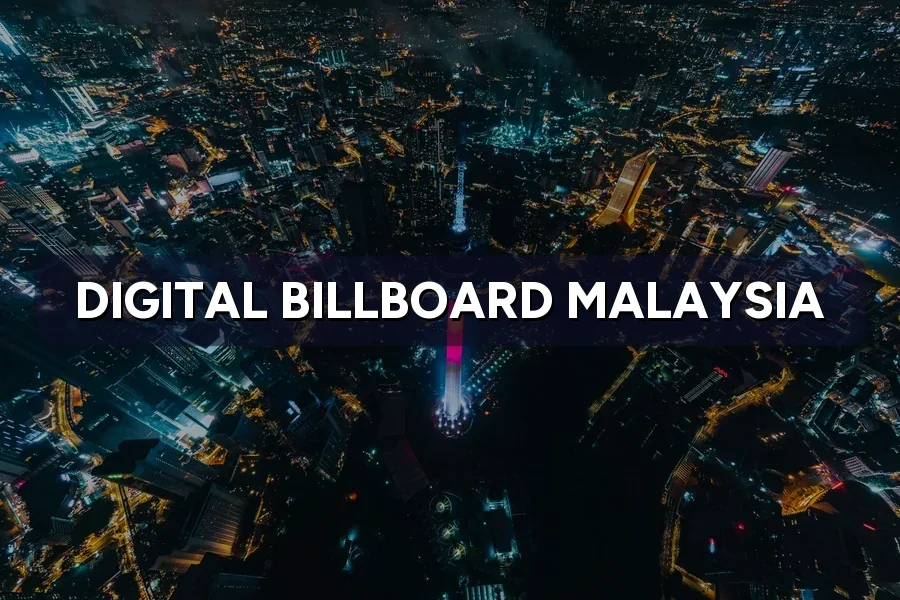
Every business owner who has driven down a Klang Valley highway has seen them: bright LED screens that switch ads every few seconds. Sooner or later the question comes up. What does it cost to put my brand up there, and how do I book it?
Media owners rarely publish their rate cards, so this guide sets out what booking a digital billboard in Malaysia involves: how LED screens are sold, indicative ringgit rates, how loop length changes what you get, and the two ways to book. At ZenWeb, a Google Partner agency working with 500+ Malaysian businesses, we judge every channel by what it costs to win a customer. Screens are no exception.
If you are still deciding between static and digital boards, start with our wider guide to billboard advertising costs in Malaysia. This article goes deeper on LED screens only. The webinar below explains how screens are now bought through programmatic platforms, which is the newer of the two booking routes.
Source video: Watch on YouTube
Quick Answer: A digital billboard is an LED screen that rotates several advertisers’ ads in a fixed loop. Instead of renting the whole face for a month, you buy a slot in that loop, so your ad plays a set number of times per hour. Screens sit on highways, in city centres, malls, stations and buildings.
Industry people call this digital out-of-home, or DOOH. Google’s own Display & Video 360 help page on DOOH describes it as ads on public-facing screens such as billboards, signage and screens inside businesses. In Malaysia, the main formats are:
| Format | Where You See It | Our Deeper Guide |
|---|---|---|
| Roadside LED | Highways, junctions, city-centre facades | Outdoor advertising formats |
| Mall screens | Atriums, escalators, car park entrances | Mall advertising |
| Transit screens | LRT and MRT stations, platforms | LRT and MRT advertising |
| Building screens | Condo and office lifts, lobbies | Lift advertising |
| Forecourt screens | Petrol station pumps and shops | Petrol station advertising |
This guide focuses on the large roadside LED screens most people mean by a digital billboard in Malaysia. The other formats are sold the same way, so the booking advice applies to them too.
Comparing a screen quote against your online budget?
See what the same ringgit buys in search and social first. Check ZenWeb’s digital marketing pricing →
Quick Answer: Indicatively, a slot on a roadside LED screen costs RM 8,000–30,000 a month, and a landmark city-centre screen RM 40,000–100,000 or more. Mall, station and lift screen networks are cheaper per screen. Minimum bookings are usually one to three months, and every media owner prices differently.
The figures below are indicative ranges drawn from media-owner proposals ZenWeb clients have shared with us. They are not a published rate card, and they exclude production and permit costs.
| Format | Buying Unit | Indicative Rate per Month | Typical Minimum |
|---|---|---|---|
| Roadside LED slot | One slot in the loop | RM 8,000–30,000 | 1–3 months |
| Landmark city screen | Slot or takeover | RM 40,000–100,000+ | Campaign-based |
| Transit screen network | Package of stations | RM 5,000–25,000 | 2–4 weeks |
| Mall screen network | Screens in one mall | RM 3,000–15,000 | 2–4 weeks |
| Lift and lobby screens | Cluster of buildings | RM 2,000–10,000 | 4 weeks |
| Programmatic screens | Per 1,000 viewers | Set by your budget | Platform minimums |
Source: Indicative ranges compiled by ZenWeb from media-owner proposals shared by Malaysian clients, 2024–2026. Rates vary by media owner, location and season; always request a current rate card.
Location moves a quote most: a screen facing jammed city traffic sells for more than one on a fast rural stretch. Festive months such as Hari Raya and Chinese New Year book out early. Media owners also quote the media only, so artwork production and design changes sit on top. For other offline price points, compare our guides to cinema advertising rates and bus advertising rates.
Quick Answer: Two LED quotes at the same price can deliver very different exposure. A shorter loop with fewer advertisers plays your ad more often each hour. Always ask for loop length, spot length, number of advertisers and daily operating hours, then work out how many plays you get per day.
Here is the arithmetic for a screen running 18 hours a day, playing your 15-second spot once per loop.
| Loop Length | Plays per Day | Plays | Share of Voice |
|---|---|---|---|
| 2 minutes | 540 | 1 in 8 | |
| 3 minutes | 360 | 1 in 12 | |
| 5 minutes | 216 | 1 in 20 | |
| 6 minutes | 180 | 1 in 24 |
Source: Illustrative calculation by ZenWeb, assuming 18 operating hours a day, one 15-second spot per loop and a full loop. Actual loops, hours and spot lengths vary by media owner.
At the same monthly price, a slot in a 2-minute loop plays three times as often as one in a 6-minute loop. Divide the monthly quote by total monthly plays to get a cost-per-play figure you can compare across offers.
Ask these questions before you sign:
Quick Answer: LED screens suit brands that need mass awareness in one city or along one route: property launches, retail chains, new outlets, events and consumer products. They suit businesses that need measurable leads on a small budget poorly, because a screen cannot be clicked and costs thousands before it shows any result.
The audience is there. According to DataReportal’s Digital 2026 Malaysia report, 79.8% of Malaysia’s 36.1 million people lived in urban centres in late 2025. A digital billboard in Malaysia reaches that urban population while they commute, shop and wait.
Good fits:
Poor fits:
Quick Answer: Book direct when you want a specific screen for a fixed period: you sign with the media owner and pay a monthly rate. Book programmatically when you want flexibility: you buy screen impressions through a platform, choose locations and hours, and pay per 1,000 estimated viewers.
Programmatic buying is now available through mainstream ad platforms. Google added digital out-of-home ads to Display & Video 360 in August 2022, with ads targeted by screen location and time of day rather than personal data. Which Malaysian screens are available this way depends on whether their owners sell through a connected exchange, so check inventory before planning around it. Our guide to programmatic advertising in Malaysia explains the wider buying model.
For a direct booking, the usual steps are:
Keep the artwork simple: one message, a large logo and a brand name that is easy to search. Content rules are covered in our guide to advertising law in Malaysia.
Want the screen to drive searches you can actually capture?
We line up search and social campaigns to catch the demand an LED campaign creates. Plan it with ZenWeb’s digital marketing team →
Quick Answer: A digital billboard puts your brand in front of everyone passing one place. Google Ads reaches people already searching, and Meta Ads reaches people by interest. Screens win on physical presence and scale; online ads win on targeting, minimum spend and tracking down to the lead.
This comparison uses each channel’s buying rules, not performance claims.
| Factor | Digital Billboard | Google Ads | Meta Ads |
|---|---|---|---|
| Targeting | Location and time of day | Search keywords, location | Interests, demographics, location |
| Buying unit | Loop slot per month, or per 1,000 viewers | Mostly per click | Mostly per 1,000 impressions |
| Entry budget | Thousands of ringgit per month | Any daily budget | Any daily budget |
| Measurement | Plays, estimated viewers, search lift | Clicks, calls, leads, sales | Clicks, leads, sales |
| Best job | Local fame and recall | Capturing ready buyers | Creating new demand |
Source: Aggregated by ZenWeb from each channel’s published buying model, including Google’s Display & Video 360 DOOH documentation, 2026.
The entry-budget row matters most for SMEs. A Google Ads campaign or Meta Ads campaign can start small and scale once it works, while a screen needs a large commitment up front. Options such as Grab Ads with their minimum spend sit in between.
Quick Answer: Measure three layers: proof that the ad ran, estimated viewers, and what changed online. Compare branded searches, direct website visits and enquiries from the campaign area against the weeks before. A rise that starts with the screen and fades after it ends is your clearest signal.
Programmatic platforms report viewers differently from websites. Google’s help page explains that publisher impressions are the publisher’s estimate of viewers per ad, calculated with an impression multiplier, and differ from the number of times the ad played. Treat them as estimates, not counted people.
The table below models what a healthy eight-week test can look like, with a four-week screen run in the middle.
| Week | Phase | Branded Searches | Website Enquiries |
|---|---|---|---|
| 1 | Baseline | 400 | 20 |
| 2 | Baseline | 410 | 21 |
| 3 | Screen live | 460 | 23 |
| 4 | Screen live | 520 | 26 |
| 5 | Screen live | 560 | 28 |
| 6 | Screen live | 570 | 29 |
| 7 | After | 490 | 24 |
| 8 | After | 440 | 22 |
Source: Modelled scenario by ZenWeb for illustration only, assuming no other campaigns change during the eight weeks. Real results depend on the screen, creative and brand.
Look for the pattern: a lift during the run that fades afterwards. To make it readable:
Our guide to measuring brand awareness covers more methods, and marketing attribution for owners explains how to credit offline channels fairly.
Quick Answer: For most businesses, a digital billboard in Malaysia comes after search and social are already working. Screens create interest; Google Ads, SEO and Meta Ads turn that interest into enquiries. Without them, people who see your screen and search your name may find a competitor first.
Think of the mix as layers that support each other:
Quick Answer: Digital billboards in Malaysia are sold as loop slots, indicatively RM 8,000–30,000 a month for roadside LED. Compare quotes on cost per play, choose direct or programmatic booking to suit your plans, prepare Bahasa Malaysia-first artwork, and measure search lift against a clean baseline.
A digital billboard in Malaysia can make a brand feel big in its city, but it works best when the business is already easy to find online. Before you sign, check what the same money would do online. A clear digital marketing budget plan makes that comparison simple.
Indicatively, a slot on a roadside LED screen costs around RM 8,000–30,000 a month, while landmark city-centre screens can exceed RM 40,000. Mall, station and lift screens cost less per screen. Rates vary by media owner, location and season, so always request a current rate card.
Roadside LED screens are usually booked for one to three months. Mall and transit screen networks often accept two to four weeks. Programmatic platforms let you set a smaller budget, subject to each platform’s own minimums.
A loop is the full rotation of ads on a screen before it repeats. If the loop is five minutes and your spot is 15 seconds, your ad plays once every five minutes. Shorter loops with fewer advertisers give you more plays for the same price.
Yes, where the screen owner sells through an exchange connected to a buying platform such as Google’s Display & Video 360. You choose screens, locations and hours, and pay per 1,000 estimated viewers. Availability varies by screen, so check inventory before planning around it.
Yes. Local councils regulate outdoor advertising. In Kuala Lumpur, DBKL’s advertisement by-law requires Bahasa Malaysia to take priority over other languages. Media owners usually manage permits for their screens, but confirm this in writing before you book.
Cite this page: ZenWeb (2026). Digital Billboard Malaysia: LED Screen Rates and Booking. https://zenweb.my/blog/digital-billboard-malaysia/
You may quote our data with this credit and a link. See our Terms of Use.
Weighing an LED screen against your online budget?
Book a free 30-minute strategy session — we’ll review your search presence, your current ad spend and your local market, then give you a concrete 90-day plan with realistic channel budgets and cost-per-lead targets.
Get A Free Proposal
Complete the form and our team will contact you to discuss your goals. Let’s grow your business.
Chat with us on WhatsApp
Tell us a little about what you need. We'll open WhatsApp with your message ready to send.