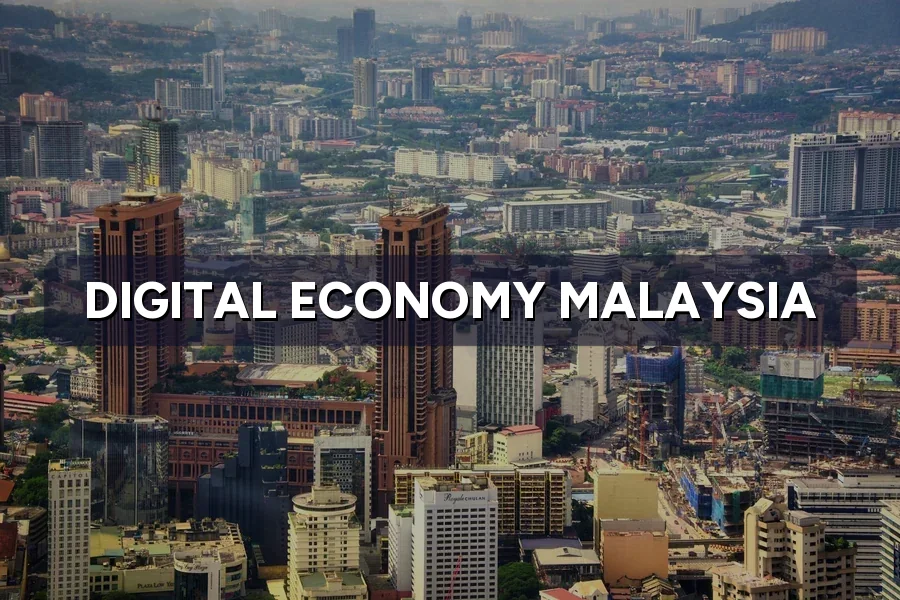
“The digital economy is a quarter of GDP” is a line you hear in budget speeches and conference keynotes. But which number is that, which year, and what does it actually measure? Many articles on the digital economy in Malaysia mix three different figures: DOSM’s value-added share, DOSM’s e-commerce income, and consultancy estimates in US dollars. They are not the same thing.
This guide sorts them out. You will see the latest official size and share of GDP, how it has moved since 2018, how far it is from the government’s targets, where e-commerce money comes from, and what consumers spend online. Every figure links to its source. Where a 2026 number is not published yet, we say so and use the latest year available.
At ZenWeb, a Google Partner agency serving 500+ Malaysian businesses, we use this macro data to judge how much of a client’s market is already buying online. If you want channel and platform numbers instead, see our digital marketing statistics for Malaysia.
Is your business getting its share of online demand?
We plan search, social and website work around where your buyers already spend. See ZenWeb’s digital marketing services →
First, this launch session from Google Singapore walks through the e-Conomy SEA 2025 findings, which include the Malaysian consumer figures we use in Section 7.
Source video: Google Singapore (official channel), Watch on YouTube. The session covers the whole region; Malaysia-specific figures are in the article below.
Quick Answer: The digital economy in Malaysia contributed RM451.3 billion, or 23.4% of the economy, in 2024. The ICT industry made up 13.9% and e-commerce by non-ICT industries 9.5%. It grew 5.1%, faster than 3.5% a year earlier. This is DOSM’s latest official figure; 2025 data has not been released yet.
| Measure | 2024 figure | DOSM source |
|---|---|---|
| ICT and e-commerce, value added | RM451.3 billion | ICT Satellite Account 2024 |
| Share of the economy | 23.4% | ICT Satellite Account 2024 |
| ICT industry share / e-commerce of non-ICT share | 13.9% / 9.5% | Malaysia Digital Economy 2025 |
| Growth of ICT and e-commerce | 5.1% | ICT Satellite Account 2024 |
| E-commerce income of establishments | RM1,288.1 billion | ICT and E-Commerce by Establishment 2025 |
| ICT exports | RM449.7 billion | ICT Satellite Account 2024 |
| ICT employment (share of all jobs) | 1.25 million (7.6%) | ICT Satellite Account 2024 |
| Establishments with a web presence | 74.4% | ICT and E-Commerce by Establishment 2025 |
Sources: Department of Statistics Malaysia (DOSM), Information and Communication Technology Satellite Account 2024 (released 15 October 2025); Malaysia Digital Economy 2025 (released 26 November 2025); Usage of ICT and E-Commerce by Establishment 2025 (released 30 June 2026, reference year 2024).
The headline value, growth, exports and jobs come from DOSM’s ICT Satellite Account 2024, and the 13.9% and 9.5% split from DOSM’s Malaysia Digital Economy 2025. Three points stand out for business owners:
Quick Answer: DOSM defines the digital economy as the ICT industry plus e-commerce carried out by all other industries, measured as value added. That is why its share is about 23%. E-commerce income of over RM1.2 trillion and consultancy figures in US dollars measure different things, so they should never be compared with it directly.
Most confusion about the digital economy in Malaysia comes from comparing numbers that were never meant to match. Here are the three measures you will meet most often:
| Measure | What it counts | Latest size |
|---|---|---|
| DOSM ICT and e-commerce share | Value added by the ICT industry plus e-commerce value added by non-ICT industries. Comparable with GDP. | RM451.3 billion, 23.4% (2024) |
| DOSM e-commerce income | Total value of online sales by businesses, mostly business-to-business. Not value added, so not a share of GDP. | RM1,288.1 billion (2024) |
| e-Conomy SEA consumer GMV | Consumer spending on e-commerce, ride-hailing, food delivery, online travel and online media, estimated by Bain. | US$39 billion (2025) |
The DOSM share is the one to quote when someone asks about GDP. MITI’s digital economy page adds one more cut: e-commerce alone added RM258.2 billion, or 13.4% of GDP, in 2024. For a marketer, the consumer GMV figure is often the most useful, because it tracks what shoppers actually spend. Our e-commerce statistics for Malaysia go deeper on that side.
Quick Answer: In ringgit, steadily: from RM267.7 billion in 2018 to RM451.3 billion in 2024. As a share of the economy, it jumped from 18.5% to 22.6% during the 2020 pandemic, then flattened at about 23% to 23.5% from 2021 to 2024. Growth slowed from 14.3% in 2022 to 3.5% in 2023, before recovering to 5.1%.
| Year | Share of the economy | Share | Value |
|---|---|---|---|
| 2018 | 18.5% | RM267.7b | |
| 2020 | 22.6% | RM320.0b | |
| 2021 | 23.2% | RM359.3b | |
| 2022 (revised) | 22.9% | RM411.6b | |
| 2023 | 23.5% | RM427.7b | |
| 2024 (latest) | 23.4% | RM451.3b | |
| 2025 target | 25.5% | n/a | |
| 2030 target | 30% | n/a |
Sources: DOSM digital economy and ICT Satellite Account releases (2019, 2021, 2022, 2024 and 2025 editions); 2022 revised figures as reported by MIDA; 2025 target per MDEC via Bernama; 2030 target per the Digital Minister via Digital News Asia. 2019 is left out because DOSM’s releases give only its growth rate. The Digital Minister reported 25.5% for 2025 in August 2026, pending DOSM data. Bars scaled to 30% = full width; grey bars are targets, not data.
The series is built from DOSM’s 2018 release, its 2020 ICT Satellite Account, its 2021 ICT Satellite Account and Malaysia Digital Economy 2024. The revised 22.9% for 2022 comes from MIDA’s summary of DOSM’s 2024 release; DOSM first reported 23.0%.
What the trend tells you:
Quick Answer: Possibly, but it is not confirmed yet. MDEC aimed for 25.5% of GDP by the end of 2025, and in August 2026 the Digital Minister said the share had reached 25.5%. DOSM’s latest official reading is still 23.4% for 2024. Its 2025 figure is due on 15 October 2026. The next goal is 30% by 2030.
The 25.5% goal was restated by MDEC’s chief executive in February 2025, as Bernama reported. The 30% goal for 2030 was reaffirmed by the Digital Minister, as Digital News Asia reported in September 2025. In August 2026, the minister said the share stood at 25.5% last year, as The Star reported, but he did not name the data source. If DOSM confirms it, that would be a jump of about two points in a year. Three forces could explain a jump like that:
Our view: data centres lift ICT output, but they create few customer-facing jobs or sales. For most SMEs, the targets matter less than whether their own customers have moved online. Regional data helps here. Our Selangor, Kuala Lumpur, Johor Bahru, Cyberjaya and Kuching guides show how digital demand differs by location.
Want a plan that fits your budget, not a national target?
We match channels to where your buyers already search and shop. Compare ZenWeb’s digital marketing packages →
Quick Answer: Mostly from businesses selling to other businesses. In 2024, e-commerce income reached RM1,288.1 billion, up 8.8%. Business-to-business sales made up RM879.6 billion, about two thirds. Business-to-consumer sales were RM374.7 billion but grew faster, at 11.3%. Nearly nine in ten ringgit were earned from domestic buyers.
| Segment | 2023 (RM b) | 2024 (RM b) | Growth |
|---|---|---|---|
| By buyer | |||
| Business-to-business | 817.1 | 879.6 | +7.6% |
| Business-to-consumer | 336.6 | 374.7 | +11.3% |
| Business-to-government | 30.4 | 33.8 | +11.4% |
| By market | |||
| Domestic | 1,053.0 | 1,150.1 | +9.2% |
| International | 131.1 | 138.0 | +5.2% |
| Total e-commerce income | 1,184.1 | 1,288.1 | +8.8% |
Source: DOSM, Usage of ICT and E-Commerce by Establishment 2025 (released 30 June 2026; reference year 2024). Green marks the fastest-growing segments. DOSM’s quarterly series gives a slightly different 2024 total, RM1,230.1 billion, because it uses a different survey.
These figures come from DOSM’s Usage of ICT and E-Commerce by Establishment 2025. For more recent signals, BernamaBiz reported DOSM’s quarterly e-commerce income at RM338 billion in the second quarter of 2026, up 2.9% year on year. What this means in practice:
Quick Answer: About US$39 billion in 2025, according to the e-Conomy SEA 2025 report by Google, Temasek and Bain. That covers e-commerce, ride-hailing and food delivery, online travel and online media. E-commerce was the largest part at US$20 billion. Bain’s outlook puts consumer spending at roughly US$45 billion to US$70 billion by 2030.
| Sector | 2023 | 2024 | 2025 | 2030 outlook | Share of 2025 GMV |
|---|---|---|---|---|---|
| E-commerce | 13 | 17 | 20 | ~29 | |
| Transport and food | 6 | 9 | 10 | ~16 | |
| Online travel | 3 | 4 | 4 | ~6 | |
| Online media | 3 | 3 | 4 | ~6 | |
| Total digital economy GMV | 26 | 33 | 39 | ~45–70 | 100% |
Source: Google, Temasek and Bain & Company, e-Conomy SEA 2025, Malaysia report (Bain analysis, November 2025). 2025 figures are estimates and 2030 figures are an outlook. Shares are ZenWeb’s calculation from rounded sector values, so they may not add to exactly 100%. Bars scaled to 100% = full width.
The figures come from the e-Conomy SEA 2025 Malaysia report. Total GMV rose about 18% in 2025, from US$33 billion to US$39 billion (ZenWeb’s calculation from the report’s rounded figures). For marketers, this is the closest thing to a “consumer wallet” view:
Quick Answer: The digital economy in Malaysia is large and growing steadily, but no longer booming. That rewards businesses that win share: a website that converts, search visibility where buyers compare, paid ads measured by cost per sale, and offline channels used only where the data supports them.
Here is the five-step approach we use when a client asks how big their online opportunity really is:
All five steps work best as one plan under our digital marketing services, so every channel is judged on the same sales numbers.
Quick Answer: Malaysia’s digital economy was worth RM451.3 billion, or 23.4% of the economy, in 2024. The share held near 23% from 2021 to 2024. The minister reports 25.5% for 2025, pending DOSM’s figures, and the goal is 30% by 2030. Either way, e-commerce income and consumer online spending keep growing, which is where businesses find new sales.
The digital economy Malaysia figures will update soon: DOSM’s 2025 share is due on 15 October 2026, with a wider digital economy release on 26 November 2026. When they arrive, check the measure, the year and any revisions before you quote them.
If you want help turning this data into a plan for your own business, our digital marketing team can map where your buyers are online and what it costs to reach them.
According to DOSM, ICT and e-commerce contributed 23.4% of Malaysia’s economy in 2024, worth RM451.3 billion. The ICT industry accounted for 13.9% and e-commerce by non-ICT industries for 9.5%. This is the latest official figure.
DOSM defines it as the ICT industry, covering ICT manufacturing, services, trade and content and media, plus e-commerce carried out by all other industries. It is measured as value added, so it can be compared with GDP.
MDEC aimed for the digital economy to reach 25.5% of GDP by the end of 2025, and the government has set a goal of 30% by 2030. The Digital Minister said in August 2026 that the 2025 share was 25.5%; DOSM’s latest official reading, for 2024, was 23.4%.
DOSM lists its ICT Satellite Account release for 15 October 2026 and its next Malaysia Digital Economy publication for 26 November 2026. Until then, 2024 is the latest official year.
Malaysian establishments earned RM1,288.1 billion from e-commerce in 2024, up 8.8%, mostly from business-to-business sales. Consumer digital spending, measured differently by the e-Conomy SEA report, reached about US$39 billion in 2025.
Cite this page: ZenWeb (2026). Digital Economy Malaysia 2026: Size, Growth and Share of GDP. https://zenweb.my/blog/digital-economy-malaysia/
You may quote our data with this credit and a link. See our Terms of Use.
Ready to win your share of Malaysia’s online spending?
Book a free 30-minute strategy session. We’ll look at your website, your channels and how much online demand you are missing today.
Get A Free Proposal
Complete the form and our team will contact you to discuss your goals. Let’s grow your business.
Chat with us on WhatsApp
Tell us a little about what you need. We'll open WhatsApp with your message ready to send.