

Share this post:
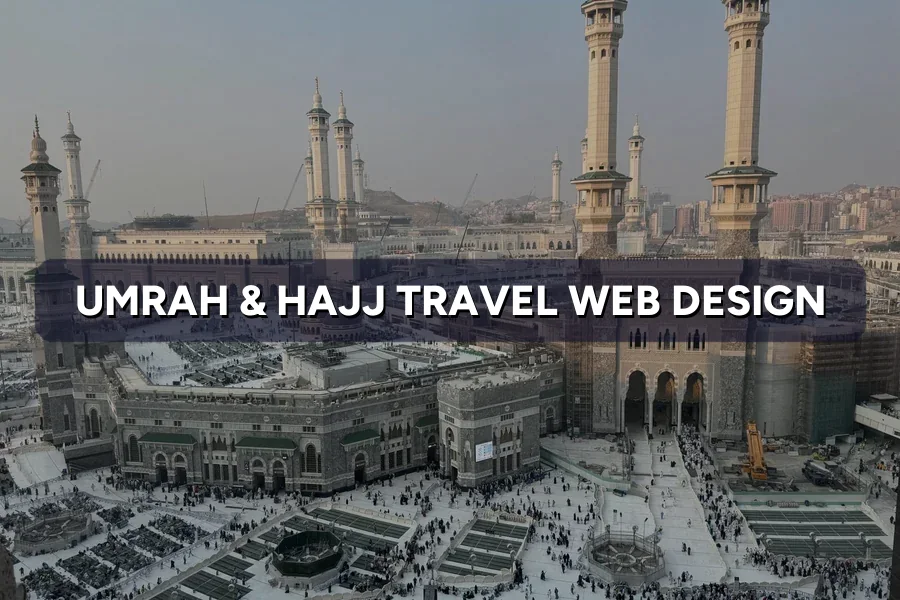
Most Malaysian umrah agency websites are built like brochures. A hero image of Masjidil Haram, three package cards priced “from RM 7,900”, a paragraph about twenty years of service, and a WhatsApp button.
The family reading it wants to know six things. Which dates are still open in the school holidays. What the RM 7,900 does not include. How far the hotel actually is from the Haram. Whether the agency is licensed. Whether a 71-year-old mother can travel on that package. And who holds the money until departure.
Answer none of those and the site pushes every visitor into a WhatsApp queue your staff clear by hand, while three other agencies reply faster.
ZenWeb builds websites for umrah and hajj agencies across 500+ Malaysian accounts. Good web design for umrah agencies is rarely about the styling. It is about removing the unknowns that stop a five-figure family decision.
Plenty of umrah enquiries, very few paid deposits?
We rebuild the path from departure page to deposit receipt before touching the visuals. Compare our web design packages →
Before the page structure, it helps to see how a travel booking site is put together end to end.
Source video: How To Support on YouTube
Quick Answer: The site’s job is to close the gap between interest and a paid deposit. Every page should remove one unknown a family raises before they transfer money. Pages that only build atmosphere push that work onto your WhatsApp team, where you lose on speed instead of substance.
Umrah is not an impulse purchase. A family talks about it for months, then decides inside a week, usually after a group chat and a call to whoever went last year.
By the time they reach your site they are not looking to be inspired. They are looking to eliminate you or shortlist you, whatever the wider umrah agency marketing plan is spending to send traffic over.
Quick Answer: The next three departure dates with a price and seats remaining, your MOTAC licence number in plain text, and one button that goes to the departure list. Everything else — company history, gallery, testimonials — belongs below the fold on a phone.
The first screen on a Malaysian phone is roughly 600 pixels tall. Most umrah sites spend all of it on a photograph and a company slogan.
A stronger version reads like a counter conversation. Umrah 12 days, departing 14 March 2026 from KLIA. RM 8,900 per person, twin sharing. 9 seats left. MOTAC licence KPL/LN 1234. Under it, one button: See all dates.
That is not a downgrade in design quality. It is the discipline any high-converting landing page uses: one job per screen, and the job here is proving you have something bookable now.
Quick Answer: Build the site around departure dates, not package names. A family searches by when they can travel, then filters by budget. A departure table sorted by date, with tier, price, seats and status on each row, beats three glossy package cards every time.
Package names like “Pakej Ekonomi” and “Pakej Eksekutif” mean nothing to a first-time buyer. Dates do.
The structural fix is one departure table listing every trip you are selling, sorted by date, with a status column, and each row linking to a detail page for that departure. It also gives your umrah SEO a real page per month to rank, instead of one bloated page trying to rank for everything.
Keep the row honest. Status wording matters more than styling. “9 seats left” is useful. “Almost full!” reads like pressure, and buyers who have read the scam warnings treat pressure as a red flag.
Quick Answer: Every departure page needs a plainly worded “not included” list beside the “included” list. Vague itineraries are the most common complaint pattern in this trade, and an agency that publishes its exclusions first removes the single biggest reason a family hesitates.
Ask any umrah agency what their WhatsApp team answers all day and the list is the same: is the visa included, are meals included, is there a single-room surcharge, what about excess baggage and ziarah extras.
All of that can sit on the page as a two-column block. Publishing it costs nothing except the pretence that your headline price is final, and the buyer finds that out anyway — later, when they trust you less.
It is the same mechanic behind every website trust signal that works in Malaysia: specific beats reassuring.
Quick Answer: Assume the person filling the form is 60-plus, or a daughter doing it on their behalf. Use 16px minimum text, one question per screen on mobile, and let the form be saved and finished later. Six fields to register interest; passport details come after contact is made.
Umrah has an older buyer than almost any other Malaysian travel product, and a strong pattern of a younger family member booking for a parent. A 14-field form asking for passport number, expiry, IC, address and emergency contact before anyone has spoken to you is asking a nervous buyer to hand identity documents to a stranger. Most abandon it.
Add a proper WhatsApp button and payment gateway alongside the form. Some jemaah will never use a form, and that is fine.
Not sure where your booking path is leaking?
We map every step from departure page to deposit receipt and show you which screen loses the family. See why traffic stops short of enquiries →
Quick Answer: Umrah forms collect passports, IC numbers, vaccination records and next-of-kin details — some of the most sensitive data any Malaysian SME handles. Since June 2025 a qualifying data controller must appoint a data protection officer and report a serious breach within 72 hours, so form design is a compliance decision.
Most umrah agency websites still collect passport scans through a plain contact form that emails the attachment to an office inbox and leaves a copy in the site’s uploads folder, reachable by anyone who guesses the filename.
Malaysia’s Department of Personal Data Protection now sets out mandatory data breach notification for controllers, with a 72-hour window where a breach is likely to cause significant harm and a breach register to be kept. A folder of jemaah passports is exactly that kind of harm.
Quick Answer: Licence numbers belong in selectable text in the header or footer of every page, plus a dedicated verification page. Badge images fail because they cannot be copied into a government search box, and a scam-wary family will not retype a number off a picture.
Umrah packages may only be sold by a licensed outbound travel agency with additional umrah approval, overseen through the Umrah Regulatory Council at MOTAC. Private hajj packages need a separate Pengelola Jemaah Haji licence from Tabung Haji.
So those numbers must be text, sitting next to a link to the government’s own Licensed Umrah Agency Search. Inviting the check is stronger than surviving it.
Families arrive primed. Tabung Haji runs a public #THElakScam campaign, so the verification habit is already taught. Build a page that rewards it: licence numbers, SSM registration, registered office address, the company bank account name, and a plain statement that payment is only ever collected to that account. It belongs on the short list of features every Malaysian business website needs.
Quick Answer: A template refresh runs RM 3,500 to RM 6,000. A departure-calendar site sits around RM 8,000 to RM 15,000. Adding online deposits and a document stage pushes it to RM 16,000 to RM 28,000. Multi-branch sites with a portal start near RM 30,000.
| Build tier | Typical cost | Build time | What it adds |
|---|---|---|---|
| Template refresh | RM 3,500 – 6,000 | 3 – 4 weeks | Mobile fix, licence strip, enquiry form |
| Departure-calendar site | RM 8,000 – 15,000 | 6 – 8 weeks | Page per departure, seat status, exclusions block |
| Deposit and document site | RM 16,000 – 28,000 | 10 – 12 weeks | Online deposit, receipts, secured document stage |
| Multi-branch and portal | RM 30,000+ | 14 – 16 weeks | Branch pages, group leader portal, instalment tracking |
Source: ZenWeb operational data, 500+ Malaysian SME campaigns under management, 2024–2026.
Tier two usually pays for itself fastest. Moving from three package cards to a page per departure gives search, ads and remarketing somewhere specific to land. Our Malaysian website cost breakdown sets the same tiers against other industries.
Quick Answer: Publishing a departure table with seats left produces the biggest lift in enquiry-to-deposit rate, followed by an itemised exclusions block and licence numbers above the fold. Redesigning the hero image ranks near the bottom, which is where most agencies start.
| Website fix | Relative lift | Lift |
|---|---|---|
| Departure table with seats left | +34% | |
| Itemised exclusions block | +27% | |
| Licence numbers above the fold | +22% | |
| Online deposit payment | +19% | |
| Form cut from 14 fields to 6 | +16% | |
| New hero image and branding | +4% |
Source: aggregated from ZenWeb-managed campaigns, Malaysia, 2024–2026.
Information fixes beat aesthetic fixes by roughly five to one. The three cheapest changes on that list — a table, an exclusions block, and a line of text with your licence number — sit at the top, which is why web design for umrah agencies is an information project first. The same ordering shows up in conversion rate optimisation work across Malaysian sites.
Quick Answer: Umrah departure pages are unusually heavy because agencies upload full-resolution hotel and Haram photography. Past about three seconds on mobile the enquiry rate falls sharply, and the deposit rate falls faster still, because the slowest pages carry the most unanswered detail.
| Mobile load time | Enquiry rate | Enquiry to deposit | Bounce rate |
|---|---|---|---|
| Under 2.0 seconds | 6.8% | 23% | 41% |
| 2.0 – 3.0 seconds | 5.9% | 21% | 47% |
| 3.0 – 4.5 seconds | 4.1% | 17% | 58% |
| 4.5 – 6.0 seconds | 2.7% | 13% | 67% |
| Over 6.0 seconds | 1.6% | 9% | 74% |
Source: ZenWeb client tracking across Malaysian travel and pilgrimage accounts, 2024–2026.
The fix is almost always the image library: compress and correctly size every hotel photo, lazy-load the gallery below the itinerary, and drop the uncompressed PDF brochures. Our guide on what a slow website costs you covers the sequence, and Core Web Vitals explains what Google measures.
Quick Answer: Umrah booking traffic is overwhelmingly mobile, but the pattern shifts with age. Younger buyers book on their own phone; over-55s more often have a family member submit for them, which is why the “booking for someone else” path deserves real design attention.
| Buyer age band | Phone | Tablet | Desktop | Booked for someone else |
|---|---|---|---|---|
| 25 – 34 | 91% | 2% | 7% | 38% |
| 35 – 44 | 87% | 3% | 10% | 44% |
| 45 – 54 | 81% | 6% | 13% | 29% |
| 55 and over | 72% | 11% | 17% | 12% |
Source: ZenWeb operational data, Malaysian travel and pilgrimage client accounts, 2024–2026.
Two consequences follow. Tablet use among older jemaah is high enough that a layout tested only at phone and desktop widths will break for them, so responsive design needs a real mid-width test. And because four in ten bookings in the 25–44 bands are made for someone else, the form must treat booker and traveller as different people.
Want these benchmarks applied to your own site?
We audit the departure pages, the form and the load time, then rebuild in the order that moves deposits first. See how our web design service works →
Quick Answer: The recurring faults are a site organised by package name instead of departure date, prices with no exclusions, licence numbers trapped inside images, brochure PDFs used as the itinerary, and a form asking for a passport before anyone has said hello.
Quick Answer: Build the departure structure first, publish exclusions in ringgit, make the licence checkable, split the form so identity documents come after contact, and keep the pages under three seconds on mobile. Those five decisions carry most of the result.
Umrah is bought on trust and decided on detail. Good web design for umrah agencies puts that detail where the family can reach it, instead of handing the decision to whoever answers WhatsApp fastest.
Fix the structure once and the rest gets easier. Your Google Ads finally have a specific departure page to send searchers to, and your Meta remarketing has a page worth returning people to.
A template refresh with a working mobile layout and licence strip runs roughly RM 3,500 to RM 6,000. A departure-calendar site sits between RM 8,000 and RM 15,000. Adding online deposits and a secured document stage takes it to RM 16,000 to RM 28,000.
Yes, with the exclusions beside them. Hiding the price sends every visitor to WhatsApp, where you compete on reply speed rather than substance. Publishing both filters out mismatched budgets before your team spends time on them.
In selectable text in the footer of every page, in the first screen of the homepage, and on a verification page alongside your SSM number, registered address and company bank account name. Link the government’s Licensed Umrah Agency Search from that page.
Yes, through a Malaysian payment gateway paying into the company account named on your site. Issue an automated receipt showing the departure date, traveller names and balance due. Never accept payment to a personal account, and say so on the page.
A separate section, at minimum. Hajj runs on a different licence — a Pengelola Jemaah Haji approval from Tabung Haji — and mixing the two under one price list blurs which approval covers what.
Three to four weeks for a refresh, six to eight for a departure-calendar build, ten to twelve once online deposits and a document stage are included. The slowest part is usually collecting accurate hotel details and itineraries from your operations team.
Ready to grow your umrah agency?
Book a free 30-minute strategy session — we’ll review your departure pages, your Google ranking and your competitors, then give you a 90-day plan with realistic cost per enquiry and deposit targets.
Complete the form and our team will contact you to discuss your goals. Let’s grow your business.



Meowketing Specialist
Online


























