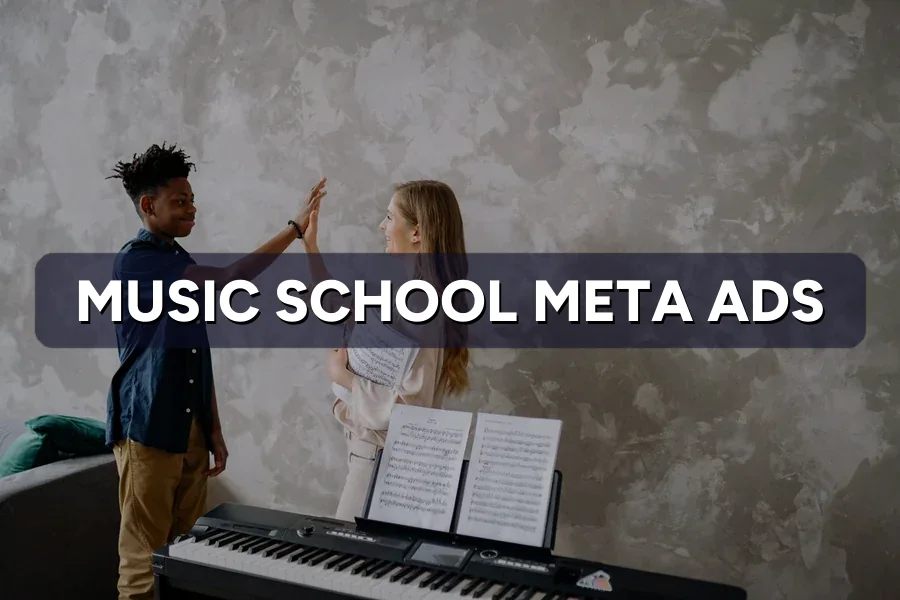
A father in Puchong scrolls Instagram at 11pm, sees a ten-second clip of a seven-year-old finishing a piece, and taps once. The child in that clip is not who bought the lesson. The man holding the phone did.
That gap between user and buyer is what makes Meta ads for music schools behave unlike any other local service. This guide covers who you can legally reach, what your ad may sound like, where the click should land, and four data sets behind those calls.
ZenWeb manages Meta campaigns for over 500 Malaysian businesses. Music schools sit in an odd corner of that portfolio: the most obvious creative idea — a well-known song under the video — is also the one that can get an account restricted.
Not sure what a trial class should be costing you?
We benchmark your account against music and enrichment centres in comparable catchments before we touch a single campaign. See our Meta Ads plans →
Start with the structural reason the channel behaves this way.
Source video: Blake Bauer Business on YouTube
Quick Answer: The person who pays is almost never the person who plays. That splits every campaign decision in two — the creative has to move a child, but the copy, targeting and landing experience all have to satisfy a parent comparing fees, distance and timetable.
On Google, a parent already decided to find lessons. On Meta, nobody was looking, so the ad has to raise the question — should my child be learning an instrument this year? — then answer it before the scroll continues. Our digital marketing guide for Malaysian music schools covers how the two channels feed each other. Three consequences follow:
Quick Answer: Parents aged 28 to 48 inside a realistic driving radius, adult beginners aged 25 to 45, and everyone who has already touched your site. Teenage learners cannot be targeted meaningfully at all — Meta now uses only age and location to serve ads to under-18s.
Meta announced in 2023 that age and location would be the only information used to show ads to teens. Schools that still build an audience around “interested in guitar, aged 13–17” are quietly buying every teenager in the radius, because the interest filter is ignored. Set the age floor at 25.
The other hard constraint is distance. A weekly lesson is a fifty-week commitment for the driver, and most Klang Valley families cap themselves at 15 to 20 minutes from home or school. Three layers are worth funding:
Resist layering “interested in classical music” on the cold layer — it shrinks an already small pool without improving quality. Once conversion data is flowing, a broad setup with Meta Advantage+ audience beats a hand-built interest stack, as our guide to Facebook ad targeting in Malaysia explains.
One caveat: uploading a parent list means processing personal data, so your enrolment form needs a notice satisfying the seven data protection principles under Malaysia’s PDPA.
Quick Answer: Not without clearing it. Meta requires advertisers to hold the licences for any music in an ad, and the in-app music library used for organic Reels is not cleared for paid placements. A student performing a piece live is the safest soundtrack you have.
This is the trap unique to your industry. Every other local business can drop a trending track under a Reel and boost it. A music school’s most natural creative is recorded music — exactly what the policy covers. Meta’s advertising standards state that if your ad contains music you are required to secure the necessary licences.
Malaysian copyright adds a second layer. Recorded music played in commercial premises needs a licence from Public Performance Malaysia, and the educational exemption most owners assume covers them does not — the Copyright Act 1987 requires a non-profit institution, no fee charged, and an educational purpose, all three together. A fee-charging school fails the second condition, and infringement carries a fine of not less than RM 10,000.
Four soundtracks that keep you clear:
The same care applies to the visuals — see our notes on Facebook ad creative that converts.
Quick Answer: Short vertical video of a real lesson beats every polished alternative. Progress clips — the same child at week one and week twelve — convert best, because they answer the only question a parent actually has about lessons.
Parents are not buying a piano. They are buying evidence that their child will stick with it. Creative that shows improvement beats creative that shows facilities, awards or qualifications.
Get written consent from parents before any child appears in an ad, and keep the file.
Running ads but not filling the timetable?
We rebuild the creative, the audience and the enquiry handling as one system rather than tuning them separately. Explore our Meta Ads management →
Quick Answer: Click-to-WhatsApp for most Malaysian music schools. Parents want to ask about age, level and timing before committing, and a chat handles that in three messages. Instant forms are cheapest per lead and worst per enrolment.
Instant lead forms are tempting because the cost per lead looks excellent. The problem shows up two days later, when half the numbers never answer. Match the destination to the decision:
| Destination | Best for | Main weakness |
|---|---|---|
| Click-to-WhatsApp | Parents with questions about age, level or timing | Needs someone answering within minutes |
| Instant lead form | Volume at the top of a new account | Low intent, heavy follow-up load |
| Booking page on your site | Schools with published fees and open slots | Highest cost per enquiry |
Whichever you pick, the response window decides the outcome. Our benchmarks on WhatsApp ads cost in Malaysia and the routine in handling WhatsApp enquiries point the same way: a reply inside five minutes roughly doubles the odds of a booked trial.
Quick Answer: Between RM 12 and RM 29 per enquiry depending on the instrument, and RM 39 to RM 83 per attended trial. Group classes for young children are cheapest to fill; violin and vocal cost the most because the audience is narrower and the parent hesitates longer.
| Instrument | Cost per attended trial | Cost per enquiry | Show-up rate |
|---|---|---|---|
| Group class, ages 4–6 | RM 39 | RM 12 | 31% |
| Guitar | RM 52 | RM 16 | 31% |
| Drums | RM 58 | RM 19 | 33% |
| Piano | RM 61 | RM 22 | 36% |
| Violin | RM 74 | RM 29 | 39% |
| Vocal | RM 83 | RM 25 | 30% |
Aggregated from ZenWeb-managed campaigns, Malaysia, 2024–2026.
The show-up column is worth staring at. Violin produces the most expensive enquiries but the most reliable attendance, because a parent who names violin has already decided. Vocal is the opposite — cheap curiosity, weak follow-through. Cost per enquiry here sits below the cross-industry averages in our Facebook cost per lead benchmarks, which is why enquiry cost alone misleads here.
Quick Answer: Retargeting produces the cheapest enrolled student at around RM 74, followed by click-to-WhatsApp at RM 124. Boosted posts look cheapest per enquiry and cost the most per student at roughly RM 300.
| Campaign type | Cost per enquiry | Trial attendance | Enquiry to enrolment | Cost per enrolled student |
|---|---|---|---|---|
| Retargeting (site and video viewers) | RM 17 | 52% | 23% | RM 74 |
| Click-to-WhatsApp | RM 21 | 41% | 17% | RM 124 |
| Instant lead form | RM 14 | 24% | 9% | RM 156 |
| Traffic to booking page | RM 33 | 47% | 19% | RM 174 |
| Boosted post / engagement | RM 9 | 11% | 3% | RM 300 |
Aggregated from ZenWeb-managed campaigns, Malaysia, 2024–2026.
Read left to right and the cheapest column reverses into the most expensive one. Boosted posts buy attention from people who were never going to enrol; retargeting buys the last nudge for people who already looked. Compare this against the search-side economics in our Google Ads guide for music schools before splitting a fixed budget.
Quick Answer: January is the strongest month by a wide margin, with December and November close behind. August to October is the weakest stretch, when school exams take over the household calendar and enquiries fall roughly 20% below the annual average.
| Month | Enquiry index (avg = 100) | Cost per enquiry |
|---|---|---|
| January | 148 | RM 19 |
| February | 96 | RM 22 |
| March | 104 | RM 21 |
| April | 92 | RM 23 |
| May | 88 | RM 25 |
| June | 118 | RM 20 |
| July | 83 | RM 26 |
| August | 79 | RM 27 |
| September | 91 | RM 24 |
| October | 86 | RM 26 |
| November | 121 | RM 20 |
| December | 134 | RM 18 |
Aggregated from ZenWeb-managed campaigns, Malaysia, 2024–2026. Index of 100 equals the twelve-month average enquiry volume.
The curve tracks the school year, not the shopping year. The Ministry of Education 2026 academic calendar puts the long break from early December and a mid-year break in late May, and that is exactly when parents plan the next twelve months of activities.
So raise budgets in the second half of December, and treat August to October as a retention window rather than an acquisition one — the same shape we see in tuition marketing in Kuala Lumpur.
Want your January intake planned before December?
We build the enrolment calendar, creative and budget curve as one plan rather than reacting month by month. See how we plan digital marketing →
Quick Answer: RM 1,500 to RM 2,500 a month is the range where a single-branch school gets reliable output. Below RM 800 the account never leaves the learning phase; above RM 4,000 a single catchment starts to saturate and cost per student stops improving.
| Monthly spend | Enquiries | Attended trials | Enrolled students | Cost per student | Spend on retargeting |
|---|---|---|---|---|---|
| RM 800 | 34 | 12 | 4 | RM 200 | 10% |
| RM 1,500 | 68 | 26 | 10 | RM 150 | 15% |
| RM 2,500 | 112 | 45 | 18 | RM 139 | 20% |
| RM 4,000 | 172 | 72 | 30 | RM 133 | 25% |
| RM 6,000 | 244 | 104 | 43 | RM 140 | 30% |
Aggregated from ZenWeb-managed campaigns, Malaysia, 2024–2026. Single-branch schools with one catchment of roughly 5–8km.
Cost per student improves up to RM 4,000, then worsens at RM 6,000. That is saturation, not mismanagement — one catchment holds only so many parents of school-age children, and schools at that ceiling grow by opening a second location.
If RM 800 is all you have, run one instrument, one audience and one offer. Our note on the minimum Facebook ads budget that still works explains why splitting it across ad sets wastes it.
Quick Answer: Almost nobody advertises to the parents they already have. A small campaign aimed at current families — recital reminders, grade exam prep, sibling offers, second-instrument classes — is usually the cheapest revenue in the account.
A school lives or dies on how long students stay, and adding two months to average tenure beats adding two new students. Four campaigns worth running against your parent list:
Mechanically this is retargeting with a warmer list, so frequency caps matter more — parents notice when their own school chases them daily.
Quick Answer: Meta can see the enquiry but not the enrolment, so you have to send the outcome back. Upload attended trials and signed enrolments as offline conversions and the delivery system starts finding parents who behave like the ones who stayed.
Most accounts optimise toward a lead event, which teaches Meta to find people who fill in forms — not people who enrol a child for a year. The chain worth building is short:
Response speed feeds this data directly. A slow reply does not just lose the lead — it teaches the algorithm the lead was bad, the argument behind our piece on speed to lead.
Quick Answer: Boosting recital videos instead of running campaigns, hiding the fee, targeting teenagers, using licensed music, and letting enquiries sit overnight. Each is common, and each is fixable within a week.
If organic search is also in the plan, read the parallel list in our SEO guide for music schools alongside this one.
Quick Answer: Meta ads for music schools reward operators who advertise to parents, prove progress on camera, clear their soundtrack, answer in minutes and measure enrolments rather than enquiries. Around RM 2,500 a month, that combination produces roughly 18 enrolled students.
None of this is about clever targeting. The channel rewards a school that can show a real child improving, name a fee, and pick up the phone. Start with the thing you are not measuring — almost always the attended trial — and work backwards. Our Meta Ads service is for schools that would rather teach than sit in Ads Manager.
Expect RM 18 to RM 31 per enquiry and RM 124 to RM 240 per enrolled student, depending on instrument and campaign type. A single-branch school needs RM 1,500 to RM 2,500 a month for steady enrolments.
Not without licences. Meta requires advertisers to hold rights to any music in an ad, and the in-app library used for organic Reels is not cleared for paid placements. Record your own students playing public-domain pieces instead.
Parents. Meta only uses age and location to serve ads to under-18s, so interest targeting on teenage learners does nothing. Set the age floor at 25 and reach students organically.
They do different jobs. Google captures parents already searching; Meta creates demand among parents who had not started looking. Most schools run Meta first because it is cheaper per enquiry.
Mid-December through January, when demand runs 35 to 50% above the annual average and cost per enquiry is lowest. August to October is the weakest stretch and suits retention campaigns.
Ready to fill your music school’s timetable?
Book a free 30-minute strategy session — we’ll review your ads, your enquiry handling and your catchment, then give you a concrete 90-day plan with realistic cost-per-trial and enrolment targets.
Complete the form and our team will contact you to discuss your goals. Let’s grow your business.