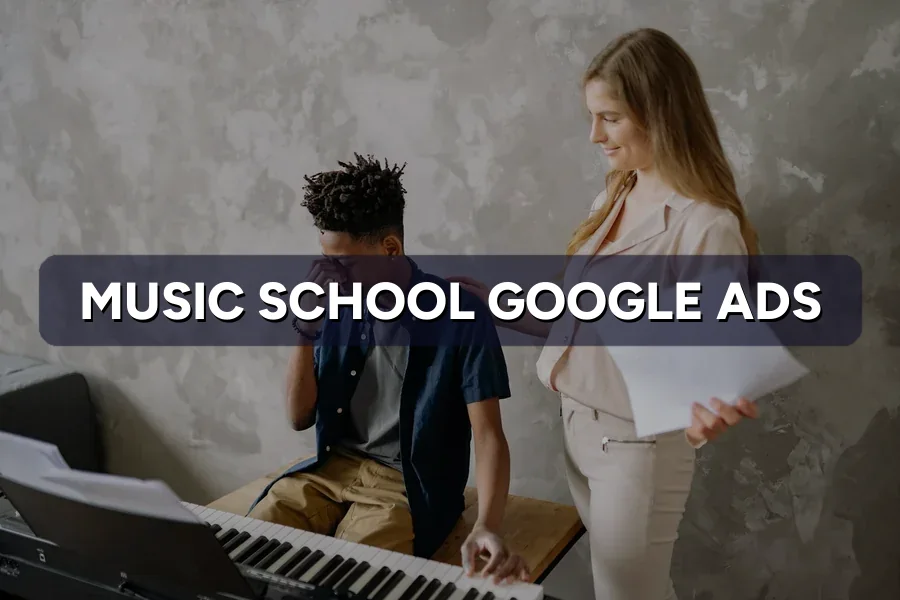
A mother in Kota Damansara searches “piano class near me” on a Sunday night, opens five tabs, and messages three schools. By Tuesday one of them has her child in a Saturday 10am slot.
Music lessons are a considered purchase with a short shortlist. Parents compare fee, distance and time, then decide fast. This guide covers what to bid on, what to block, what the ad should say, and four data sets behind those decisions.
ZenWeb runs Google Ads across 500+ Malaysian accounts, and music schools behave unlike almost every other local service we manage. The buyer is not the user, the sale is a subscription, and much of the search volume around your keywords belongs to people who want to learn for free.
Not sure what a trial class should cost you?
We benchmark your account against music and enrichment centres in comparable catchments, then rebuild the half that leaks. See our Google Ads plans →
Start with why the channel behaves the way it does.
Source video: Surfside PPC on YouTube
Quick Answer: Because you are buying a subscription, not a job. One student at RM 220 a month is worth roughly RM 2,600 over a year, so a RM 167 acquisition cost pays back in the first month.
Most Malaysian service businesses buy a one-off transaction and hope for a repeat. A music school buys a standing order, so you can outbid a plumber for the same click and stay comfortable.
The catch sits on the other side. Music keywords are surrounded by free tutorials, chords, sheet music and karaoke tracks, and Google will happily spend your budget there. That is why the wider marketing plan and the negative keyword list matter more here than the bidding strategy.
Quick Answer: They add an instrument, a place, an age or an exam grade. “Violin class Bandar Puteri” and “ABRSM Grade 3 piano teacher” are booking searches. “Learn piano” and “music school Malaysia” are not, and the gap is worth about five times the enquiry rate.
Four phrasings signal a parent ready to book:
Malay phrasing deserves its own ad groups: “kelas piano” and “piano class” attract different households at different costs. Our music school SEO guide covers the organic side of the same searches.
Quick Answer: Split by instrument first, then by branch. Piano parents and drum parents want different pages, different fees and different reassurance, and no match type setting can separate them after the click has happened.
| Campaign | Who it catches | Landing page |
|---|---|---|
| Instrument, children | Parents of 4 to 12 year olds | Instrument page with fee and open slots |
| Instrument, adults | Adult beginners and returners | Evening and weekday-off timetable |
| Exam preparation | Transfers chasing a grade deadline | Grade page with teacher credentials |
| Branch and near-me | Parents searching by location | Branch page with map and parking |
| Brand defence | People who already know you | Home or enquiry page |
Keep budgets separate. Adult classes convert slowly and will drain the budget your children’s campaign needed on a Sunday evening.
Quick Answer: Instrument plus area on phrase and exact match, then exam grade terms, then near-me variants. Leave the category head term alone until the rest of the account is profitable.
The opening list:
Skip the generic head term. It looks impressive in the planner and leaks money in the account, which is where most keyword research for this sector goes wrong.
Quick Answer: Music keywords sit inside a free-tutorial ocean. A proper negative keyword list typically returns a third of a music school’s budget in the first month — the single biggest saving available in this sector.
No other local business shares its vocabulary with so much free content. Block these on day one:
Then read the search terms report weekly for two months. The list is never finished; every hit song adds fresh ways to waste money.
Quick Answer: A monthly fee, a location and an open slot. “Piano Class Kota Damansara, RM 200/Month, Sat 10am Slot Open” outperforms “Nurturing Young Musicians Since 2009”, because it answers the three questions in the parent’s head before she clicks.
Every music school says it is passionate and experienced. None of that survives a parent comparing five tabs at 10pm. A fee and a free Saturday slot do.
Spend the headlines on decisions, not adjectives: fee, branch, day, teacher qualification. Put “free trial class” in the ad only if the trial is genuinely free and bookable this week, because parents check.
Teacher credentials belong in a description line. A diploma from a recognised board and current students’ exam results carry more weight than any brand promise, so keep the copy concrete rather than warm.
Ads running but the Saturday slots still empty?
Usually it is the landing page and the reply time, not the bids. Get your account reviewed →
Quick Answer: On the instrument page for that branch, never the homepage. It needs the monthly fee, the lesson length, this month’s open slots and a WhatsApp button above the fold. Those are the landing page fixes that lift bookings fastest.
They arrive on a phone, often with a child asleep next door. That sets the rules:
Cut the stock photo of a child at a grand piano. One picture of your own studio does more work.
Quick Answer: You advertise to parents, never to children. Google states that users under 18 are not eligible for personalised advertising of any kind, so audiences, remarketing lists and customer match uploads must be built from parent data only.
Two layers apply. On the platform side, Google’s personalised advertising policy bars personalised serving to under-18s and prohibits uploading customer information gathered from child-directed content. So build remarketing lists from your fee and timetable pages, and keep children’s names and ages out of any file you upload.
On the local side, private educational institutions register under the Education Act 1996, overseen by the Ministry of Education’s private education division. If you are registered, say so on the landing page. Parents moving a child mid-grade check it, and it separates you from the living-room operators bidding on the same keywords.
Quick Answer: Track the attended trial and the enrolment, not the WhatsApp click. Enrolment happens days after the click, so offline conversion import is what teaches Google which clicks became students paying every month.
An account optimising on chat clicks will buy a thousand of them from parents who never turn up. Three fixes:
Once value flows back, the account favours the RM 320 twice-weekly violin student over the RM 150 group class by itself. Until then every enquiry looks identical to the algorithm.
Quick Answer: Instrument plus area costs about RM 3.10 a click and converts at 8.4 percent. Free-tutorial terms cost RM 0.90 and convert at 0.4 percent, so the cheap keyword is six times dearer per enquiry, the pattern seen across Malaysian industries.
| Keyword type | Avg CPC | Click to enquiry | Enquiry to attended trial |
|---|---|---|---|
| Instrument plus area | RM 3.10 | 8.4% | 61% |
| Exam grade preparation | RM 3.80 | 7.1% | 68% |
| Music class near me | RM 2.40 | 5.9% | 57% |
| Adult beginner class | RM 2.90 | 6.2% | 52% |
| Fee and price terms | RM 2.20 | 4.4% | 46% |
| Rival brand names | RM 4.60 | 4.8% | 44% |
| Broad category terms | RM 1.60 | 1.6% | 31% |
| Free tutorial and song terms | RM 0.90 | 0.4% | 12% |
Source: ZenWeb client tracking, Malaysia, 2024-2026. Music and enrichment centre search campaigns.
Exam grade terms are the quiet winner. They cost more per click than anything except rival brand names, but they bring transfer students who already practise, already sit exams, and stay far longer than a curious beginner.
Quick Answer: Brand defence produces students at RM 35 but has little volume. Instrument-and-area Search sits at RM 135, unrestricted Performance Max reaches RM 565, and broad match with no negatives passes RM 1,100.
| Campaign type | Cost per enrolled student | Cost per enquiry | Enquiry to enrolment |
|---|---|---|---|
| Search, own brand | RM 35 | RM 18 | 52% |
| Remarketing to fee-page visitors | RM 118 | RM 26 | 22% |
| Search, instrument plus area | RM 135 | RM 42 | 31% |
| Search, exam grade intent | RM 150 | RM 51 | 34% |
| Performance Max with exclusions | RM 288 | RM 69 | 24% |
| Performance Max unrestricted | RM 565 | RM 96 | 17% |
| Broad match, no negatives | RM 1,100 | RM 121 | 11% |
Source: ZenWeb client tracking, Malaysia, 2024-2026. Bars show cost per enrolled student relative to the worst performer.
Read the bottom row against your fee sheet. At RM 220 a month, a student acquired for RM 1,100 needs five months just to repay the click. That is how a school decides “Google Ads does not work for music”.
Performance Max is not the villain; the unrestricted version is. Add it once Search is stable, with brand exclusions and account-level negatives, the limit that makes PMax awkward for most Malaysian SMEs.
Paying more than RM 300 for an enrolled student?
That is usually match types, negatives or tracking, and all three are fixable inside a month. Compare our Google Ads management →
Quick Answer: RM 800 a month buys about 14 enquiries and 4 enrolled students. RM 4,000 buys 78 enquiries and 24 students, and cost per student falls from RM 200 to RM 167 because tighter targeting only becomes affordable at scale.
| Monthly budget | Enquiries | Trials booked | Students enrolled | Cost per student | Spend on high-intent terms |
|---|---|---|---|---|---|
| RM 800 | 14 | 7 | 4 | RM 200 | 58% |
| RM 1,500 | 27 | 13 | 8 | RM 188 | 65% |
| RM 2,500 | 47 | 23 | 14 | RM 179 | 71% |
| RM 4,000 | 78 | 39 | 24 | RM 167 | 77% |
| RM 6,000 | 118 | 58 | 36 | RM 167 | 80% |
Source: ZenWeb client tracking, Malaysia, 2024-2026. Single and two-branch music schools with tracking in place.
The curve flattens after RM 4,000 for a physical reason: a studio runs out of teaching hours. Past that point the constraint is your timetable, not your monthly budget.
Quick Answer: A booked trial costs RM 236 in the first fortnight and RM 107 by week twelve. Almost all of that comes from wasted spend falling from 41 percent to 8 percent as search terms are cleaned weekly.
| Fortnight | Cost per booked trial | Avg CPC | Spend on irrelevant terms |
|---|---|---|---|
| Weeks 1-2 | RM 236 | RM 3.90 | 41% |
| Weeks 3-4 | RM 188 | RM 3.40 | 29% |
| Weeks 5-6 | RM 152 | RM 3.10 | 21% |
| Weeks 7-8 | RM 128 | RM 2.90 | 15% |
| Weeks 9-10 | RM 114 | RM 2.80 | 11% |
| Weeks 11-12 | RM 107 | RM 2.70 | 8% |
Source: ZenWeb client tracking, Malaysia, 2024-2026. New accounts launched with a starter negative list in place.
Judge the channel at week twelve, not week three: schools that switch off in month one pay for the whole learning period and collect none of the benefit. Most of the gain is manual work on search terms, not the algorithm settling.
Quick Answer: Bid ahead of the two intakes, January and the mid-year holiday, and inside a catchment a parent will drive weekly for years. Set location targeting to presence only, built from where your current students live.
The intake calendar is not marketing theory, it is the school year. Enquiries peak when parents rebuild the family timetable and collapse during the Ramadan fortnight. Exam entry deadlines, published on the ABRSM Malaysia exam dates and fees page, pull a third wave of parents whose current teacher will not enter their child.
Raise budgets three weeks before each intake, and lower them in the trough without hitting zero. Pausing surrenders the conversion history right before the expensive weeks, the trap covered in seasonality adjustments.
Geography is tighter than most schools assume. A weekly lesson is a weekly commute for a parent already driving to school, tuition and swimming, so the catchment is often five to eight kilometres in the Klang Valley. Leaving location on “presence or interest” buys clicks from another state, and default ad scheduling spends during school hours when enquiries actually cluster after 8pm.
Quick Answer: Broad match without negatives, homepage landing pages, hiding the fee, counting chat clicks as conversions, and replying on Monday to a Saturday enquiry. Reply speed is usually the cheapest of the five to fix.
Reply speed costs nothing to fix. A reply inside five minutes books roughly twice as many trials as one sent next morning, which is why education centres in Kuala Lumpur that staff the phone on Sunday beat better-funded rivals.
Quick Answer: Bid on instrument plus area and exam grade intent, block the free-tutorial world, land the click on a fee-and-slots page, and import enrolments as conversions. Those four moves carry most of the result.
Google Ads for music schools is a patient channel with an impatient audience. The parent decides in one evening, but the student she brings stays for years, and that asymmetry is what makes paid search worth running. Schools that publish a fee and an open slot land students at RM 135 to RM 188. Schools that lead with heritage and passion pay several times that and blame the platform.
Fix the negative list first, then the landing page, then the tracking. Run Google Ads for music schools alongside the organic pages that rank for the same searches, and the January scramble stops deciding your year.
Quick Answer: Music schools ask most about budgets, click costs, speed and whether ads beat SEO. Plan detail sits on our Google Ads pricing page.
RM 800 a month is a fair starting test for one branch, producing roughly 14 enquiries and 4 enrolled students once the negative list is tight. RM 4,000 lifts that to about 78 enquiries and 24 students, and drops cost per student from RM 200 to RM 167. Below RM 800 the account rarely gathers enough data to improve.
Instrument-plus-area terms average about RM 3.10, exam grade terms RM 3.80, and rival brand names RM 4.60. Free-tutorial and song terms cost RM 0.90 but convert so poorly that each enquiry works out roughly six times dearer. Compare on cost per enrolled student, not cost per click.
Enquiries arrive within days, but the account needs about twelve weeks to settle. Cost per booked trial falls from RM 236 in the first fortnight to RM 107 by week twelve as irrelevant search terms are cleared, so judge the channel at month three.
Ads first, SEO alongside. Paid search fills trial slots within a fortnight, while instrument and grade pages take four to six months to rank. Most schools run both and let organic enquiries take over the volume, lowering the blended cost per student.
Ready to fill next term’s timetable?
Book a free 30-minute session. We review your account, your instrument pages and what nearby schools are bidding, then give you a 90-day plan with realistic cost per enrolled student.
Complete the form and our team will contact you to discuss your goals. Let’s grow your business.