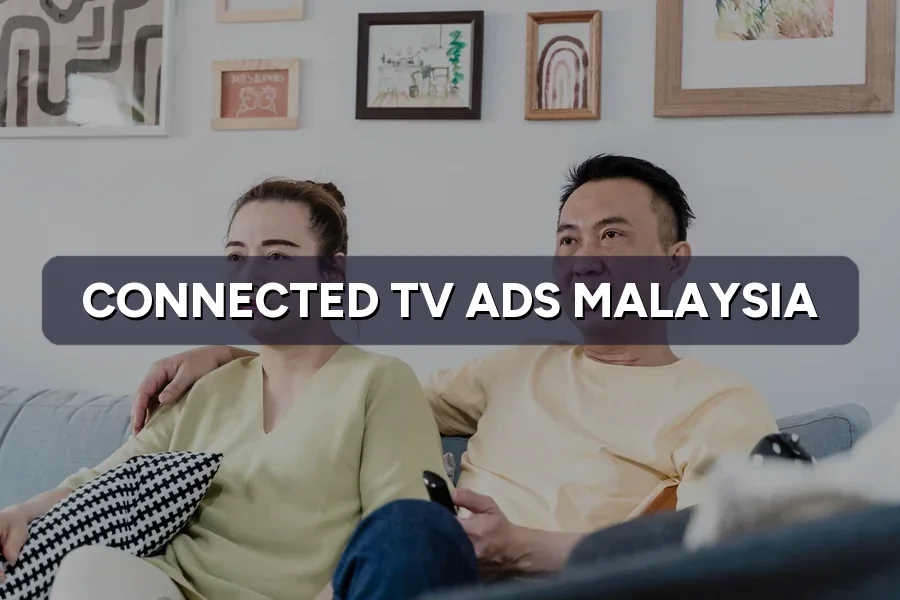
Many Malaysian families now watch YouTube on the living-room TV, not the phone: cartoons for the kids, podcasts or football highlights for the parents. Every one of those sessions can carry ads, and most small business owners have never bought one on purpose.
Connected TV advertising is how you reach that big screen. It feels like a TV commercial, but it is bought, targeted and measured like a digital ad. This guide covers which options are actually open in Malaysia today and who they suit. It also covers what they cost in ringgit, how to set them up and how to tell if they worked.
At ZenWeb, a Google Partner agency with 500+ Malaysian clients, we plan YouTube campaigns across phone and TV screens. If you are weighing traditional broadcast slots instead, our TV advertising cost guide covers those rates; this page is about streaming. Start with this short explainer on how streaming TV ads work.
Source video: Epom, January 2026, Watch on YouTube. A global overview; the Malaysian options are covered below.
Quick Answer: Connected TV advertising means video ads shown inside apps on internet-connected TVs: smart TVs, streaming sticks, set-top boxes and game consoles. Unlike a broadcast spot, the ad is served to a specific household or audience, bought by the impression, and reported like any digital campaign. In Malaysia, YouTube is the biggest and most accessible connected TV channel.
The jargon trips people up, so here is how the three terms differ:
| Term | What it means | How you buy it |
|---|---|---|
| Connected TV (CTV) | The device: a TV screen connected to the internet | Per 1,000 impressions, targeted by audience |
| OTT / streaming | The content: shows and videos delivered over the internet, on any screen | Through the platform’s ad tool or media sales team |
| Broadcast TV | Free-to-air or satellite channels on a fixed schedule | Per spot or rating point, everyone watching sees the same ad |
Google defines its “TV screens” device type as smart TVs, gaming consoles and connected devices like Chromecast, available for Display and Video campaigns. That one setting is the door most Malaysian businesses will use. For how TV-screen video compares with search and display, see our guide to search vs Display vs YouTube ads.
Already running YouTube ads?
Some of your budget may already be on TV screens without you knowing. We check device reports before changing anything. See how ZenWeb manages Google and YouTube Ads →
Quick Answer: Connected TV ads suit Malaysian brands that sell to households and benefit from being seen on a big screen: property, cars, home appliances, insurance, education, F&B chains and festive campaigns. They suit businesses with a decent video and a working search campaign. They are a poor first channel for a small service business that needs enquiries next week.
The living room changes who sees your ad. A phone is personal; a TV is shared. That works for some offers and wastes money on others.
If you are new to YouTube altogether, start with our YouTube ads Malaysia guide and add TV screens once the basics work.
Quick Answer: YouTube’s internal data showed over 7.5 million people in Malaysia streamed YouTube on their TV in May 2022, and 66% of Malaysian viewers said YouTube “is TV” on a TV screen. YouTube’s total ad reach here was 23.6 million in late 2025. No 2026 TV-screen figure for Malaysia has been published yet.
| Measure | Value | Period |
|---|---|---|
| People who streamed YouTube on their TV | 7.5 million+ | May 2022 |
| Viewers who say YouTube on a TV “is TV” | 66% | 2022 |
| YouTube ad reach, all devices | 23.6 million | Late 2025 |
| YouTube ad reach as share of population | 65.4% | Late 2025 |
Sources: Google Malaysia Blog, December 2022 (YouTube internal data) and DataReportal, Digital 2026: Malaysia. Ad reach is an advertising audience estimate, not a count of TV viewers.
The TV-screen number is Google’s own 2022 data, and the 23.6 million covers every device, not TV alone. Still, the living-room audience clearly runs into the millions, so budget, not audience size, will limit a Malaysian campaign. Our YouTube users in Malaysia report and online video statistics break the audience down further.
Quick Answer: In October 2026, YouTube through Google Ads is the only self-serve connected TV option open to every Malaysian business. YouTube Pause ads are also sold in Malaysia, but only through reservation buys. Netflix’s ad plan is not available here and is not on its 2027 list. Local streaming and pay-TV apps sell ads through their own media sales teams.
| Option | Available in Malaysia? | How you buy it |
|---|---|---|
| YouTube on TV screens | Yes | Self-serve in Google Ads, any budget |
| YouTube Pause ads | Yes | Reservation, YouTube Select lineups only |
| YouTube Masthead on TV | Limited | Reservation through Google, large budgets |
| Local pay-TV and streaming apps | Direct only | Media owner’s sales team; rates vary |
| Netflix ads plan | No | Not sold in Malaysia; not in 2027 list |
Sources: Google Ads Help, YouTube Pause ads (Malaysia listed among 37 countries), Google, Brandcast 2025 recap and Netflix Upfront 2026, May 2026. Checked October 2026; availability changes.
Netflix’s May 2026 upfront named 15 new ad-plan countries for 2027, including Thailand, Indonesia and the Philippines, but not Malaysia. Locally, pay-TV operator Astro has sold addressable ads, where different households see different ads during the same programme, since late 2021. Those deals go through the media owner, and rates vary by package.
Quick Answer: Most standard YouTube video formats can show on TV screens: skippable in-stream, non-skippable in-stream and six-second bumper ads. TV-only formats sit on top: Pause ads, which show a static image when a viewer pauses, and the Masthead on the TV app’s home screen. Google also announced Shoppable CTV in 2025, but has not confirmed it for Malaysia.
| Format | What the viewer sees | Best use |
|---|---|---|
| Skippable in-stream | Your video, skippable after 5 seconds | Telling a story to interested viewers |
| Non-skippable in-stream | A short video that must play in full | Launches and offers that need the full message |
| Bumper (6 seconds) | A six-second unskippable reminder | Repeating one idea cheaply |
| Pause ads (TV only) | A static image 10 seconds after pausing | Low-intrusion brand presence |
| Masthead on TV | A full-width ad on the TV app home screen | Big one-day launches |
On a TV, the viewer sits three metres away, usually with sound on. Use big text, show your brand early and end with a QR code. For the six-second format in detail, read our guide to YouTube bumper ads; for Google’s goal-based video campaigns that also reach TVs, see Demand Gen ads costs.
Quick Answer: In ZenWeb-managed Malaysian campaigns, YouTube ads limited to TV screens typically cost RM20 to RM35 per 1,000 impressions, against RM12 to RM20 on phones. Google publishes no rate card or fixed minimum; the auction sets the price and it climbs in Q4 and festive seasons. Reservation formats such as Pause ads are priced separately by Google.
| Screen and format | CPM (bar scale RM0–35) | Typical RM |
|---|---|---|
| Mobile: bumper | 14 | |
| Mobile: skippable in-stream | 18 | |
| TV screens: bumper | 20 | |
| TV screens: skippable in-stream | 26 | |
| TV screens: non-skippable | 35 |
Source: aggregated from ZenWeb-managed campaigns, Malaysia, 2024–2026. Typical middle values; costs vary by audience, season and industry. Indicative, not a quotation. Malaysian service tax is added to the Google bill.
Why the premium? TV inventory is scarcer and watched on a bigger screen, so more advertisers bid for it. A TV impression may reach a whole room, but Google counts it as one, so do not plan on the extra viewers. For production, management and every other YouTube cost line, see our YouTube marketing cost guide.
Quick Answer: At RM26 per 1,000 impressions and three showings per screen a month, RM3,000 reaches about 38,000 TV screens, RM6,000 about 77,000, RM12,000 about 154,000 and RM24,000 about 308,000. ZenWeb suggests RM3,000 a month as a practical floor for a tightly targeted TV-screen test in Malaysia.
| Monthly media budget | Daily budget | Impressions | TV screens reached (x3) |
|---|---|---|---|
| RM3,000 | RM99 | 115,000 | 38,500 |
| RM6,000 | RM197 | 231,000 | 76,900 |
| RM12,000 | RM395 | 462,000 | 153,800 |
| RM24,000 | RM789 | 923,000 | 307,700 |
Modelled projection by ZenWeb: impressions = budget ÷ RM26 x 1,000; screens reached = impressions ÷ 3. Daily = monthly ÷ 30.4. Real reach depends on targeting and auction prices. Media only; excludes video production and management fees.
Two planning rules follow from this table:
Management and production sit on top of media spend; our Google Ads pricing page shows how ZenWeb structures both.
Want a TV-screen reach forecast before you spend?
We run Google’s reach planner for your audience and budget, then show what the same ringgit would do on mobile. Request a YouTube on TV plan with your Google Ads quote →
Quick Answer: Link your YouTube channel to Google Ads, create a Video campaign with a reach goal, and limit devices to TV screens. Set a Target CPM bid and budget, target Malaysia and your audience, add a horizontal video with a TV-friendly end card, then run it at least four weeks before judging it.
Before launch, note last month’s branded searches and direct website visits. Without that baseline, you cannot show the TV ads did anything.
Quick Answer: Measure what happens after the TV ad, not clicks on it. Track unique reach and frequency on TV screens, the rise in branded searches against your baseline, QR code scans and view-through conversions. Google’s free Brand Lift study measures ad recall directly, but it needs a minimum spend and is not open to every account.
| Metric | What it tells you |
|---|---|
| Reach and frequency (TV screens) | Whether the right number of households saw it often enough |
| Branded search lift | Whether viewers picked up a phone and looked you up |
| QR code scans | Direct response from the living room, tracked with a tagged URL |
| View-through conversions | Leads or sales from viewers who came back another way |
| Brand Lift (ad recall) | Survey-based proof that exposed viewers remember the ad |
Google’s Brand Lift is free but gated by spend, so smaller budgets lean on branded search and QR scans. Set up Google Ads conversion tracking first, or view-through conversions never appear. If you serve walk-in customers, pair the TV push with Google Maps ads and watch direction requests.
Quick Answer: Connected TV advertising creates demand; search ads, SEO and Meta Ads capture it. Add TV screens only after your search campaign is profitable, and for most Malaysian SMEs keep it to about 10% to 20% of paid media, based on ZenWeb planning. Without a catching channel, the interest a TV ad creates goes to whoever ranks first.
Quick Answer: For Malaysian businesses, connected TV advertising today mostly means YouTube on the living-room TV, bought in Google Ads. It costs more per impression than mobile, works best for shared, considered purchases, and should be judged on branded search, QR scans and visits rather than clicks.
Start with a working search campaign and a strong horizontal video, then add a TV-screens-only campaign of at least RM3,000 a month for four weeks. When you want connected TV planned alongside search, Meta and SEO, our Google Ads team can map the budget with you.
No. Broadcast TV shows the same ad to everyone watching a channel. Connected TV ads play inside streaming apps such as YouTube on a smart TV, so they can be targeted by audience and bought per 1,000 impressions.
Not yet. Netflix’s ad-supported plan is not sold in Malaysia, and its May 2026 list of 15 new ad markets for 2027 does not include Malaysia. YouTube is the main self-serve option today.
Google sets no fixed minimum. ZenWeb suggests at least RM3,000 of media a month for a TV-screens-only test, so a focused audience sees the ad about three times.
Not easily with a remote. That is why TV ads should carry a QR code or a short web address, and why results are measured through branded searches, scans and later website visits.
Cite this page: ZenWeb (2026). Connected TV Ads Malaysia: YouTube on TV and Streaming. https://zenweb.my/blog/connected-tv-ads-malaysia/
You may quote our data with this credit and a link. See our Terms of Use.
Ready to put your brand on Malaysia’s living-room screens?
Book a free 30-minute strategy session. We’ll check your device reports, forecast TV-screen reach and show how connected TV fits beside your search, Meta and SEO spend.
Get A Free Proposal
Complete the form and our team will contact you to discuss your goals. Let’s grow your business.
Chat with us on WhatsApp
Tell us a little about what you need. We'll open WhatsApp with your message ready to send.