

Share this post:
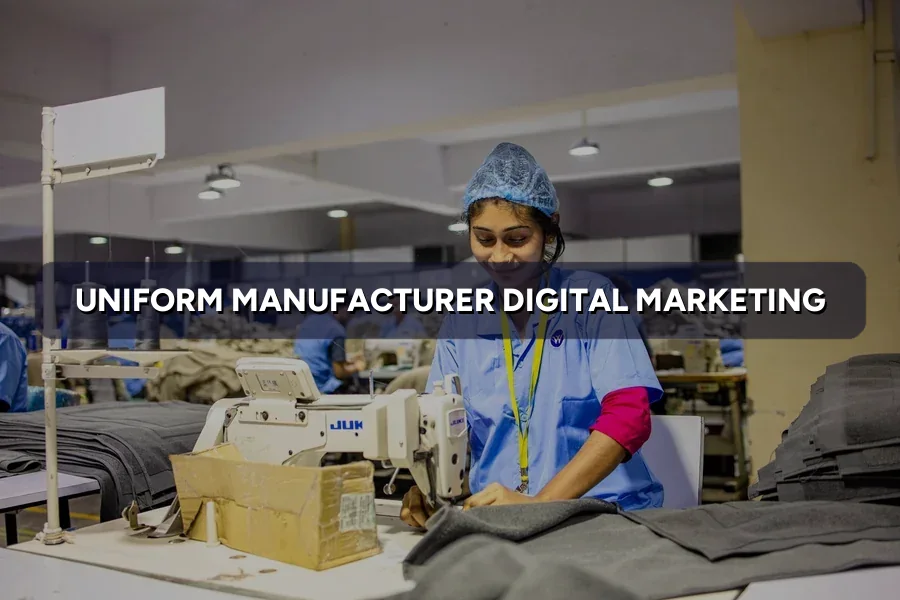
An HR executive in Shah Alam is handed a job on Monday: 180 embroidered polo shirts, needed before the company dinner in six weeks. By lunchtime she has asked five suppliers the same three questions — price per piece, minimum order, and can you make the date. Three reply “kindly PM for quotation”. The fifth has a page that already answers all three. The purchase order follows on Thursday.
This guide is for Malaysian uniform businesses — corporate and school uniform suppliers, hospitality outfitters, scrub specialists, industrial workwear manufacturers and jersey printers. It covers which channel feeds which order type, and why the minimum order quantity you repeat twenty times a week on WhatsApp is your strongest unused ranking asset.
ZenWeb runs digital marketing for uniform suppliers across a Malaysian client base of 500+ accounts. The pattern repeats: the better factory loses to the supplier whose page answered quantity, price and lead time first. ZenWeb closes that gap.
Not sure what one corporate uniform account should cost you to win?
We size a monthly budget against your average order value and the production slots you actually have free. See our digital marketing pricing →
The market is bigger than most operators assume. Malaysia’s apparel and clothing accessories trade reached RM 18.24 billion in 2025, with exports at RM 6.88 billion, and those buyers are online long before they are on the phone — household internet access hit 97.1% in 2025, per the Department of Statistics Malaysia. The video below covers how custom apparel businesses build demand; the rest of this guide adapts it to Malaysia.
Source video: Sell More Custom T-Shirts: Marketing Made Easy on YouTube
Quick Answer: Uniform orders are bought by staff who did not choose to buy them. HR, admin and purchasing officers get a deadline and a budget, so they shortlist whoever answers fastest and clearest. Digital marketing for uniform suppliers is the work of answering before the call.
Two things make this trade unusual. The first is that your buyer is almost never the wearer. An HR executive, a school co-op treasurer or a safety officer is doing a task, not shopping — judged on hitting the date and the budget, not on fabric weight.
The second is that the deciding facts are identical everywhere: minimum order, price per piece, lead time, and whether you can put a logo on it. Suppliers treat those as negotiation material. Buyers treat them as filters. Our guide to B2B marketing in Malaysia covers why this shortlisting happens before any human contact.
Quick Answer: A date forces the search — an intake, an audit, a rebrand, a dinner. The buyer then compares four or five suppliers almost entirely on MOQ, unit price and delivery date, and awards the job to whoever made those three easiest to put in a memo.
The journey runs in five steps, and each step is a page you should own:
Step four is where most factories lose. Almost nobody publishes their MOQ, because it feels like turning away small jobs. In practice the page that states it is the page the buyer forwards. Our guide on quote request forms that attract serious enquiries only covers how to capture that moment.
Quick Answer: Search and Maps win the buyer who already has a deadline. Social and short video win the buyer who has not started looking. Tender portals and outreach win institutional volume. Most Malaysian uniform suppliers run only one of the three.
Match the channel to the order, not to what a competitor posts:
Any serious programme of digital marketing for uniform manufacturers runs at least two of these. See cost per lead by channel in Malaysia for the wider benchmarks.
Quick Answer: Buyers do not search “polo shirt 220gsm”. They search by who they are — clinic uniform, kilang coverall, hotel housekeeping, school jersey. One page per buyer industry outranks one page per garment, every time.
Most uniform websites are organised like a warehouse: shirts, pants, jackets, caps. Buyers think in situations, not garments. The site that ranks is arranged by who is buying.
Build a page for each buyer type you serve — clinic scrubs, cafe uniforms, hotel housekeeping, factory coveralls, school jerseys, event tees. Each carries the same skeleton: typical order size, price band, lead time, artwork requirement, photos of real work. That structure also feeds AI answer engines cleanly, as our note on formatting pages that LLMs can quote explains further.
Quick Answer: Bid on deadline language, not garment language. “Urgent uniform supplier”, “coverall supplier near me” and industry-plus-city terms convert. Broad terms like “t-shirt printing” drain budget on one-off buyers who want ten pieces.
Search ads work here because the intent is dated. Someone typing “corporate uniform supplier Klang” on a Tuesday morning has a purchase order waiting. Three rules keep the spend honest:
Track the outcome, not the click. Our guide to search ads for long B2B sales cycles covers attributing an order that closes six weeks later.
Paying for clicks that ask for 10 pieces?
We rebuild uniform campaigns around order size and lead time so the budget reaches buyers who can meet your MOQ. Get a free Google Ads review →
Quick Answer: Meta and TikTok create demand that did not exist that morning — a cafe owner sees a finished apron set and decides. LinkedIn does the opposite job: it reaches the HR and procurement heads who sign off multi-site corporate rollouts.
These platforms are not interchangeable. Meta and short video reward the finished result: a staff line-up in matching polos, an embroidery machine running a logo, a tired uniform replaced. Sound off, logo visible, price band in the caption.
LinkedIn is slower and dearer per enquiry, but the accounts are larger and last longer. It suits group-wide contracts, not one branch. Our comparison of LinkedIn Ads versus Facebook Ads sets out where each earns its cost.
Quick Answer: A uniform website has one job: turn a browsing HR executive into a quote request with enough detail to price. Quantity, garment type, logo method, deadline and a file upload — five fields, nothing more.
Most uniform sites fail in the same two places. The quote form asks for a company registration number before it asks what the buyer wants, and there is nowhere to attach a logo file.
Fix the order of the questions. Ask what, how many and by when first; ask who they are last. Add a logo upload, a sizing chart and a lead-time table. Sites with traffic but no enquiries usually fail here — our piece on websites that get traffic but no leads walks through the same pattern in other trades.
Quick Answer: Minimum order quantity, a price band per garment and a lead-time table are the three facts every uniform buyer needs and almost no Malaysian supplier publishes. Stating them cuts enquiry volume and roughly doubles the number of orders actually won.
The fear is understandable: publish a price and you lose room to negotiate. But the buyer is not negotiating yet — they are deciding whether to put you in a memo. “Embroidered polo, RM 28–55 per piece by fabric and quantity, minimum 30 pcs, 14–21 working days” commits you to nothing and puts you on the shortlist.
Publish three things per industry page: the MOQ, a price band with the factors that move it, and a lead-time table by order size. Section 13 shows what that does to enquiry quality.
Quick Answer: Safety officers check certification marks, government buyers check MOF registration, and corporate finance checks whether you are SST-registered and can issue a proper invoice. Each one is a page-level fact that either exists or costs you the order.
Three compliance layers decide who is even eligible:
Put all of it on one credentials page, linked from every quote form.
Quick Answer: Uniform buyers search by industrial estate, not by state. Shah Alam Section 23, Balakong, Bukit Minyak, Pasir Gudang and Senai bring in factory workwear enquiries that “Selangor uniform supplier” never reaches.
Two local moves matter most. First, a complete Google Business Profile: right primary category, real photos of your showroom or factory floor, posted lead times. Buyers use Maps to check you are real before they call. Our guide to ranking a Google Business Profile in Malaysia covers the setup.
Second, write pages for the industrial estates you deliver to, and make each genuinely local: the estate, the plants there, your delivery day, one job completed nearby. A page that could apply to any town ranks nowhere.
Quick Answer: Institutional work runs on a fixed calendar, not on demand. School co-ops, hostels, hospitals and uniformed bodies buy in known windows, so the marketing job is to be visible and pre-qualified three months before the window opens.
This is the highest-value and slowest segment. One school or hostel contract can outlast twenty corporate orders, and the buyer rarely changes supplier mid-cycle. Timing is everything.
Policy moves this segment too. The Education Ministry has confirmed that school uniform standardisation is still under study, with a phased start under consideration for 2027. Suppliers who explain what that means get called when it lands. Pair that with LinkedIn outreach to Malaysian B2B decision-makers for the non-school institutional work.
Chasing school and institutional contracts next cycle?
We map the buying windows for your segments and build the pages that need to rank before the window opens. See how our SEO service works →
Quick Answer: A school uniform buyer costs about RM 25 in media to win and is worth roughly RM 640 over three years. A certified workwear account costs about RM 801 and is worth around RM 165,000. Same factory, two entirely different economics.
| Segment | Cost per enquiry (RM) | Enquiry to quote | Quote to order | Cost per won account (RM) | 3-year account value (RM) |
|---|---|---|---|---|---|
| School uniform, retail to parents | 6 | 71% | 34% | 25 | 640 |
| Event tees and sublimation jerseys | 14 | 66% | 41% | 52 | 4,300 |
| F&B and hospitality uniforms | 27 | 58% | 29% | 161 | 17,500 |
| Medical and clinic scrubs | 33 | 61% | 31% | 174 | 21,000 |
| Corporate office uniforms | 38 | 54% | 26% | 271 | 38,000 |
| Industrial workwear, standard | 46 | 49% | 24% | 391 | 62,000 |
| Certified flame-resistant and hi-vis | 74 | 44% | 21% | 801 | 165,000 |
| School and institutional contracts | 58 | 39% | 17% | 875 | 210,000 |
Based on ZenWeb’s client sample of 500+ Malaysian SME accounts (2024–2026), uniform and workwear segment.
Read the last two columns together. Cheap segments look attractive on cost per enquiry and are worth almost nothing. Expensive segments look alarming until you divide by three years of repeat orders — certified workwear returns roughly RM 206 per RM 1 spent.
Quick Answer: Yes, and the trade is worth making. Publishing MOQ, a price band and a lead time cuts monthly enquiries from 48 to 29, but lifts won orders from about 5 a month to about 10, while sales time per order falls from 9.4 hours to 2.6.
| What the page publishes | Qualified share | Enquiries per month | Quote to order | Sales hours per won order |
|---|---|---|---|---|
| Nothing published | 22% | 48 | 11% | 9.4 |
| MOQ only | 41% | 39 | 19% | 6.1 |
| MOQ plus price band | 63% | 31 | 28% | 3.8 |
| MOQ, price band and lead time | 78% | 29 | 36% | 2.6 |
Based on ZenWeb’s client sample of 500+ Malaysian SME accounts (2024–2026), uniform and workwear segment.
Enquiry count is the vanity number. Won orders climb from about 5 a month to about 10 as the page gives more away, and the sales team wins back roughly 30 hours a month. Judging leads on volume is the error our note on telling good leads from bad ones is built around.
Quick Answer: Organic search supplies the largest share of uniform enquiries at 31%, and Maps converts best among paid-free channels at 27%. LinkedIn costs RM 88 an enquiry but delivers first orders averaging RM 21,000 — roughly eight times a Meta lead.
| Channel | Enquiry share | Cost per enquiry (RM) | Enquiry to order | Avg first order (RM) |
|---|---|---|---|---|
| Organic search | 31% | 9 | 21% | 7,400 |
| Google Search Ads | 22% | 41 | 24% | 8,900 |
| Google Business Profile and Maps | 14% | 4 | 27% | 3,200 |
| Meta Ads | 11% | 23 | 12% | 2,600 |
| Referral and repeat buyers | 7% | No media cost | 46% | 12,800 |
| TikTok and short video | 6% | 15 | 8% | 1,900 |
| LinkedIn, organic and paid | 5% | 88 | 19% | 21,000 |
| ePerolehan and tender portals | 4% | No media cost | 9% | 46,000 |
Based on ZenWeb’s client sample of 500+ Malaysian SME accounts (2024–2026), uniform and workwear segment.
Two things stand out. Maps is the cheapest real channel here, and most uniform suppliers still have a half-finished profile. Referrals convert at 46% but supply only 7% of enquiries — the best channel, left to chance.
Quick Answer: Enquiries peak in November and January and bottom out in June. School work swings hardest, from an index of 47 in May to 180 in November. Industrial workwear barely moves all year, which makes it the segment that steadies a factory schedule.
| Month | All enquiries | School uniform | Corporate uniform | Industrial workwear |
|---|---|---|---|---|
| January | 132 | 180 | 132 | 96 |
| February | 92 | 74 | 108 | 101 |
| March | 88 | 55 | 104 | 108 |
| April | 89 | 51 | 118 | 106 |
| May | 84 | 47 | 96 | 104 |
| June | 79 | 58 | 74 | 102 |
| July | 86 | 71 | 79 | 110 |
| August | 94 | 88 | 87 | 114 |
| September | 101 | 106 | 98 | 103 |
| October | 108 | 133 | 106 | 97 |
| November | 135 | 180 | 118 | 92 |
| December | 122 | 170 | 80 | 67 |
Aggregated from ZenWeb-managed campaigns, Malaysia, 2024–2026, uniform and workwear segment.
Use this table for budget timing. Ranking pages must be live and indexed by September to catch the November peak, and ad budget should shift to industrial workwear through the May to July trough rather than switching off.
Quick Answer: Hiding the MOQ, organising the site by garment, using supplier catalogue photos instead of real finished work, and treating a WhatsApp enquiry as the start of the sale rather than the end of a comparison already made.
None of these are budget problems. They are page-content problems, which is what makes digital marketing for uniform suppliers cheap to fix.
Quick Answer: Publish MOQ, price bands and lead times, organise pages by buyer industry, finish the Google Business Profile, and budget against three-year account value instead of cost per enquiry. That is most of the work.
Nothing here requires a bigger factory or cheaper fabric. It requires writing down the answers your sales team already gives twenty times a week, where a buyer with a deadline can find them.
Done properly, digital marketing for uniform suppliers stops being an advertising cost and becomes a filter — fewer conversations, better orders, and a schedule that fills before the peak instead of during it.
Most uniform businesses start between RM 1,500 and RM 6,000 a month across search, Maps and social, plus the website rebuild. Set the ceiling against three-year account value rather than first-order value, and keep media cost per won account under roughly 5% of that figure. Add production capacity before lead times start slipping.
Yes. Publishing MOQ cuts enquiries by roughly a third but lifts the qualified share from 22% to 41%, and adding a price band and lead time takes it to 78%. Won orders roughly double. Hiding the MOQ wins no small jobs, it only fills the inbox with jobs you will turn down.
For federal government supply above the basic threshold, yes — Ministry of Finance registration and an active ePerolehan supplier profile, with Bumiputera status recorded at registration. School co-operatives and private institutions buy outside that system, so requirements vary. State on your site which you are registered for.
Google Search Ads and organic search together supply about half of all uniform enquiries and convert at 21% to 24%, which suits corporate work where the buyer already has a deadline. LinkedIn costs around RM 88 an enquiry but produces first orders averaging RM 21,000, so it earns its place on multi-site accounts.
Google Ads and a completed Google Business Profile can produce quote requests within two to four weeks. Industry and location pages generally start ranking between month four and month eight. Institutional and tender work runs on its own calendar, so expect those enquiries once the buying window opens, typically two to three quarters out.
Ready to fill your production schedule before the peak, not during it?
Book a free 30-minute strategy session — we’ll review your site, rankings and quote form, then give you a 90-day plan with realistic media cost per won account by segment.
Complete the form and our team will contact you to discuss your goals. Let’s grow your business.



Meowketing Specialist
Online


























