

Share this post:
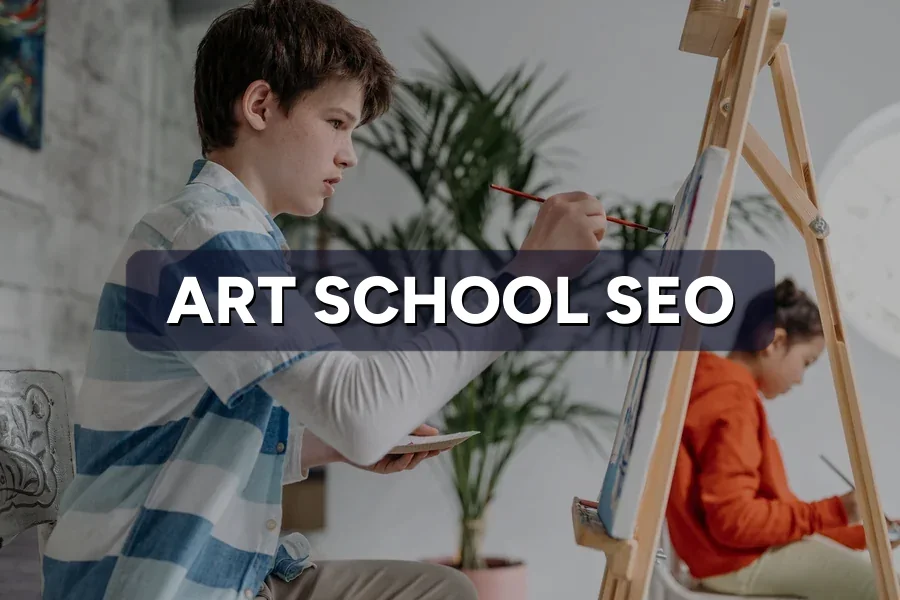
An art school sells something a parent cannot judge from a price list. She wants to see what a twelve-year-old produced after two terms, and whether your Saturday class still has a seat.
This guide is for children’s art studios, watercolour and acrylic ateliers, pottery workshops, digital illustration classes, art jam venues and portfolio-prep academies anywhere in Malaysia. It covers the pages that rank, the consent rules that decide what you may publish, and four original data sets on keywords, timing, cost and page performance.
ZenWeb runs SEO for art schools and other class-based education businesses across 500+ Malaysian accounts. One pattern repeats everywhere: the studio with the strongest teaching hides its student work behind Instagram, where Google cannot read it.
Not sure what art school SEO should cost you?
We size the monthly figure against your studio capacity and your average term fee, not a generic package. See our SEO pricing →
First, a short video on getting an art business found without leaning on social media.
Source video: Sophie Mahir on YouTube
Quick Answer: Because the parent is buying evidence of progress, not a studio. Student work by age and level, the medium taught and the free Saturday seat decide the shortlist. The wider enrolment picture sits on top of that.
Most Malaysian art school websites open with a line about nurturing creativity and a slider of tidy easels. The visitor wants to know whether a nine-year-old who cannot draw a straight line will produce something she wants to frame.
Search cannot rank a feeling. It can rank a page that names the medium, the age band, the level and the branch — and shows what came out of it. If that evidence only exists in an Instagram grid, no search engine can use it.
Quick Answer: Two different people search for you. Parents type medium plus area and age — “kids art class Puchong”, “kelas lukisan kanak-kanak”. Teenagers type exam and portfolio terms. The Malay-language side has far weaker competing pages.
Malaysia is effectively fully online: 35.4 million internet users at the end of 2025, a penetration rate of 98 percent, per DataReportal’s Digital 2026 report. Every family in your catchment can compare four studios before bedtime. The queries sort into predictable shapes:
Only the last group is price shopping. The other four are ready to book.
Quick Answer: Medium plus area first, portfolio prep second, age band third. Leave “art school Malaysia” alone — it is national, crowded and full of people who will never drive to you. Good art school SEO starts narrow.
The instinct is to chase the biggest phrase. It is the wrong instinct for a business defined by a fifteen-minute drive and a free Saturday.
A sensible order of attack, roughly by how fast each pays back:
Free keyword research is enough to size these lists. Demand for local art tuition is thin — an advantage, because six well-built pages can own a township.
Quick Answer: One page per medium, one per age programme, one per branch, plus portfolio prep, fees and a trial booking page. A single “Our Classes” page listing six mediums ranks for none of them. The page-per-intent rule applies here unchanged.
The usual Malaysian art studio site is a homepage, an about page, a gallery and a contact form. Four pages cannot carry twenty search intents:
Five mediums across two outlets is fifteen legitimate pages, not one crowded menu.
Quick Answer: Yes, as a band with what is included. Weekly children’s classes across ZenWeb’s Malaysian studio clients commonly sit around RM 150 to RM 280 a month. Hiding the number pushes the question to WhatsApp, where slow replies quietly lose the enrolment.
Owners resist because they fear being undercut by the studio one floor down. The parent finds a figure anyway.
Materials are the second reason to publish. They are the hidden cost that causes disputes later — canvases, clay, firing, a tablet for digital classes. Publish the shape of the money, not one headline figure:
Quick Answer: Write it as the answer to “what will my child actually make in the first term”. Session length, class size, the skills sequence, the materials provided and the teacher’s own practice. On-page basics come after the substance.
Generic art copy is interchangeable. Every studio promises patient teachers and a fun, creative environment, which is precisely why none of that text ranks.
Specific copy is not. A pottery page stating two-hour sessions, six students to one teacher, hand-building for four weeks then the wheel, two firings included per term, and a named ceramicist teaching it, answers a dozen long-tail queries by accident.
Quick Answer: The map pack settles most first visits, and it rewards upkeep over cleverness. Correct primary category, fresh student-work photos, answered reviews and accurate school-holiday hours. Getting into the Maps top three is the first job.
An art school competes inside a few kilometres, which makes local SEO the cheapest ranking work available to you and the most neglected. The upkeep list is short and dull, which is exactly why it works:
Fill your Google Business Profile properly before touching anything technical on the site.
Not ranking in your own neighbourhood?
We audit your map profile against the studios currently above you and show you the gap in plain terms. Talk to our SEO team →
Quick Answer: Two rules shape an art school’s website. Private educational institutions register under the Education Act 1996, and publishing a child’s photo or named artwork needs consent under the PDPA 2010. Both are trust signals worth publishing.
Registration first. Private educational institutions, including tuition and enrichment centres, register with the Registrar General of Educational Institutions, and the Ministry of Education’s Private Education Division oversees the category. Whether a recreational studio needs registration depends on what you teach, so confirm with the state division rather than guessing.
Consent second, and this one is specific to art schools. Your best ranking asset is student work, and much of it was made by a minor. The seven personal data protection principles under section 5(1) of the PDPA 2010 include a Notice and Choice principle: the person must be told the purpose before their data is processed. In practice that means a written release at enrolment.
A workable consent form covers four things:
Quick Answer: Named teacher pages with training, exhibitions and the medium they actually practise feed both Google’s quality signals and the parent’s real question. Person schema on each profile makes those credentials machine-readable.
Art tuition is a trust purchase with a slow payback. A parent commits a year of Saturdays to somebody she has met once, and a teenager commits a college application. Anonymity reads as an answer.
A page naming the teacher, their degree, the exhibitions they have shown in and the students they have taken into foundation programmes closes that gap faster than any testimonial slider.
Teacher pages also solve a practical problem. They are the only pages that can honestly rank for “art teacher [area]” and “ceramics teacher [area]”, patterns most studios ignore.
Quick Answer: Portfolio queries are low volume and unusually warm — the teenager already knows the deadline and roughly what it costs. Almost nobody writes for them, which makes it the best-value cluster in an art school’s search strategy.
Studios treat portfolio coaching as a side service and give it one line on the classes page. Meanwhile a Form Five student searches “how many pieces in an art portfolio” and lands on an overseas university page that does not match her intake. Each of these deserves its own page:
Five honest pages here will out-earn twenty posts about the benefits of creativity for children.
Quick Answer: Answer engines quote specifics — fees, session lengths, age minimums, portfolio piece counts — and skip adjectives. Short, self-contained answers near the top of each page get lifted. Getting cited in AI answers follows the same discipline.
Parents increasingly ask an assistant before they ask Google. “What age can a child start pottery in Malaysia” is now an answer, not a list of ten links. Three habits get an art school quoted:
Quick Answer: Compress the gallery, describe every image in text, and keep the timetable out of a poster JPEG. Most Malaysian traffic is mobile, often a parent standing in a school car park with one bar of signal.
Art school sites carry heavier media than almost any other local business. An unoptimised gallery of forty student paintings loses the visitor before the page renders.
The short technical list:
The rest is ordinary technical SEO — speed, SSL and clean headings.
Quick Answer: Portfolio and exam art searches convert to enquiries at roughly twenty times the rate of free-tutorial searches, on under a third of the traffic. Tutorial and colouring-page terms inflate your analytics and fill nobody’s easel, which is why cluster choice decides the whole programme.
| Keyword cluster | Session share | Session to enquiry | Enquiry to enrolled |
|---|---|---|---|
| Portfolio prep and exam art terms | 6% | 12.4% | 71% |
| Medium plus area | 15% | 8.9% | 64% |
| Kids art class plus age band | 13% | 8.1% | 66% |
| Art jam and one-day workshop | 11% | 7.4% | 58% |
| Art class near me and area only | 18% | 5.3% | 47% |
| Class fee and package terms | 10% | 3.9% | 44% |
| Adult hobby and corporate paint session | 7% | 4.6% | 39% |
| Free tutorials, references and colouring pages | 20% | 0.6% | 15% |
Source: ZenWeb client tracking, Malaysia, 2024-2026.
Tutorial content is the trap. It draws the largest share of sessions and converts worst of all, because the searcher wanted a free reference photo, not a teacher.
Quick Answer: Map movement shows by month two or three, medium pages settle around month five, and enrolments steepen between months four and nine. Art schools rank faster than most sectors because the competing pages are thin. The honest timeline holds here too.
| Month | Avg map pack position | Keywords in top 10 | Organic enrolments |
|---|---|---|---|
| Month 1 | 16.0 | 0 | 2 |
| Month 2 | 11.0 | 1 | 4 |
| Month 3 | 8.0 | 3 | 6 |
| Month 4 | 6.1 | 6 | 9 |
| Month 6 | 4.2 | 12 | 16 |
| Month 8 | 3.1 | 18 | 23 |
| Month 10 | 2.5 | 24 | 30 |
| Month 12 | 2.0 | 29 | 35 |
Source: ZenWeb client tracking, Malaysia, 2024-2026. Single-studio art school, five mediums.
Months four to nine are when medium and portfolio pages start ranking together — also when the mid-year and year-end holiday intakes land, so planning around the Malaysian calendar pays.
Quick Answer: Between RM 25 and RM 44 per enrolled student by month twelve, depending on studio type. Against a student paying RM 150 to RM 280 a month who stays several terms, that is recovered inside the first month’s fee. Local SEO pricing in Malaysia sits in a narrow band.
| Studio type | Monthly spend | Enrolments at month 12 | Cost per enrolled student |
|---|---|---|---|
| Home studio, single teacher | RM 620 | 14 | RM 44 |
| Single-branch neighbourhood studio | RM 1,180 | 35 | RM 34 |
| Portfolio-prep academy | RM 1,840 | 66 | RM 28 |
| Multi-outlet studio, three to six sites | RM 3,300 | 132 | RM 25 |
Source: ZenWeb client tracking, Malaysia, 2024-2026. Bar width is proportional to cost per enrolled student. Excludes paid media spend.
The portfolio-prep academy beats the neighbourhood studio on cost per student despite spending more, because foundation-entry pages face almost no competition here.
Want these numbers modelled against your own studio capacity?
We build the forecast from your term fee, your empty seats and your retention, not an industry average. Compare SEO packages for art schools →
Quick Answer: Medium pages and portfolio-prep pages carry the site between them, taking 46% of organic enquiries. The homepage that owners spend months redesigning contributes 2%. Write the class pages first.
| Page type | Avg top-10 keywords | Share of organic enquiries |
|---|---|---|
| Pages that sell the class | ||
| Medium and course pages | 14 | 27% |
| Portfolio-prep pages | 8 | 19% |
| Pages that remove friction | ||
| Art jam and trial booking page | 5 | 14% |
| Fees and materials page | 6 | 12% |
| Branch pages | 7 | 8% |
| Pages that build trust or traffic | ||
| Student gallery pages | 9 | 10% |
| Teacher profile pages | 4 | 5% |
| Blog and parent guides | 24 | 3% |
| Homepage | 3 | 2% |
Source: ZenWeb client tracking, Malaysia, 2024-2026.
Student gallery pages produce twice the enquiries of teacher pages — the clearest argument for publishing work on your own site rather than only on Instagram. The blog row holds the most keywords and produces almost the fewest enquiries.
Quick Answer: Student work living only on Instagram, one classes page for every medium, timetables locked in poster images, portfolio coaching in a single line. Each is a week of work left undone for years.
These undo an art school’s rankings faster than any rival does, in rough order of cost:
The other half of the problem is the one tuition centres in KL know well: rankings bring the enquiry, a slow reply loses it.
Quick Answer: Effective SEO for art schools in Malaysia is a page per medium, a page per portfolio stream, captioned student galleries, published fees and a live map profile. Write down what your front desk explains every day, and the enrolments follow the rankings.
The studios that win these searches are rarely the ones with the prettiest interiors. They are the ones whose mediums, levels, fees and free Saturday seat are written where a parent and an answer engine can both read them.
Start with one medium page, one portfolio-prep page and a captioned gallery of last term’s work.
Map pack movement usually appears by month two or three, and medium pages settle around month five. Organic enrolments reach roughly 35 a month by month twelve for a single studio, per ZenWeb client tracking.
Yes, with consent. The PDPA 2010 Notice and Choice principle requires the purpose to be explained before personal data is processed, so take a written release at enrolment. Keep artwork and the child’s face as separate permissions.
Your busiest medium page, then a portfolio-prep page. Together those two page types account for about 46% of organic enquiries across Malaysian art school sites in ZenWeb client tracking, against 2% for the homepage.
They serve different moments. Ads buy visibility during the school-holiday rush; search earns the parent comparing studios over several weeks. At RM 25 to RM 44 per enrolled student, SEO is usually cheaper long-run.
Ready to fill your easels from search?
Book a free 30-minute strategy session — we’ll review your site, your map ranking and the studios ranking around you, then give you a concrete 90-day plan with realistic enrolment targets.
Complete the form and our team will contact you to discuss your goals. Let’s grow your business.



Meowketing Specialist
Online


























