

Share this post:
The school website is the highest-leverage asset in the marketing stack. Google Ads point at it. SEO points at it. Meta Reels point at it. WhatsApp replies link to it. Get it right and every other channel converts better; get it wrong and you lose half your qualified parent traffic before they ever message you. For the broader playbook, see the Digital Marketing Guide for International Schools.
Source video: Part 2: Marketing and admissions trends to inform your school's strategy on YouTube.
Quick Answer: The homepage hero shows campus, curriculum, intake date and a calendar widget. Term fees are public. Accreditation badges are visible. The campus walk-through video is embedded, not buried in a separate page.
The schools that convert best run a homepage that answers four parent questions in the first scroll — what curriculum, what ages, what fees, and how to book a tour. The campus walk-through video plays above the fold. Accreditation badges (CIS, COBIS, IB World School, NEASC) are visible without scrolling. The “Book a Tour” calendar widget sits in the header on every page. This architecture takes a generic homepage from 1.4% to 4–6% conversion.
Quick Answer: Five top-level menus — Curriculum, Admissions, Fees, About, Open Days. Footer carries every Year-group, sustainability, safeguarding and policies. One page per curriculum per campus.
The winning structure is curriculum-first, age-second, location-third. Curriculum hubs (IGCSE, IB, American, Australian) link down to Year-group pages (Early Years, Primary, Secondary, Sixth Form). Multi-campus groups should run /kl/, /penang/, /jb/ subfolders with one local page per campus per curriculum. Every page links up to its curriculum hub and across to “Book a Tour”, “Term Fees” and “Open Day Calendar”.
Quick Answer: Show term fees, capital levy, registration deposit and bus/lunch add-ons publicly. Schools that hide fees behind a form lose half their qualified parents at this step.
The fees page is where most school websites lose half their qualified traffic. Parents who cannot see fees move on to the next school. Build a public fees page with term fees by Year group, capital levy where applicable, registration deposit, sibling discount and bus/lunch add-ons. Add a downloadable PDF for the bursar’s review, but never gate the headline numbers behind a form. Schools that show fees see two to three times more qualified enquiries.
Quick Answer: Calendly-style widget with the next 30 days of available slots. Saturday morning prioritised. Confirmation email plus WhatsApp message with the principal’s photo and pre-tour brief.
The “Book a Tour” calendar should be one click from every page. Parents pick a slot in 30 seconds, receive an immediate email confirmation, and a follow-up WhatsApp 24 hours before the tour with the principal’s photo and a five-minute orientation video. The calendar should default to Saturday morning slots and show only 60-minute blocks. Cancellation should be one click. Pair the calendar with admissions CRM (HubSpot, Pipedrive, Zoho) to automate the post-tour follow-up.
Quick Answer: One landing page per curriculum per area. Above the fold — campus, curriculum, intake date, fees range, calendar widget. Below the fold — campus video, accreditation badges, exam outcomes, parent voices, FAQ.
Curriculum-and-area landing pages are the highest-converting page type on a school website — 7–11% conversion versus 1.4% on a generic homepage. A KL campus might publish IGCSE Mont Kiara, IGCSE Bangsar, IB Mont Kiara, IB Subang as separate pages. Each page carries unique copy (no Yoast-flagged duplication), unique facility photos, unique exam outcomes, and a campus-specific calendar slot list. Send Google Ads, Meta Click-to-WhatsApp and SEO traffic to these pages, never the homepage.
Quick Answer: Accreditation badges link to issuing-body verification pages. Exam outcomes cite year and cohort. Parent voices show name, child’s Year group, and signed PDPA media-release.
School trust signals fall into three groups. Accreditation badges — CIS, COBIS, IB World School, NEASC, ACS WASC — link to the issuing body’s verification page. Exam outcomes — IGCSE pass rates, IB diploma scores, A-Level grades — cite year and cohort, never a vague “outstanding”. Parent voices — first name, child’s Year group, optional photo with PDPA consent — beat polished testimonials. Add staff bios with bylines, qualifications and years at the school. Never use unattributed superlatives.
Quick Answer: 70% of parent searches happen on mobile. Score above 85 on PageSpeed mobile. LCP under 2.5s, INP under 200ms, CLS under 0.1. Compress every image to WebP.
School sites bloat fast on photo galleries and embedded virtual tours. Compress every campus photo to WebP at 75 quality. Lazy-load below-the-fold images. Serve hero images at responsive breakpoints. Move virtual tour videos to YouTube unlisted and embed via iframe. Defer the cookie-banner script and any third-party chat widget. Mobile-first design beats responsive desktop-first by 25–40% conversion on parent traffic.
Quick Answer: One annual campus photoshoot plus monthly student-life Reels capture. Real classroom moments beat stock or staged shots. Every student image needs PDPA consent.
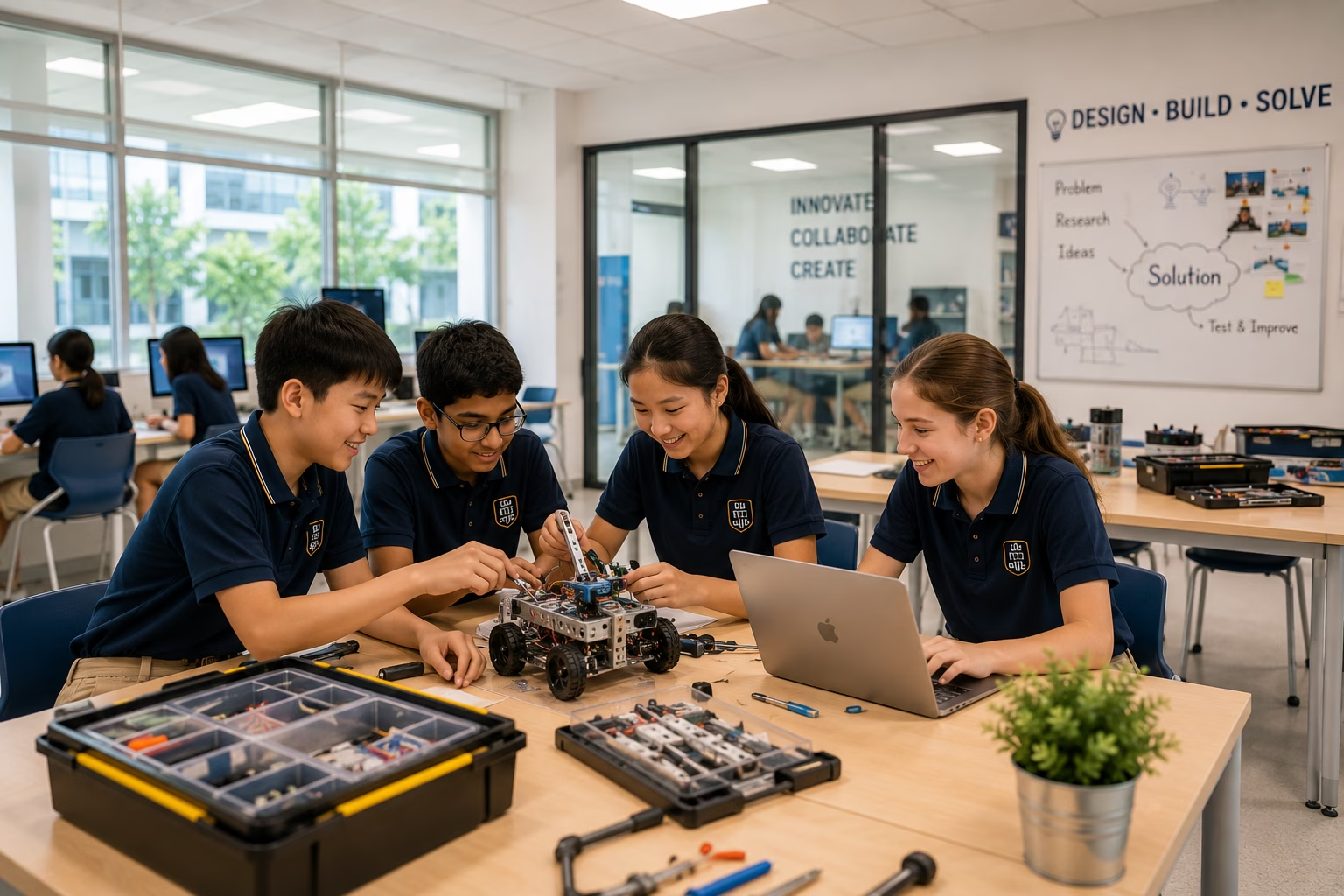
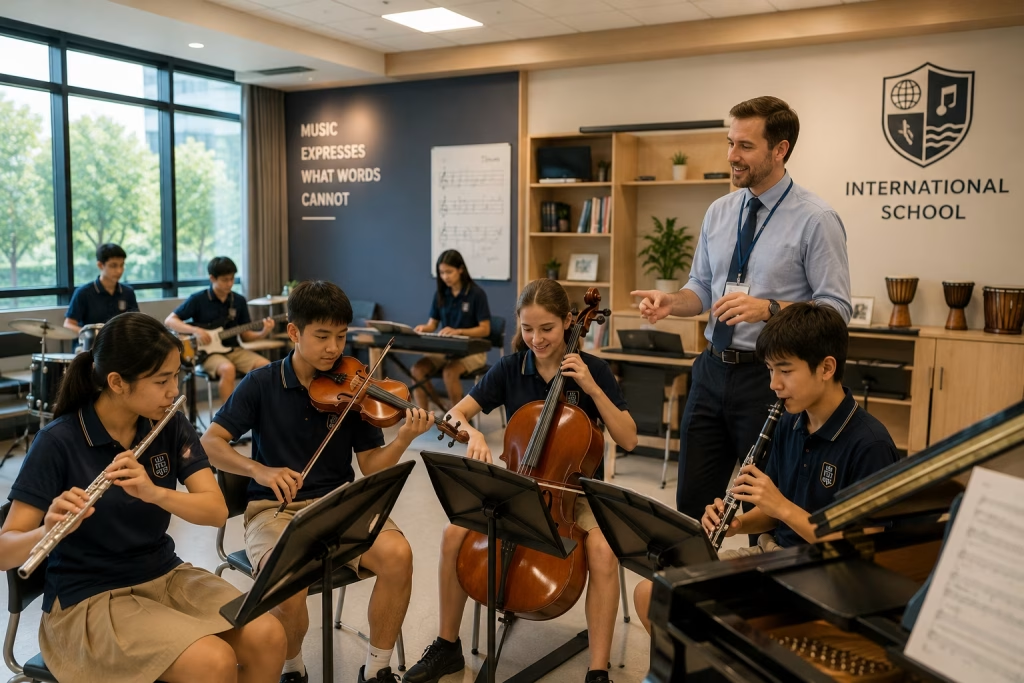
Schools that photograph well convert better. Run one annual full campus photoshoot (architecture, classrooms, labs, sports facilities, library, dining hall) plus monthly student-life captures (assemblies, productions, Year-group activities, sports days). Use real students with documented PDPA consent. Avoid stock photography — parents instantly spot it. Embed a 90-second campus walk-through video on the homepage and a 3-minute curriculum-specific video on each curriculum hub page.
Quick Answer: One domain with /en/, /zh/ subfolders for Mandarin-speaking expats; one /kl/, /penang/, /jb/ structure for multi-campus. Avoid separate sites per campus — fragmentation kills SEO equity.
Premium boarding and IB schools targeting regional families benefit from Mandarin and Bahasa Indonesia translations. Use /en/ and /zh/ subfolders rather than separate domains so SEO equity stays consolidated. Multi-campus groups should run one site with /kl/, /penang/, /jb/ subfolders, never one domain per campus. Each subfolder still gets unique copy, photos, exam outcomes and GBP citations.
Quick Answer: PDPA-compliant cookie banner, opt-in consent for marketing emails, encrypted form submission, GDPR-equivalent privacy policy, and a documented data-retention period.
The Personal Data Protection Act 2010 requires explicit consent for personal data collection beyond the immediate enquiry purpose. Use a PDPA-compliant cookie banner with categories (necessary, analytics, marketing). Form fields collecting parent and child data need a clear consent checkbox for marketing follow-up. Forms should encrypt submission via HTTPS and the receiving CRM should be PDPA-aware. Document data retention — typically two years from last contact for non-enrolled enquiries.
Quick Answer: WordPress with Elementor or Webflow for single campuses. Headless React/Next.js for multi-campus groups managing 100+ pages. Avoid bespoke custom CMS — succession risk.
For single-campus and 2–3-campus groups, WordPress with Elementor (or Webflow) handles the content velocity well — admissions can edit pages without developer help. For groups managing 100+ pages across multi-campus and multi-curriculum, headless React/Next.js with a CMS like Sanity or Contentful gives faster page speeds and tighter editorial control. Avoid custom in-house CMS builds — when the original developer leaves, the school is stuck.
Quick Answer: Tour-booking pages with a calendar widget convert at 9–14%. Curriculum-and-area landings 7–11%. Generic homepages 0.7–1.4%. Where you send paid traffic decides ROI.
| Page type | Conversion rate | CPL multiplier |
|---|---|---|
| Generic homepage | 0.7%–1.4% | 2.4x |
| Curriculum hub | 2.4%–4.2% | 1.4x |
| Public fees page | 3.8%–6.2% | 1.2x |
| Curriculum-and-area landing | 7.0%–11.0% | 1.0x |
| Tour-booking with calendar | 9.0%–14.0% | 0.8x |
Source: ZenWeb operational data, Malaysian international school client campaigns, 2024–2026.
Quick Answer: Mobile LCP under 2.5s holds bounce under 35%. LCP above 4s pushes bounce to 65%+ and halves enquiry rate.
| Mobile LCP | Bounce rate | Enquiry rate (indexed) |
|---|---|---|
| Under 2.0s | 28% | 100 |
| 2.0–2.5s | 34% | 88 |
| 2.5–3.5s | 46% | 72 |
| 3.5–5.0s | 59% | 52 |
| 5.0s+ | 68% | 38 |
Source: ZenWeb client tracking, Malaysian international school websites, 2024–2026.
Quick Answer: A RM 30,000–60,000 build typically delivers 1.6–2.2x more annual qualified enquiries than a sub-RM 10,000 site, holding paid spend constant.
Under RM 10,000 build
RM 10,000–18,000 build
RM 18,000–30,000 build
RM 30,000–60,000 build
RM 60,000+ build
| Build investment | Annual qualified enquiries |
|---|---|
| Under RM 10,000 | 280 |
| RM 10,000–18,000 | 450 |
| RM 18,000–30,000 | 620 |
| RM 30,000–60,000 | 820 |
| RM 60,000+ | 1,050+ |
Source: ZenWeb operational data, Malaysian international school client website builds, 2024–2026.
Quick Answer: Build cost rose 18% from 2022 to 2026 driven by accessibility, schema and Core Web Vitals work. 2027 will see costs flatten as AI-assisted build tools mature.
| Year | Single campus (RM) | Multi-campus (RM) | Premium boarding (RM) |
|---|---|---|---|
| 2022 | 22,000 | 75,000 | 160,000 |
| 2023 | 24,000 | 82,000 | 175,000 |
| 2024 | 25,500 | 90,000 | 195,000 |
| 2025 | 26,500 | 96,000 | 215,000 |
| 2026 | 26,000 | 98,000 | 230,000 |
| 2027 (proj.) | 25,500 | 98,000 | 240,000 |
Source: ZenWeb operational data, Malaysian international school website builds, 2022–2026. Projections based on observed AI-assisted build cost compression.
Quick Answer: Single campus RM 18,000–35,000. Multi-campus group RM 60,000–120,000. Premium boarding RM 150,000–250,000+.
Single-campus IGCSE/IB schools should budget RM 18,000–35,000 for a proper rebuild including curriculum-and-area landing pages, fees page, calendar widget, schema and Core Web Vitals work. Multi-campus groups should budget RM 60,000–120,000 because each campus needs its own subfolder, photography and exam-outcome pages. Premium boarding needs RM 150,000+ to handle multilingual subfolders, virtual-tour integration and CRM-connected forms.
Quick Answer: Gated fees, generic homepages, no curriculum-and-area landing pages, prospectus-PDF reliance, no calendar widget, slow LCP from un-optimised hero images.
The biggest mistake is gated fees. Second is the generic homepage that tries to speak to every parent and converts none. Third is missing curriculum-and-area landing pages — paid traffic dies on the homepage. Fourth is reliance on a 60-page PDF prospectus that crawlers cannot index. Fifth is the un-optimised hero image that pushes mobile LCP past 4 seconds and halves bounce.
Quick Answer: Track six — page-level conversion rate, mobile LCP, fees-page exit rate, calendar booking completions, form abandonment rate, and qualified enquiries per session.
Page-level conversion is the master metric. Mobile LCP correlates directly with bounce. Fees-page exit rate diagnoses pricing transparency. Calendar booking completions measure tour-booking funnel health. Form abandonment exposes friction. Qualified enquiries per session ties site quality to pipeline. Quarterly heat-map and session-recording reviews catch hidden friction faster than monthly analytics dashboards.
Quick Answer: Most schools should hire a specialist agency. The build needs SEO architecture, Core Web Vitals work, schema, calendar widget, CRM integration and PDPA-compliant forms — none of which a generic web shop typically delivers.
The case for in-house is content authenticity — only your team knows the form-room culture and the next open day. The case for an agency is technical execution. Most schools we work with run hybrid — in-house copy and photography; ZenWeb on architecture, build, schema, Core Web Vitals, calendar integration and CRM connection. Pair with ZenWeb Web Design or Web Design pricing.
Malaysian international schools win on the website by showing fees, building curriculum-and-area landing pages, embedding the campus video above the fold, and putting a calendar widget on every page. Mobile LCP under 2.5s. PDPA-compliant forms. Accreditation badges with verification links. Real student photos with consent. For the broader playbook see the pillar guide, SEO guide, Google Ads guide and Meta Ads guide.
If you would like ZenWeb to audit your school’s current website and propose a rebuild scope, contact our team for a complimentary review.
Single-campus IGCSE/IB schools should budget RM 18,000–35,000 for a proper rebuild. Multi-campus groups budget RM 60,000–120,000. Premium boarding needs RM 150,000+ to handle multilingual subfolders and virtual-tour integration.
Yes. Hiding fees behind a form loses half your qualified parent traffic. Build a public fees page with term fees, capital levy, registration deposit and bus/lunch add-ons. A downloadable PDF for the bursar’s review is fine, but never gate the headline numbers.
Both work. WordPress with Elementor handles content velocity well — admissions can edit pages without developer help. Webflow gives tighter design control. For multi-campus groups managing 100+ pages, headless React/Next.js with Sanity or Contentful gives faster page speeds.
Typically 8–14 weeks from kick-off to launch for a single-campus build, 16–24 weeks for a multi-campus group. The two longest steps are content production (curriculum copy, parent voices, exam outcomes) and the photoshoot.
Yes if you target expat or regional families. A 90-second campus walk-through video plus 360 facility tours embedded on the homepage and curriculum hub pages converts overseas parents 30–45% better than text-only descriptions.
Major rebuild every 4–5 years. Continuous content refresh quarterly — fees, term dates, exam outcomes, parent voices, photography. A site running unchanged for 6+ years typically loses 30–40% of organic traffic to faster, fresher competitors.
Complete the form and our team will contact you to discuss your goals. Let’s grow your business.



Meowketing Specialist
Online


























