

Share this post:
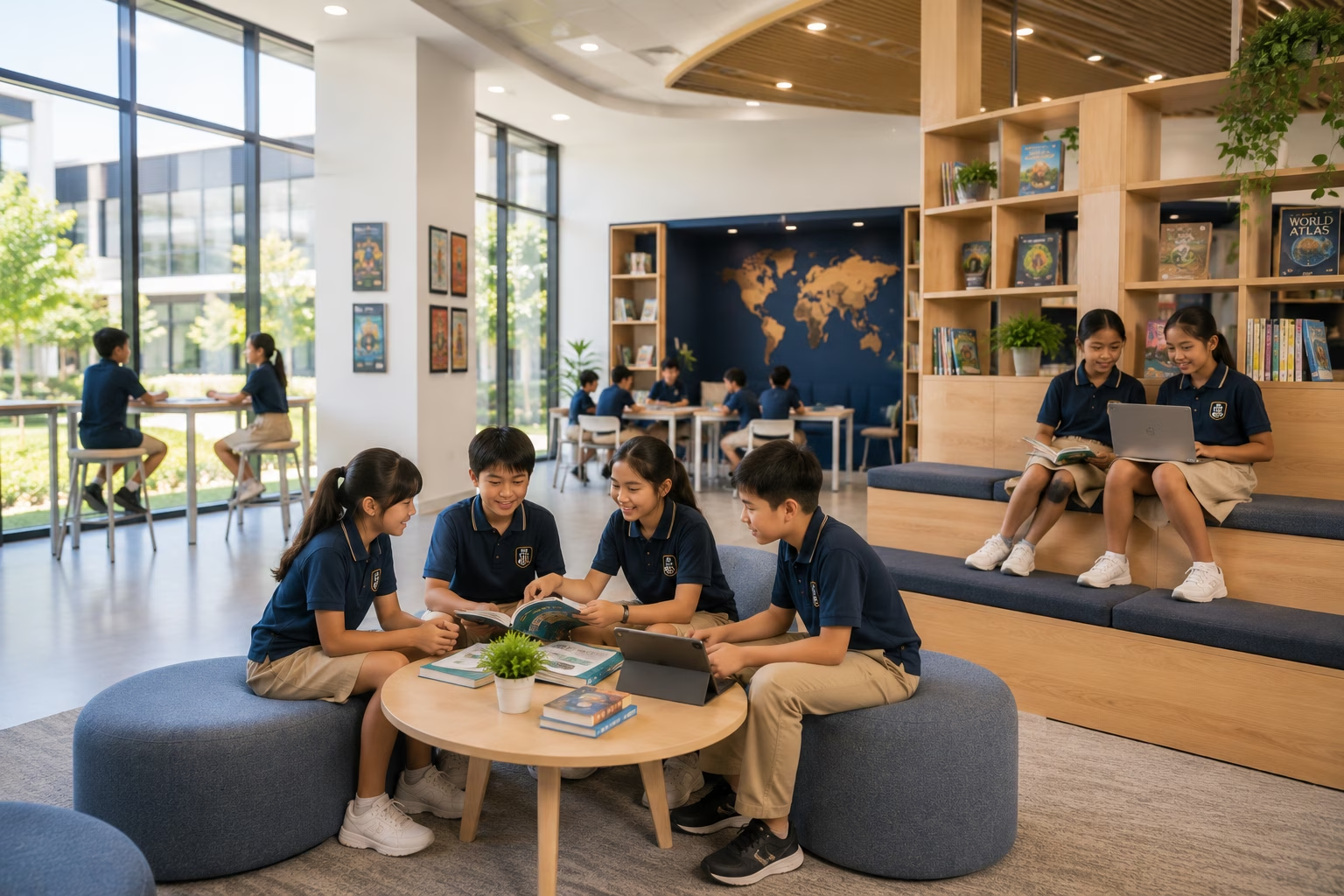

Google Ads for International Schools buy parent intent in real time. While SEO compounds across enrolment cycles, Google Ads convert this intake’s parents this month. The trade-off is rising CPC, international-school keywords sit at the top of Malaysian PPC pricing alongside legal and insurance. Get the structure right and CPL stays under RM 320 for IGCSE and IB; get it wrong and you burn RM 8,000 on brand-only campaigns that capture no new pipeline. For the broader playbook, see the Digital Marketing Guide for International Schools.
Source video: Part 2: Marketing and admissions trends to inform your school's strategy on YouTube.
Quick Answer: Parents searching “IGCSE school KL” or “IB school Subang” are weeks away from a tour booking. Google Ads put your school in front of them at the moment of intent, before SEO has time to mature.
Most international schools cannot wait 12 months for SEO to compound. Google Ads close the gap during enrolment windows. The cost is a structurally rising CPC: competitive curriculum-and-city keywords now clear RM 18–34 in Klang Valley, RM 12–22 in Penang, and RM 9–18 in Iskandar Malaysia. The schools that win run three campaign types in parallel and move budget weekly between them based on tour-booking yield.
Quick Answer: Three campaign types: Search on curriculum-and-city, Performance Max with campus feed and creatives, and Search brand defence. Add YouTube pre-roll for premium boarding accounts.
The right account structure mirrors the parent journey. Search on curriculum-and-city intent (“IGCSE school Mont Kiara”) catches bottom-funnel parents. Performance Max with the campus feed surfaces across Discover, YouTube, Gmail and Search partners. Brand defence ensures your school name does not get poached by competitors bidding on it. YouTube pre-roll suits premium boarding because the audience watches campus walk-throughs end-to-end.
Quick Answer: One ad group per curriculum per city. Tight match types. Negative every “tuition”, “kindergarten”, “preschool”, “homework”, “tutor”. They kill quality score.
For a KL campus, build IGCSE-Mont-Kiara, IGCSE-Bangsar, IGCSE-Damansara, IB-Mont-Kiara, IB-Subang ad groups. Use phrase and exact match. Broad match wastes budget on tutoring queries. Add negatives: “free”, “cheap”, “homework help”, “online tuition”, “diploma” (filters out post-secondary). RSA headlines should mention curriculum, city, and one differentiator (campus, accreditation, intake date). Final URLs go to curriculum-and-area landing pages, never the homepage.
Quick Answer: Use PMax with the campus feed (one campus per asset group), tight audience signals (parent age 28–48, postcodes near campus), and varied creative: campus video, classroom photos, exam-outcome graphics.
Performance Max works for schools when fed with strong assets and audience signals. Build one asset group per campus. Audience signals: parent age range, KL/PJ/JB postcodes within a 15km radius, expat-relocation interests, and lookalikes off enrolled-parent lists. Upload 5–10 images per campus, a 30-second campus video, two long-form descriptions, and four short headlines. Exclude the homepage as a final URL. Send to the curriculum-and-area landing page.
Quick Answer: Always run a brand defence campaign. RM 4–8 CPC, near-100% impression share. Without it, competitors bid on your name and steal qualified parents.
Most schools’ top-converting keyword is their own brand name. A parent who searched the school name is 70% of the way to a tour. Without brand defence, a competitor can buy the position above your organic listing for under RM 10 a click. Run an exact-match brand campaign with 100% impression share target, sitelinks to fees, admissions, the open-day calendar and a campus video. Spend rarely exceeds RM 600/month per campus.
Quick Answer: One landing page per ad group. Above-the-fold: campus name, curriculum, intake date, fees range, “Book a Tour” calendar. Below: campus video, accreditation badges, exam outcomes, parent voices, FAQ.
The curriculum-and-area landing page is where Google Ads ROI is made or lost. Above-the-fold the parent should see the campus name, the curriculum, the next intake date, the fees range, and a calendar widget for booking a tour. Below the fold add the campus walk-through video, accreditation badges (CIS, COBIS, IB World School), latest exam outcomes (year and cohort cited), three to five parent quotes, and a six-question FAQ. Conversion rate on a well-built page sits at 7–11% versus 0.7–1.4% on a generic homepage.
Quick Answer: Start on Maximise Conversions, switch to Target CPA after 30 enquiries, then to Target ROAS once you can attribute enrolment value back to clicks.
Google’s smart bidding only works when conversion tracking is solid. Track three conversions: qualified enquiry (parent submitted form with curriculum and intake year), tour booked, and enrolled. Import enrolment as offline conversion via Google Ads conversion import or via the new Enhanced Conversions for Leads API. Without offline conversions, bidding optimises for cheap top-of-funnel forms instead of paying parents.
Quick Answer: Avoid superlatives like “best”, “top”, “number one”. MOE marketing review and the Trade Descriptions Act 2011 frown on unverifiable claims. Cite year, cohort and source on any exam-outcome claim.
Headlines that work: “IGCSE School in Mont Kiara”, “August 2026 Intake Open”, “Cambridge IGCSE Curriculum”, “Book a Campus Tour”. Headlines to avoid: “Best International School in Malaysia”, “Number One IGCSE Results”, “Guaranteed University Place”. The MOE Bahagian Sekolah Swasta and the Ministry of Domestic Trade can both flag unverifiable superlatives. Outcome claims are fine when sourced: “100% IGCSE Pass Rate (May 2025 Cohort, n=86)”.
Quick Answer: Sitelinks lift CTR 8–15% on school accounts. Use “Term Fees”, “Book a Tour”, “Open Day Calendar”, “Curriculum Overview”, “Latest Results”, “Bus Routes”.
Schools under-use ad extensions. The four-sitelink minimum should always be deployed. Callouts work best with concrete signals: “August Intake Open”, “Cambridge Authorised Centre”, “IB World School”, “Free Campus Tour”. Structured snippets work for the Course schema list: “Curriculum: IGCSE, IB DP, A-Level”. Lead form extensions can short-circuit landing-page friction for top-of-funnel campaigns but typically lower the qualified-enquiry rate by 30–50%.
Quick Answer: Two big windows: August–November (August intake) and February–April (January-intake follow-up). Push 60–70% of annual budget into these months.
School Google Ads spend should not be spread evenly. The August intake window opens around August in the prior year: top-of-funnel research starts then, with most decisions closing by November. The January intake window opens in February for the following August. Premium boarding follows a different rhythm: applications open 12–18 months ahead. Push 60–70% of annual budget into these peak windows; cruise the rest of the year on brand defence and remarketing.
Quick Answer: Remarket every fee-page exit and every Year-group page visitor. YouTube pre-roll on the campus walk-through suits premium boarding and IB campuses with regional reach.
Most parents need 5–9 touches before booking a tour. Remarketing is the cheapest of those touches. Build audience lists for fee-page visitors, Year 6/Year 9 page visitors, and tour-booking page visitors who did not complete. Run 30-day remarketing on Search and Display. YouTube pre-roll works on premium boarding accounts targeting Singapore, Jakarta and Hong Kong expats relocating to KL: CPV sits at RM 0.06–0.14, view-through rate 22–34%.
Quick Answer: Klang Valley sits at the highest CPC. Penang and JB run 30–45% cheaper. IB and American command the highest CPC across every city.
| Curriculum / City | Klang Valley CPC (RM) | Penang CPC (RM) | Iskandar CPC (RM) |
|---|---|---|---|
| IGCSE / A-Level | 22 | 15 | 12 |
| Australian (HSC/SACE) | 25 | 17 | 14 |
| IB | 28 | 19 | 15 |
| American (AP) | 30 | 21 | 17 |
| Boarding (premium) | 34 | 23 | 19 |
Source: ZenWeb operational data, Malaysian international school client campaigns, 2024–2026.
Quick Answer: Sending Google Ads to the homepage halves conversion versus a dedicated landing page. Calendar widgets above the fold lift conversion 30–50%.
| Landing page type | Conversion rate | CPL multiplier |
|---|---|---|
| Homepage | 0.7%–1.4% | 2.4x |
| Curriculum hub | 2.4%–4.2% | 1.4x |
| Fees page | 3.8%–6.2% | 1.2x |
| Curriculum-and-area landing | 7.0%–11.0% | 1.0x |
| Tour-booking with calendar | 9.0%–14.0% | 0.8x |
Source: ZenWeb client tracking, Malaysian international school accounts, 2024–2026.
Quick Answer: RM 8,000–14,000/month delivers 18–32 tour bookings during peak windows. Below RM 5,000 the funnel struggles to clear paid CPL.
| Spend tier | Tours/month |
|---|---|
| RM 3,000–5,000/mo | 7 |
| RM 5,000–8,000/mo | 14 |
| RM 8,000–14,000/mo | 25 |
| RM 14,000–22,000/mo | 38 |
| RM 22,000+/mo | 55+ |
Source: ZenWeb operational data, Malaysian international school client campaigns, 2024–2026, peak enrolment windows.
Quick Answer: Search CPC for school keywords rose 50% from 2022 to 2026. 2027 will see a smaller 7–9% rise as the market saturates.
| Year | IGCSE CPC (RM) | IB CPC (RM) | Avg Google Ads CPL (RM) |
|---|---|---|---|
| 2022 | 15 | 18 | 240 |
| 2023 | 17 | 21 | 270 |
| 2024 | 19 | 23 | 305 |
| 2025 | 20 | 26 | 335 |
| 2026 | 22 | 28 | 360 |
| 2027 (proj.) | 24 | 31 | 385 |
Source: ZenWeb client tracking, Malaysian international school accounts, 2022–2026.
Quick Answer: Single-campus IGCSE/IB schools sit at RM 8,000–14,000/month. Multi-campus groups consolidate at RM 18,000–35,000/month. Premium boarding RM 30,000+/month with a YouTube layer.
Within a typical RM 12,000/month single-campus budget, the split is 55% Search on curriculum-and-city, 25% Performance Max, 15% remarketing, and 5% brand defence. Multi-campus groups tilt 5% more to PMax and 5% less to Search because the asset feed compounds. Premium boarding adds 15–20% YouTube pre-roll.
Quick Answer: Sending paid traffic to the homepage, broad-match keyword waste, no negatives for tuition/kindergarten, no offline conversion import, and over-spending in low-intent months.
The biggest leak is sending Google Ads to the homepage. It cuts conversion by half. Second is broad-match without aggressive negatives. Third is missing offline conversion import. Without it, Google’s smart bidding optimises for cheap top-of-funnel forms instead of paying parents. Fourth is treating every month equally instead of pushing 60–70% of budget into peak windows.
Quick Answer: Track six: qualified enquiries, cost per qualified enquiry, tour bookings, cost per tour booking, application submissions, and cost per enrolled student.
Vanity Google Ads metrics (clicks, impressions, CTR) tell you nothing about pipeline. Tie every campaign to qualified enquiries and walk it through to enrolled students. The Google Ads dashboards that work feature one number per campaign per month (qualified enquiries) and one composite, cost per enrolled student.
Quick Answer: Single-campus schools spending under RM 5,000/month often DIY. Above RM 8,000/month, an agency typically pays for itself in lower CPL and tighter campaign management.
The case for in-house is admissions intimacy: only your team knows which Year-group has gaps. The case for an agency is keyword research, bid management, conversion tracking and creative production. Most schools we work with run hybrid: in-house admissions; ZenWeb on Google Ads, conversion import, landing pages and analytics. Pair with ZenWeb Google Ads or Google Ads pricing.
Malaysian international school Google Ads wins by running three campaign types in parallel: Search on curriculum-and-city, Performance Max with the campus feed, and brand defence. Send paid traffic to curriculum-and-area landing pages with a calendar widget above the fold. Push 60–70% of budget into peak enrolment windows. Import enrolment as offline conversions. For the broader playbook see the pillar guide, SEO guide, Meta Ads guide and Web Design guide.
If you would like ZenWeb to audit your current Google Ads account, contact our team for a complimentary review.
Single-campus IGCSE/IB schools sit at RM 8,000–14,000/month. Multi-campus groups consolidate at RM 18,000–35,000/month. Premium boarding spends RM 30,000+/month with a YouTube layer for regional reach.
Yes, alongside Search and brand defence, never instead of them. PMax with one asset group per campus and tight audience signals delivers RM 12–22 CPC and surfaces across Discover, YouTube, Gmail and Search partners.
The same MOE marketing-claim rules apply. Avoid superlatives like “best” and “number one”. Cite year, cohort and source on any exam-outcome claim. The Trade Descriptions Act 2011 also applies to ad copy.
Use Enhanced Conversions for Leads or offline conversion import. Pass the GCLID through the admissions form, store it in your CRM, and upload enrolments back to Google Ads weekly. This lets smart bidding optimise for paying parents instead of cheap form-fills.
Only for top-of-funnel campaigns where volume matters more than quality. Lead form extensions short-circuit the landing page but typically lower the qualified-enquiry rate by 30–50%. For curriculum-and-city campaigns, send to a proper landing page.
Technically yes, but the conversion rate is poor and competitors will retaliate, raising your brand defence costs. Most school accounts skip competitor-bidding and invest the budget in curriculum-and-city Search.
Complete the form and our team will contact you to discuss your goals. Let’s grow your business.



Meowketing Specialist
Online


























