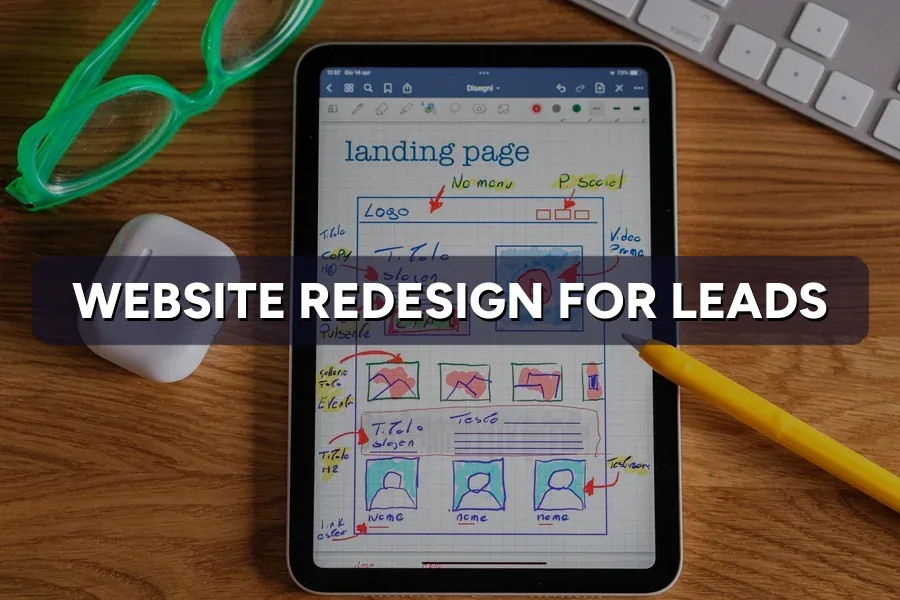
The pattern repeats across Malaysian SMEs. The site looks dated, so a rebuild gets approved. Three months after launch it looks far better — and the phone rings less. Nobody can explain the drop, because nobody wrote down what the old site was doing.
Most advice sells redesign as a guaranteed lift, quoting big gains from other people’s case studies. A rebuild is also a risk event: it touches your URLs, rankings, tracking and enquiry path at once. A website redesign for conversion is the version where each of those is handled on purpose.
Planning a rebuild this quarter?
Our builds are scoped around measured enquiries, not screens delivered. See how a conversion-led build is scoped →
Before the detail, a useful counterpoint — how much conversion improvement is available without rebuilding anything.
Source video: How To Increase Conversion Rate On Any Website Without Redesigning, on YouTube
Quick Answer: Rebuild when the problem is structural — missing pages, no real mobile layout, a CMS you cannot edit, a platform that cannot be made fast. Iterate when rankings are healthy and only the enquiry path is weak. A website redesign for conversion is the expensive answer; page-level fixes pay back sooner.
The honest test is whether your site fails at the foundation or at the finish. Foundation problems need a rebuild; finish problems need a fortnight of work. Our 15-check conversion audit tells you which one you have.
Structural signs a rebuild is justified:
Signs you should iterate instead: steady organic traffic, pages that already rank, a site you can edit yourself, and a conversion rate below the Malaysian SME benchmark range with no obvious structural cause. There, a rebuild risks more than it gains. If budget decides it, our breakdown of website redesign cost in Malaysia sets out the bands.
Quick Answer: A visual refresh changes colours, photography and typography. A website redesign for conversion changes the page set, the enquiry path, the forms, the proof and the load time. The two overlap by roughly a third — and only the second one has a lead number attached to it.
Both carry the same word in the proposal and often the same price tag, so name the difference line by line before you sign.
| Decision | Visual refresh | Conversion-led rebuild |
|---|---|---|
| Starting point | Mood board | Twelve weeks of enquiry data |
| Page set | Same pages, restyled | One page per service and per buying question |
| Forms | Restyled, same fields | Fields, routing and follow-up tested |
| Speed | Often worse — bigger images | Budgeted, tested on a mid-range phone |
| Definition of done | Client approves the design | Enquiries per 1,000 sessions beat baseline |
| After launch | Project closes | 90 days of measured iteration |
That last row is the dividing line. A refresh ends at launch; a rebuild aimed at leads treats launch as the midpoint — the same logic behind landing page optimisation, and it belongs in the agreed scope alongside everything else a full web design service includes.
Quick Answer: Across ZenWeb-managed rebuilds, a visual refresh alone barely moved enquiries. Rebuilding the enquiry path lifted them by about a third, speed and mobile work pushed that towards half, and three months of tracked iteration produced the largest gain.
| Rebuild scope | Relative lift | Median change |
|---|---|---|
| Visual refresh only | +4% | |
| Plus rebuilt enquiry path and forms | +31% | |
| Plus speed and mobile layout work | +48% | |
| Plus 90 days of tracked iteration | +62% |
Source: ZenWeb client sample, 500+ Malaysian SME accounts, 2024–2026. Licence.
Read the gap between the first two rows first. Nearly all the difference sits in work a client never sees in a mockup — exactly what gets cut when a quote is trimmed. Our comparison of CRO versus more traffic covers which spend returns faster.
Not sure your site needs a full rebuild?
Fifteen checks tell you whether the problem is structural or fixable in a fortnight. Run the conversion audit checklist first →
Quick Answer: Before a single mockup, record twelve weeks of enquiry volume, source split, top landing pages and form completion rate. Without that baseline, a website redesign for conversion cannot be judged, and month four becomes an argument about taste instead of a reading of numbers.
Almost every Malaysian SME skips this step, and it is the only one impossible to recover later. Once the old site is gone, its performance goes with it.
If conversion events are not firing yet, fix that before the rebuild starts. Our walkthrough of conversion tracking setup for GA4 and WhatsApp leads covers the plumbing, and twelve weeks of clean data gathered during the design phase costs nothing.
Quick Answer: Both planned and unplanned relaunches dip in month one. The planned one recovers to baseline by month two and keeps climbing. The unplanned one — new URLs, no redirect map, tracking rebuilt from scratch — is still below its old rate six months later.
| Month | Planned migration | Unplanned relaunch |
|---|---|---|
| Baseline | 18.0 | 18.0 |
| Month 1 | 16.4 | 9.7 |
| Month 2 | 18.9 | 11.2 |
| Month 3 | 21.6 | 13.5 |
| Month 4 | 23.8 | 15.1 |
| Month 5 | 25.1 | 16.4 |
| Month 6 | 26.3 | 17.2 |
Source: ZenWeb client sample, 500+ Malaysian SME accounts, 2024–2026. Licence.
The month-one dip is normal in both columns — crawlers revisit, returning visitors relearn the navigation. What separates the two lines is whether anyone mapped the old URLs to the new ones: half a day of work, and the costliest shortcut in a rebuild.
Quick Answer: Two things break during a rebuild: URLs and speed. Map every old address to a new one and use permanent server-side redirects. Then test the build on a mid-range phone before launch, because a heavier design undoes a conversion gain quietly.
Google’s guidance on site moves with URL changes is blunt: create a URL mapping, configure permanent server-side redirects, and expect temporary ranking fluctuation even on a clean move. An unmapped move turns “temporary” into something else.
The migration checks worth writing into the project plan:
Speed is where good-looking rebuilds lose their gain, and the fix is engineering rather than design — our breakdown of what a website speed optimisation service fixes covers that work.
Quick Answer: Roughly four in ten visitors reach a service page, fewer than two in ten reach a page with a form, and about seven in a hundred start filling one in. The biggest drop sits between seeing a form and starting it — a design problem, not a traffic problem.
| Funnel stage | Share of sessions | Drop from previous stage |
|---|---|---|
| Landed on the site | 100% | — |
| Viewed a service or product page | 41% | 59% |
| Reached a page carrying a form | 19% | 54% |
| Started filling the form | 6.8% | 64% |
| Submitted the form | 3.1% | 54% |
Source: ZenWeb client sample, 500+ Malaysian SME accounts, 2024–2026. Licence.
Read the funnel backwards when you write the brief. The steepest drop is where the rebuild budget earns most, and on Malaysian SME sites that is almost always the form itself — which is why quote request forms deserve a design conversation, not a default plugin layout.
Quick Answer: Five elements carry most of the enquiry difference: the form, the primary call to action, visible proof, the mobile view above the fold, and load speed. Get those right and the rest of a website redesign for conversion is decoration you can enjoy.
Campaign traffic is a separate question. Paid clicks sent into a rebuilt main site rarely beat a purpose-built page, so a landing page design service usually runs alongside a rebuild rather than inside it — settle the sales page versus landing page question before scoping either.
Want the enquiry path rebuilt, not just restyled?
We scope forms, calls to action and speed as deliverables with numbers attached. See what a ZenWeb rebuild covers →
Quick Answer: Page-level fixes pay back fastest because they cost least. A conversion-led rebuild of six to ten pages typically pays back inside a year. A visual refresh at similar cost often never pays back, because the lift is close to zero.
| Scope | Typical cost band | Expected lift | Months to payback |
|---|---|---|---|
| Page-level fixes, no rebuild | RM 3,000–8,000 | +10% to +20% | 3–5 |
| Conversion-led rebuild, 6–10 pages | RM 12,000–25,000 | +30% to +50% | 7–11 |
| Full rebuild with speed and tracking | RM 25,000–45,000 | +45% to +70% | 9–14 |
| Visual refresh only | RM 6,000–15,000 | 0% to +8% | Often never |
Modelled projection: ZenWeb client lift ranges (2024–2026) applied to 4,000 monthly sessions, RM 3,000 average deal value and a 20% close rate. Illustrative, not a forecast. Licence.
Change the close rate or the deal value and every row shifts, so run the model on your own numbers before approving a budget. Buying enquiries outright behaves differently again, as our look at the pay per lead model and the trade-off between inbound and outbound leads both show.
Quick Answer: Write the brief in five moves: state the enquiry baseline, name the target, list the pages that must survive, name the conversion work, and agree what happens in the ninety days after launch. Five paragraphs change what you are buying.
Agencies price what they are asked for. A brief written this way costs more than a vague one, buys something different, and turns comparing two quotes into a question of scope rather than guesswork.
Quick Answer: We measure first, migrate carefully, and stay for ninety days. Baseline capture, URL mapping, form and call-to-action rebuild, a speed budget, tracking verified on staging, then three months of reading the numbers — with every account in your name.
As a Google Partner agency working with 500+ Malaysian clients, we treat a rebuild as a measurement project that happens to involve design. The baseline goes in the proposal, the target goes in the scope, and the ninety-day iteration window is priced rather than promised. ZenWeb hands over every login at launch.
A rebuild rarely stands alone. Sites needing enquiries immediately pair it with search and paid work under one plan — the argument for a search marketing agency covering SEO and SEM together. The full build scope sits on our web design services page.
Quick Answer: Decide rebuild or iterate honestly, capture a baseline, protect URLs and speed, rebuild the five elements that carry enquiries, and stay ninety days after launch. That sequence separates a website redesign for conversion from an expensive change of clothes.
With 98% of Malaysians online at the end of 2025, per DataReportal, competitors are not winning on whether they have a website. They are winning on whether theirs turns visits into conversations. Judge your rebuild on that number and the design arguments settle themselves.
Only if the enquiry path is in the scope. A visual refresh alone moves enquiries very little. Rebuilds that also fix forms, calls to action, mobile layout and speed produce the real gains.
Expect a dip in month one while search engines recrawl, recovery to baseline by month two or three, and the gain from month four onward. Still below baseline at month four usually means a migration problem, not a design one.
Temporarily, yes, even on a clean move. Permanently only if URLs change without a redirect map or ranking pages lose their content. Map every old URL to a new one and keep the substance on pages that already earn traffic.
Fix the pages when traffic and rankings are healthy and only the enquiry path is weak — cheaper and faster. Rebuild when the problems are structural: no real mobile layout, a CMS you cannot edit, or a wrong page set.
A conversion-led rebuild of six to ten pages typically runs RM 12,000 to RM 25,000, rising once speed engineering, tracking migration and post-launch iteration are included. Below roughly RM 8,000 you are buying a template refresh.
Ready to rebuild around enquiries instead of aesthetics?
Book a free 30-minute strategy session — we’ll review your current site, your Google ranking, and your competitors, then give you a concrete 90-day plan with realistic enquiry and pipeline targets.
Complete the form and our team will contact you to discuss your goals. Let’s grow your business.



Meowketing Specialist
Online