

Share this post:
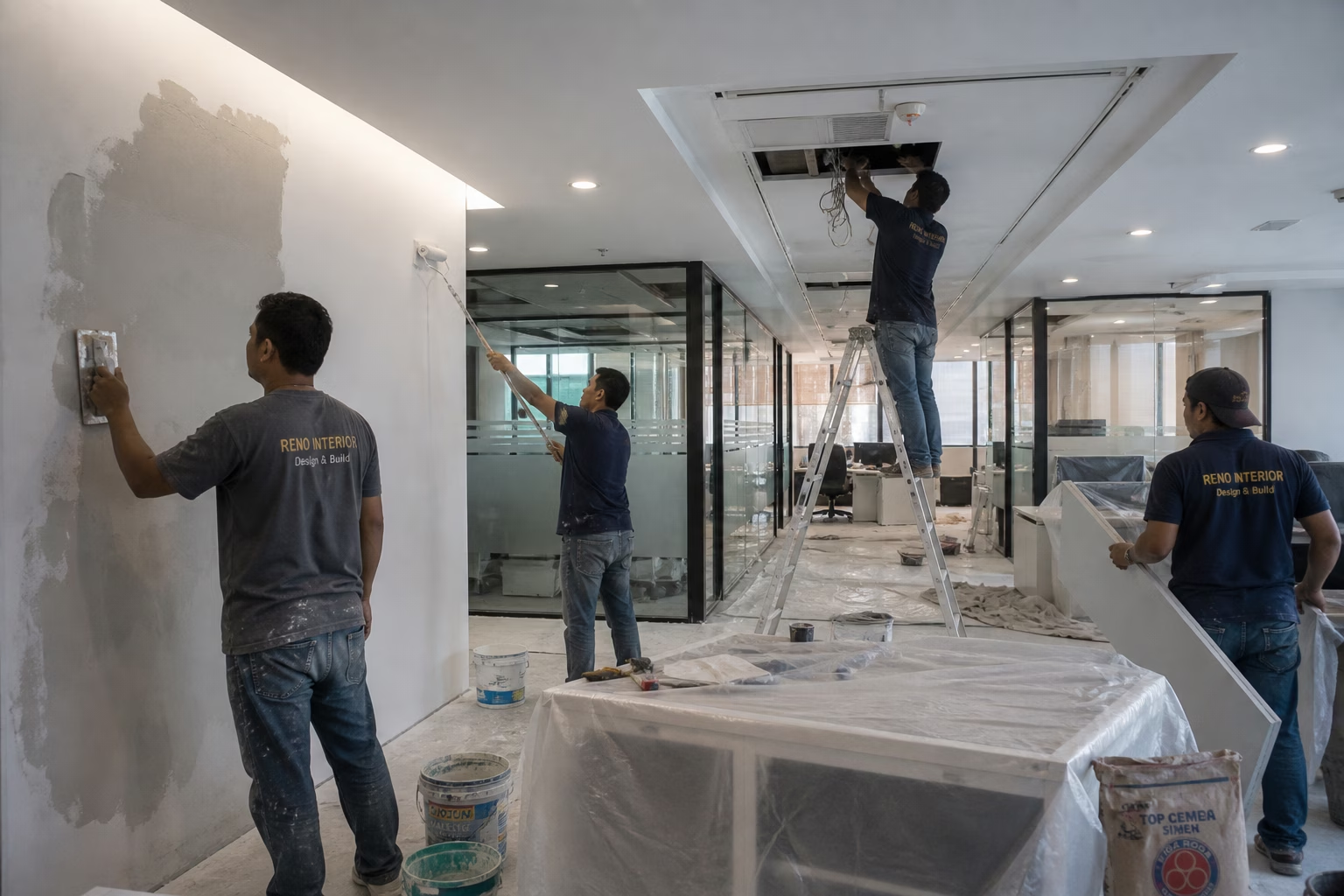
A web design for renovation contractors is the single biggest conversion lever in the funnel. Paid traffic from Meta and Google lands here. Organic SEO lands here. Word-of-mouth referrals land here. A site that takes 6 seconds to load on 4G or hides the price band kills 50–70% of paid investment before WhatsApp even opens.
This guide covers the six core pages, the filterable portfolio architecture, mobile-first conventions, CIDB and PDPA trust elements, form design and ZenWeb client benchmark data on conversion uplifts. The video below frames why portfolio depth still beats fancy graphics.
Source video: How Contractors Generate 500+ Leads on YouTube
Quick Answer: The website sits underneath every other channel. A weak site halves paid-channel ROI; a strong one doubles SEO and Meta returns. ZenWeb client data shows site rebuilds typically lift cost-per-deposit by 40–80% within 90 days.
Buyers spend 2–8 minutes on your site after clicking from Meta or Google. They scan the portfolio, look for a CIDB grade, hunt for a price band, and decide whether to message. Sites that load slowly, hide pricing, or buried the WhatsApp button get bounced. ZenWeb operational data, Malaysian renovation client campaigns, 2024–2026, shows the median renovation visitor leaves a slow or unclear site within 18 seconds.
Quick Answer: Homepage, filterable portfolio, scope pages (kitchen/bathroom/whole-home/office), city pages, about/team, and contact with a free-site-visit form. Anything more is decoration.
The homepage signals trust in three scrolls: hero portfolio, scope grid, CIDB trust block. The filterable portfolio is the workhorse, letting visitors pick unit type, city and budget. Scope pages aggregate projects by kitchen, bathroom, whole-home and commercial. City pages cover Mont Kiara, Bukit Jelutong, Damansara Heights, Bangsar South, Cheras and JB. About pages introduce the team with face shots and CIDB cards. Contact carries the form, the WhatsApp button and the showroom address.
Quick Answer: Portfolio needs three filter dimensions: unit type (condo, terrace, bungalow, office, F&B), city, and budget band. Visitors who use filters convert 2.4x better than those who scroll a flat gallery.
The standard mistake is a gallery of 200 unfiltered thumbnails. A filterable portfolio lets a Mont Kiara condo owner with RM 80k budget find three matching projects in 10 seconds. Each project page needs unit type, sqft, scope, budget band, timeline, materials list, 8–15 photos with captions, and a 300-word brief. Add a “Similar projects” block at the bottom. Internal-linking lifts session depth by 30–50%.
Quick Answer: Target LCP under 2.5 seconds, CLS under 0.1, INP under 200ms on 4G mobile. Strip image metadata, serve WebP at three breakpoints, lazy-load below-the-fold, and use a CDN.
78% of renovation site visits in Malaysia happen on mobile. A site that loads in 6 seconds loses 50% of mobile visitors before LCP fires. Strip EXIF metadata from all photos, serve WebP at 800px, 1200px and 1600px, lazy-load galleries, and serve through Cloudflare or Bunny CDN. Set explicit width and height on every image to lock CLS. Avoid carousel sliders on the homepage. They add weight and rarely lift conversion.
Quick Answer: A sticky WhatsApp button bottom-right of every page lifts WhatsApp clicks by 60–110% versus a footer-only button. Use the official WhatsApp green; never hide it during scroll.
The sticky WhatsApp button is the single highest-ROI conversion element. It sits bottom-right on every page, stays visible during scroll, opens with a pre-filled greeting (“Hi, I’m interested in a kitchen renovation. My unit is at…”). Pair with click tracking imported into Meta and Google Ads as a conversion event. Pair with the ZenWeb Web Design service or Web Design pricing.
Quick Answer: Display CIDB grade and PPK card in the footer of every page, Workmen’s Compensation cover number, JKR small-works approval where relevant, and a PDPA notice on every form. These lift form-fill rates by 25–40%.
Trust signals are dispositive in renovation. CIDB grade and PPK card go in the footer site-wide. Workmen’s Compensation cover number reassures the homeowner about on-site liability. JKR small-works approval matters for structural work on landed property. Each project page should display the CIDB grade and project value cap. PDPA notice on every form is mandatory under the 2010 Act.
Quick Answer: Show a price band on every scope page: “Kitchen renovation from RM 25,000”. Hidden pricing pushes 40–60% of homeowners to message a competitor first.
The argument against showing prices (“we’ll lose negotiating power”) is wrong in 2026. Buyers screen out hidden-price contractors before they even shortlist. A price band (“Whole-home renovation from RM 80,000”) sets expectations without committing to a quote. Trade Descriptions Act 2011 requires the smallest project you accept to actually be at the advertised “from” price. Avoid absolute claims like “guaranteed lowest price”.
Quick Answer: The form needs five fields: name, phone, unit type, target budget band, preferred site-visit date. Six fields drop conversion by 25%; ten fields drop it by 50%.
The standard mistake is a 12-field form asking for full address, employer, household income and birthday. Conversion collapses.
The optimal form is five fields, with target budget as a dropdown (under RM 30k, RM 30–80k, RM 80–200k, RM 200k+) and preferred site-visit date as a calendar picker. Add a one-line PDPA notice below the submit button. Send confirmation via WhatsApp within five minutes.
Quick Answer: Show the lead contractor or director with face, name, CIDB credential, years in business, and one-line bio. Sites with named team photos convert 30–45% better than anonymous sites.
Renovation is a trust purchase. Buyers want to see the human signing their contract. The about page introduces the lead contractor or director with a clear face shot, full name, CIDB credential, year of registration, and a 30-word bio. List two to four other team members with similar treatment: site supervisor, project manager, lead carpenter. Anonymous sites that hide the team kill conversion in renovation.
Quick Answer: WordPress with Elementor or Bricks Builder for most firms; Webflow for design-led ID studios. Avoid Wix and Squarespace for renovation: image weight and SEO control are too limited.
WordPress on a managed host (Cloudways, SiteGround) with Elementor or Bricks Builder gives the best balance of editability and Core Web Vitals. Webflow suits design-led ID studios that want pixel control. Avoid Wix and Squarespace. Image optimisation, schema control and load speed are all weaker.
Bolt on Rank Math (SEO), Cloudflare (CDN), Smush or ShortPixel (image), and Wp Rocket (caching).
Quick Answer: Track six KPIs: page load time, bounce rate, average session duration, pages per session, WhatsApp click rate, and form-submission rate.
Page load time below 2.5s. Bounce rate below 55% on portfolio pages. Average session duration above 90 seconds signals engaged visitors. Pages per session above 3.5 signals filter use. WhatsApp click rate is the conversion ceiling. Form-submission rate above 4.5% on scope pages is healthy. Set up GA4 events for filter use, gallery scroll depth, and WhatsApp button clicks: these signals drive paid-channel optimisation.
Quick Answer: Scope-specific landing pages convert at 6.8%; filterable portfolio at 4.5%; city pages at 4.2%; homepage at 2.1%; flat gallery at 1.6%.
| Page Type | WhatsApp / Form Rate | Index vs Scope |
|---|---|---|
| Scope-specific (kitchen, bathroom) | 6.8% | 100 |
| Filterable portfolio | 4.5% | 66 |
| City-specific (Mont Kiara, JB) | 4.2% | 62 |
| Individual project page | 3.6% | 53 |
| Homepage | 2.1% | 31 |
| Flat unfiltered gallery | 1.6% | 24 |
Source: ZenWeb client tracking, Malaysian renovation contractor websites, 2024–2026, n = 380,000 sessions.
Quick Answer: Five common leaks: slow loading from oversized images, hidden pricing, no WhatsApp button, anonymous about page, and forms with 10+ fields.
Sites loading over 4 seconds on 4G lose 50% of mobile visitors. Hidden pricing pushes buyers to a competitor. Missing or buried WhatsApp button drops conversion 60%. Anonymous about pages lose 30–45% of trust-seeking visitors. Long forms lose 50% of fillers per five extra fields. Each fix takes a week or less.
Quick Answer: Sites under 2.5s convert at 5.2%; 4–6s at 2.8%; 6s+ at 1.4%. Every extra second after 2.5s drops conversion by roughly 15%.
| Mobile Load Time | Conversion Rate | Index vs <2.5s |
|---|---|---|
| Under 2.5 seconds | 5.2% | 100 |
| 2.5–4 seconds | 3.9% | 75 |
| 4–6 seconds | 2.8% | 54 |
| 6–10 seconds | 1.4% | 27 |
| Over 10 seconds | 0.6% | 12 |
Source: ZenWeb client tracking, Malaysian renovation contractor websites, 2024–2026, n = 380,000 sessions.
Quick Answer: RM 8k rebuild lifts conversion 25–45%; RM 18k rebuild lifts 50–80%; RM 35k rebuild with custom photography lifts 80–120%.
| Rebuild Investment (RM) | Conversion Lift in 90 Days |
|---|---|
| RM 4,000 (template tweaks) | 10–18% |
| RM 8,000 (rebuild) | 25–45% |
| RM 18,000 (rebuild + filter) | 50–80% |
| RM 35,000 (custom + photography) | 80–120% |
| RM 60,000+ (multi-branch) | 100–140% (flattens) |
Source: ZenWeb operational data, Malaysian renovation contractor web rebuilds, 2024–2026.
Quick Answer: Median CPL reduction from site rebuilds has held at 30–45% over four years. As paid CPMs rise, web design ROI rises too.
| Year | Median CPL Reduction | Avg Rebuild Spend (RM) |
|---|---|---|
| 2022 | −30% | RM 12,000 |
| 2023 | −34% | RM 14,500 |
| 2024 | −38% | RM 17,000 |
| 2025 | −41% | RM 19,000 |
| 2026 YTD | −43% | RM 21,000 |
| 2027 (projected) | −46% | RM 23,500 |
Source: ZenWeb operational data, Malaysian renovation contractor web rebuilds, 2022–2026, with 2027 internal projection.
Quick Answer: Five recurring failures: homepage hero video that auto-plays at 8MB, no portfolio filter, hidden pricing, anonymous team, and 10-field contact form.
Auto-playing hero video at 8MB tanks LCP and burns mobile data. Galleries with no filter waste portfolio depth. Hidden pricing pushes shoppers to competitors. Anonymous team kills trust. 10-field forms collapse conversion. Avoid carousel sliders, blink animations, and cookie banners that block content.
Quick Answer: Multi-branch needs a city-finder hub, individual branch landing pages with local team and city-tagged portfolio, and per-branch WhatsApp routing.
The site sits as a hub with a city-finder (“Find your nearest showroom”). Each branch gets its own landing page with local team photos, the city-tagged portfolio subset, branch address with embedded Map, and a WhatsApp number routed to that branch. Centralised back-end works; branch-level front-end is essential.
Quick Answer: Look for renovation portfolio, Core Web Vitals discipline, and a 60–90 day build cycle. ZenWeb is a Google Partner with 500+ Malaysian SME clients.
The brief is conversion lift, not aesthetics. Insist on Core Web Vitals targets in the brief, GA4 setup as part of handover, and ownership of WordPress, hosting and domain from day one. ZenWeb’s renovation web builds pair filterable portfolios with mobile-first speed and conversion-optimised forms. Reach us via the contact page.
Renovation web design in Malaysia is decided by mobile speed, filterable portfolio, transparent pricing and a sticky WhatsApp button. Ship a 5-field form, display CIDB grade in the footer, and serve images under 2.5s on 4G. The site multiplies every other channel’s ROI. See the pillar guide for the full mix, or jump to the SEO, Google Ads and Meta Ads sub-pillars.
WordPress with Elementor or Bricks Builder for most firms; Webflow for design-led ID studios. Avoid Wix and Squarespace. Image weight, schema control and SEO depth are too limited.
Under 2.5 seconds on 4G mobile. LCP under 2.5s, CLS under 0.1, INP under 200ms. Sites loading over 4 seconds lose 50% of mobile visitors before content renders.
Yes, as a price band per scope (“Kitchen renovation from RM 25,000”). Hidden pricing pushes 40–60% of homeowners to message a competitor first. Trade Descriptions Act 2011 requires the smallest scope to actually be at the advertised price.
Five: name, phone, unit type, target budget band, preferred site-visit date. Six fields drop conversion by 25%; ten fields drop it by 50%. Add a one-line PDPA notice below submit.
Yes if you have multiple showrooms. Each branch gets its own landing page with local team, city-tagged portfolio, branch address with Map and a routed WhatsApp number. A central hub with a city-finder sits above.
RM 8,000–18,000 for a single-branch rebuild with filter and CMS. RM 35,000+ for a custom build with professional photography. RM 60,000+ for multi-branch with custom city-finder. Rebuild ROI typically lands within 90 days.
Complete the form and our team will contact you to discuss your goals. Let’s grow your business.



Meowketing Specialist
Online


























