

Share this post:
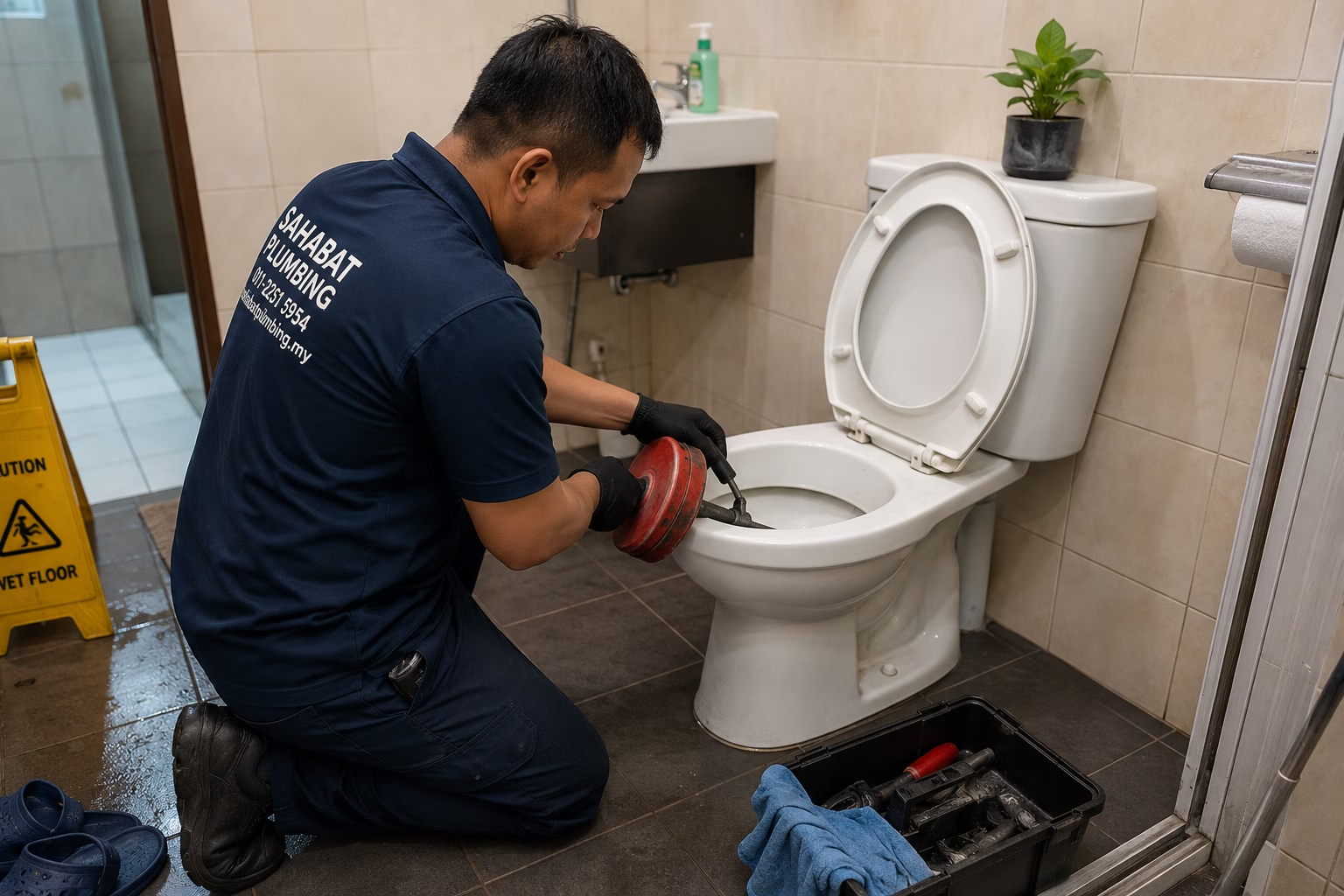
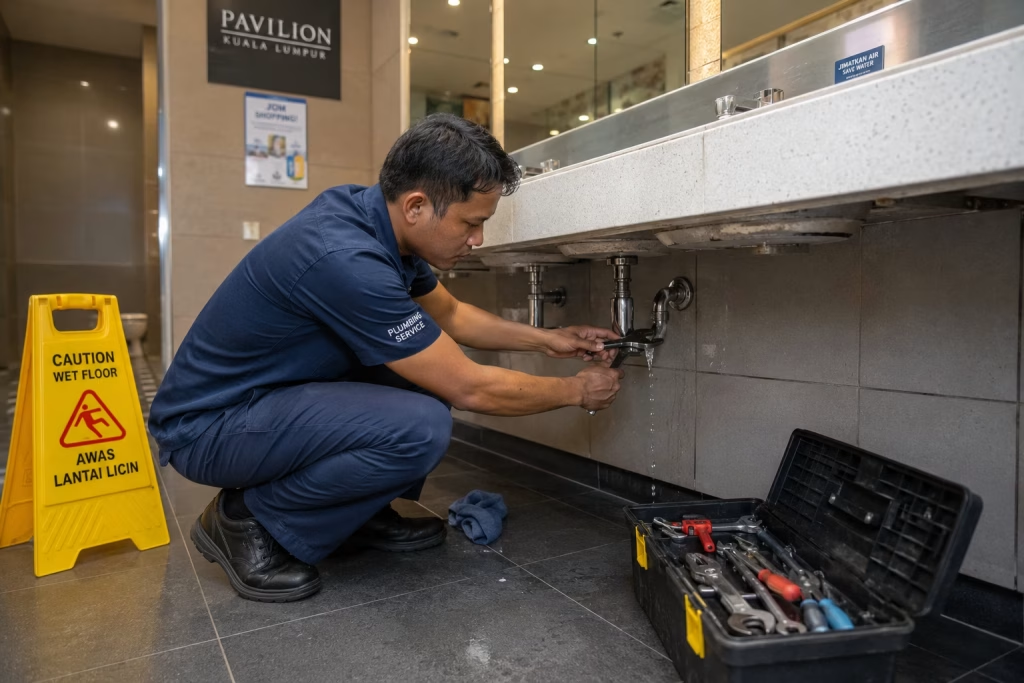
The 2026 plumbing buyer is on mobile, in panic and impatient. They scroll past the hero photo, look for the price, look for the SPAN line, and tap WhatsApp. Anything else, long About-Us paragraphs, multi-stage contact forms, slow image carousels, costs you the booking. The right plumbing website is a credentials-and-WhatsApp page with light content support.
This guide is the website-architecture companion to our Digital Marketing Pillar for Plumbing Services. Across 20 sections we cover information architecture, page templates, trust elements, performance budgets, conversion design, four ZenWeb datasets and a 60-day build plan.
Source video: Plumber Marketing Strategy 2026 on YouTube.
Quick Answer: Three failures: generic homepages instead of service-specific pages, hidden pricing, and slow mobile speed. Each one cuts conversion by 50% or more.
A typical Malaysian plumber site is a five-page WordPress build with a homepage that says “we fix everything”, a contact page, an About page and three service pages with 100 words each. That structure converts at 1–2%. The same traffic on a service-specific page with call-out fee, response time and a WhatsApp button converts at 9–14%. The site is the conversion multiplier, not the ad.
Quick Answer: Six service pages, three to six zone pages, an About page with the SPAN registration certificate, a Reviews page, a Pricing page, an Articles hub and a Contact page. Total 14–18 pages for a single-zone operator.
Six service pages mirror the search demand: burst pipe repair, blocked drain, water heater installation, toilet repair, renovation pipework, commercial maintenance. Three to six zone pages cover real geographic service areas. The About page exists to display SSM number, SPAN registration, CIDB grade and public liability insurance certificate. Pricing page lists call-out fee and price bands. Articles hub holds five to ten educational pieces.
Quick Answer: Hero with H1, response time and WhatsApp button. Then call-out fee block, real-job photos, three customer reviews, FAQ, secondary WhatsApp button. Total page length 800–1,200 words.
Above the fold: H1 stating service and city, sub-headline stating response time, primary WhatsApp button, secondary phone-call button. First scroll: transparent call-out fee with example price band. Second scroll: three real on-site photos with brief captions. Third scroll: three customer reviews pulled from GBP. Fourth scroll: five-question FAQ. Fifth scroll: secondary WhatsApp button and PDPA notice. The service page is essentially a long ad with proof.
Quick Answer: Display SSM number, SPAN registration, CIDB grade (if applicable), public liability insurance certificate, real on-job photos, real Google reviews and PAM membership. Each one lifts conversion 5–15%.
Plumbing buyers are sceptical for good reason. The industry has too many fly-by-night operators. The site fights that scepticism with stacked credentials. Display the SSM number in the footer and the About page. Show a redacted SPAN registration certificate. Display the CIDB grade if you handle construction-linked work. Show a redacted public liability insurance certificate. Embed three to five recent Google reviews. Mention PAM membership where applicable.
Quick Answer: A sticky WhatsApp button in the bottom-right of every page lifts conversion 25–40%. Use a wa.me link with a pre-filled greeting and UTM tags so you can track which page drove the click.
Most plumbing buyers prefer WhatsApp over phone calls because they want to send a photo of the problem. The wa.me link with pre-filled greeting (“Hi, I have a [problem] in [area]”) removes the friction of typing. UTM tags on the wa.me URL let you track which service page or zone page drove the click: essential for optimisation.
Quick Answer: LCP under 2.5 seconds, CLS under 0.1, INP under 200 ms. Plumbing buyers are on mobile and panicked. Every second of load time costs 7–10% of conversion.
Most plumber sites fail mobile speed on three counts: uncompressed hero images, render-blocking sliders and missing lazy-loading. Compress photos to WebP at 60–75% quality. Drop sliders for a single hero image with one CTA. Lazy-load below-the-fold images. Use a Malaysian-edge CDN for national traffic. ZenWeb’s audit on 32 Malaysian plumber sites in 2025 found 78% failing Core Web Vitals on mobile. Fixing this alone lifted conversion 18–34%.
Quick Answer: Real on-site photos beat stock imagery 2–3x on conversion. Take 30 real-job photos in week one: burst-pipe repair, water heater installation, blocked-drain reveal, uniform-team on site, van photos.
Stock plumber-with-wrench photos signal low trust. Real on-site work photos signal real plumbers doing real jobs. The photo budget is RM 1,500–3,500 for a one-day shoot covering uniform team, van, three service-type jobs and customer interaction. The same photos feed Meta Ads, GBP and the website. Avoid identifiable house numbers, family members and unrelated branding in frame.
Quick Answer: Display call-out fee and typical repair band on every service page. “RM 80 call-out, RM 150–350 typical repair” beats “Contact for quote” on conversion every time.
Plumbers fear price transparency because they fear being undercut. The data says the opposite: buyers self-qualify on price and the operators that show prices win the higher-ticket jobs from buyers who self-select out of low-budget shopping. Show the call-out fee, the typical repair band, the after-hours surcharge if applicable, and a clear note that complex jobs are quoted on site after inspection.
Quick Answer: Every page carries LocalBusiness, Service and FAQPage schema. The site root carries Organization. Service pages carry priceRange. AI Overviews and ChatGPT Citations require speakable cssSelector on TL;DR and Quick Answer blocks.
Schema is invisible plumbing for the website. LocalBusiness schema with SSM number, address, opening hours and geo coordinate feeds GBP and AI Overviews. Service schema with priceRange feeds rich results. FAQPage schema feeds AI Overview FAQ pulls. The Speakable specification on TL;DR and Quick Answer blocks signals which sentences AI assistants should read aloud or quote.
Quick Answer: Track WhatsApp clicks, phone-call clicks, form submissions and 60-second-plus call durations. Pipe these to GA4, Google Ads and Meta. Without tracking, you cannot bid or optimise.
The conversion stack: GA4 for site analytics; GTM for event firing; Google Ads for Search and PMax conversions; Meta Pixel + Conversions API for Meta. Fire conversion events on click-to-WhatsApp, click-to-call (with duration filter), form submission and 90-second-plus page time. Every paid channel needs at least 30 conversions per 30 days to optimise. Small operators must consolidate ad spend rather than spread thinly.
Quick Answer: WhatsApp leads convert at 58–64% with a 15-minute reply. Form leads convert at 22–35% in the same window. Lead with WhatsApp; keep the form as a fallback.
Forms feel safer to operators (structured data, no surprises) but lose to WhatsApp on every conversion metric. Buyers prefer WhatsApp because they can send a photo of the leak in the same message thread. Keep a 3-field form (name, area, problem description) on the site for buyers who prefer it, but make the primary CTA a sticky WhatsApp button. Forms work better for commercial maintenance enquiries where buyers expect a structured response.
Quick Answer: Build parallel BM versions of the four highest-volume service pages. Use hreflang tags so Google serves the right language. Roughly 25–35% of plumbing search is BM (tukang paip, paip pecah, service paip).
Full-site translation is overkill. Most plumbing buyers shift to English for the technical detail. The minimum bilingual stack is parallel BM versions of burst pipe, blocked drain, water heater and general repair pages, with hreflang annotations linking each pair. Avoid Google Translate auto-rendering. Malaysian English idiom (call-out fee, dispatch, SPAN registration) translates poorly. Hire a native BM writer for 1,500 words across the four pages, RM 800–1,500 one-off.
Quick Answer: Six site elements drive conversion lift: service-specific page (300%), call-out fee block (45%), sticky WhatsApp (35%), real photos (25%), credentials block (18%) and FAQ schema (8%).
| Site Element | Avg Conv. Lift | Implementation Cost |
|---|---|---|
| Service-specific page (vs homepage) | +300% | High |
| Transparent call-out fee block | +45% | Low |
| Sticky WhatsApp button (mobile) | +35% | Low |
| Real on-site photos (vs stock) | +25% | Medium |
| Credentials block (SPAN, SSM, insurance) | +18% | Low |
| FAQ + Speakable schema | +8% | Low |
Source: ZenWeb redesign tracking, 32 Malaysian plumbing accounts, 2024–2026. Lift measured against pre-redesign baseline.
Quick Answer: Sites loading under 2 seconds bounce at 28%; sites at 4–5 seconds bounce at 58%. Every additional second past 2 s adds roughly 8–10 percentage points of bounce on plumbing service pages.
| Mobile Load Time | Bounce Rate |
|---|---|
| Under 2.0 s | 28% |
| 2.0–2.5 s | 36% |
| 2.5–3.5 s | 45% |
| 3.5–5.0 s | 58% |
| Over 5.0 s | 72% |
Source: ZenWeb client tracking, Malaysian plumbing service pages, 2024–2026, n = 32 sites.
Quick Answer: RM 4,500 site delivers 4–6% conversion. RM 9,000 site delivers 7–10%. RM 18,000+ site delivers 10–14% with full schema, real photography, fast load and a structured WhatsApp triage.
| Site Investment (RM) | Conversion Rate |
|---|---|
| Under RM 2,500 (DIY / Wix) | 1–2% |
| RM 4,500 (entry build) | 4–6% |
| RM 9,000 (mid-tier) | 7–10% |
| RM 18,000+ (premium) | 10–14% |
Source: ZenWeb client tracking, Malaysian plumbing site investments, 2024–2026.
Quick Answer: Median Malaysian plumbing site mobile LCP improved from 4.2s in 2022 to 2.9s in 2026. The 2027 expectation is 2.4s as more sites adopt edge-CDN and image optimisation.
| Year | Median LCP (s) | % Sites Passing <2.5s |
|---|---|---|
| 2022 | 4.2 s | 12% |
| 2023 | 3.7 s | 18% |
| 2024 | 3.3 s | 22% |
| 2025 | 3.1 s | 28% |
| 2026 YTD | 2.9 s | 35% |
| 2027 (projection) | 2.4 s | 52% |
Source: ZenWeb client tracking + Chrome UX Report sample, Malaysian plumbing service pages, 2022–2026. 2027 projection = trailing 3-year improvement model.
Quick Answer: Five recurring mistakes: single services page, slow mobile load, hidden pricing, stock photos, missing schema. Each cuts conversion by 30%+.
Quick Answer: 12% of plumbing searches in Malaysia now happen via Google Assistant or Siri. Sites with Speakable schema and a 40-word direct answer per service page win the spoken-result citation.
The voice-search pattern in plumbing is “Hey Google, find me a plumber for a burst pipe in Petaling Jaya.” Google reads aloud the result it ranks first. Sites that win have three traits: a Speakable specification on the TL;DR and Quick Answer, a clean 40-word direct answer at the top of every service page, and LocalBusiness schema with phone number formatted as a tel-clickable link. The same hooks make ChatGPT and Gemini citations far more likely.
Quick Answer: Days 1–14 photography, copy and architecture. Days 15–30 build core pages. Days 31–45 schema, performance, tracking. Days 46–60 launch, monitor, optimise.
Entry-tier RM 4,500–7,500 for a single-zone single-van operator covering five service pages and one zone. Mid-tier RM 9,000–18,000 for a multi-van multi-zone operator with 15–20 pages. Enterprise RM 25,000+ for a multi-state operator with custom CMS and CRM integration.
WordPress with a lightweight theme (GeneratePress, Astra) is the right default for 90% of plumbing operators in Malaysia: flexible, SEO-friendly, content-editable. Custom builds suit multi-state operators with bespoke booking systems. Shopify is the wrong choice for plumbing.
No. A single site with separate residential and commercial sections works better. Both audiences look at the same trust signals (SPAN, SSM, insurance) and the same authority cues. A separate commercial sub-site dilutes SEO authority.
Important for the Klang Valley and JB. Roughly 25–35% of plumbing search is BM (tukang paip, paip pecah, service paip). The cleanest implementation is parallel BM pages for the four highest-volume services rather than a full site translation.
Every three to four years for a major redesign. Continuous improvement (new service pages, new zone pages, refreshed photos, schema updates) every quarter. Sites that go untouched for 5+ years lose 40–60% of organic ranking.
Ready to turn your plumbing site into a booking machine?
Book a free 30-minute website audit. We’ll review your current site, mobile speed, conversion tracking and competitor benchmarks, then give you a 90-day rebuild plan. See ZenWeb Web Design and Web Design pricing.
Complete the form and our team will contact you to discuss your goals. Let’s grow your business.



Meowketing Specialist
Online


























