

Share this post:
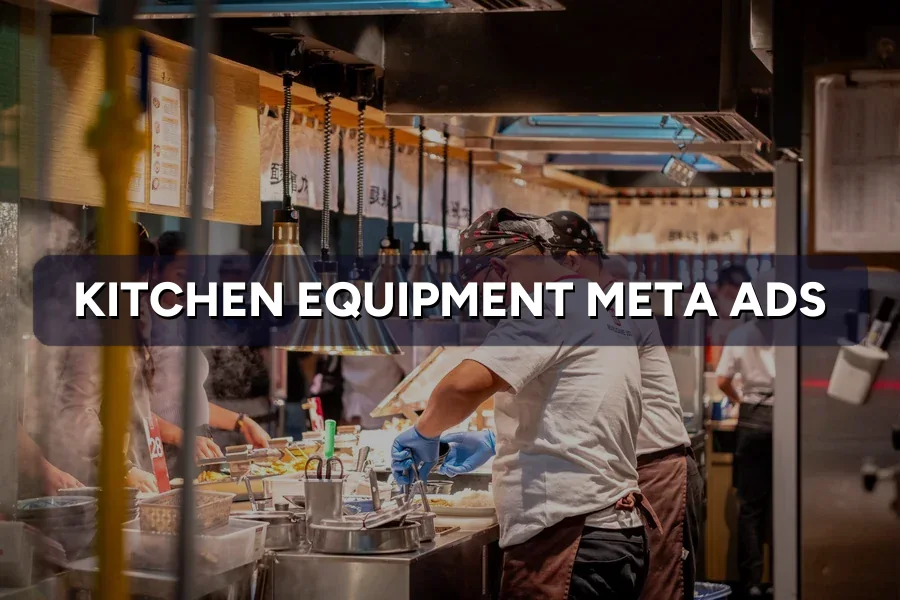
Nobody wakes up and impulse-buys a combi oven. That single fact is why so many kitchen equipment suppliers try Facebook for two months, collect forty leads that go nowhere, and conclude the platform does not work for their trade.
It does work. It just does a different job from search. This guide is for stainless steel fabricators, cold room specialists and equipment distributors selling to restaurants, cafes, hotels, central kitchens and factories across Malaysia. It covers audience building, creative, where to send the click, the remarketing ladder, and four data sets on audiences, creative formats, click destinations and budget tiers.
ZenWeb runs Meta Ads for kitchen suppliers and other Malaysian B2B equipment businesses across 500+ accounts. The pattern below repeats in almost every one of them.
Not sure whether Meta deserves any of your budget?
We size the reachable F&B audience in your delivery radius before we recommend a ringgit. Compare our Meta Ads plans →
Before the account structure, a walkthrough of how a Meta lead campaign is actually built.
Source video: Daniel Dimsey on YouTube
Quick Answer: Search reaches the operator who already has a budget. Meta reaches the same operator three months earlier, while the shoplot is still empty and the equipment list is still a WhatsApp voice note. That earlier window is what the wider channel mix is built around.
The audience is genuinely there. Facebook had 23.0 million users in Malaysia in late 2025, reaching 86.4% of adults aged 18 and above, while Instagram had 16.1 million, according to DataReportal’s Digital 2026 Malaysia report. Malaysian F&B services employed 1,079,843 people in 2022, per the Department of Statistics Malaysia Economic Census 2023. Practically every one of those owners and managers is on Facebook.
What they are not doing is searching. So the job on Meta is different:
Quick Answer: Not “restaurant owners”. Four separate people buy kitchen equipment, and only one of them signs. Sharpening who the targeting speaks to matters more here than any bidding setting.
The four buyers, and what each one reacts to:
Meta’s interest targeting cannot see any of this cleanly. What it can see is behaviour, which is why your own customer list, your website visitors and your video viewers outperform every interest stack in the platform.
Quick Answer: Three campaigns, not thirty. One cold campaign to find new F&B operators, one warm campaign for people who already engaged, and one campaign aimed only at past customers. That is the whole funnel a supplier needs below RM 10,000 a month.
| Campaign | Audience | Job it does |
|---|---|---|
| Cold reach | Lookalike of past buyers, broad in-state | Equipment demo video, no ask |
| Warm conversion | Video viewers, page engagers, site visitors | Quotation or WhatsApp ask |
| Customer base | Uploaded service and invoice list | Parts, servicing, upgrade offers |
Suppliers who split by SKU end up with fifteen ad sets, none of which gathers enough conversions to leave the learning phase. Three campaigns, refreshed creative, one budget decision a month.
Quick Answer: Equipment running in a real Malaysian kitchen, filmed on a phone, twenty to thirty seconds. That is the one asset a marketplace listing can never copy, and it consistently beats polished studio creative in this trade.
Five clips worth filming on your next installation day:
Add burned-in captions. Kitchens are loud and most of your audience is scrolling with the sound off between service periods.
Quick Answer: WhatsApp for anything a buyer wants priced today, an instant form for early-stage planners, and a showroom booking for capital equipment. Click-to-WhatsApp ads suit this trade because equipment questions are conversations, not form fields.
The trade-off is simple and worth stating plainly. Instant forms are cheap and shallow. WhatsApp costs more per lead and produces a person who answers. Showroom bookings cost the most and close the best, because nobody drives to Puchong on a Tuesday out of curiosity.
Whichever you pick, keep the questions short. Equipment type, opening date, contact number. Everything else belongs in the first reply, and a short qualifying question filters far more junk than a long form does.
Leads coming in but nobody picking up the phone?
We rebuild the route from ad to WhatsApp so the first reply lands in minutes. See how our Meta Ads management works →
Quick Answer: New outlets announce themselves on social media long before they order equipment. Building an audience around that announcement window is the highest-value B2B play available to a Malaysian kitchen supplier.
Openings cluster geographically. Selangor held 24,625 F&B establishments in 2022, followed by Johor with 15,727 and Kuala Lumpur with 13,849, per the same DOSM census. New mall wings, new industrial parks and new township shoplots all produce a wave of fit-outs within six months of handover.
Three practical moves:
Quick Answer: A kitchen buys big once, then buys parts and small wares for years. Remarketing in this trade is less about chasing this month’s lead and more about owning the next replacement decision.
A four-rung ladder works well:
Cap frequency on the top two rungs. In a market this small, the same fifty operators seeing your ad nine times a week generates complaints, and rising frequency is the earliest warning that spend is being wasted.
Quick Answer: Send order outcomes back to Meta. Form fills on their own teach the system nothing useful, so it learns to find whoever taps fastest. A working Pixel and Conversions API setup is the groundwork.
The loop takes an afternoon:
Site survey is the metric to build around. It is far enough down the funnel to mean something, and frequent enough to give the algorithm data, which is exactly why it beats optimising on signed orders alone.
Quick Answer: Your own data wins by a distance. Past customers and site visitors produce quotations at a third of the cost of interest targeting, and reach a site survey three times more often. That is why broad automated audiences should never carry the whole budget.
| Audience type | Relative cost | Cost per quotation | Reaches site survey |
|---|---|---|---|
| Past customers and service list | RM 38 | 41% | |
| Category page visitors, 90 days | RM 57 | 33% | |
| Equipment video viewers, 50%+ | RM 84 | 24% | |
| Lookalike 1% of past buyers | RM 106 | 19% | |
| F&B business owner interest stack | RM 148 | 12% | |
| Broad automated audience | RM 191 | 8% |
Source: ZenWeb client tracking, Malaysian kitchen equipment accounts, 2024–2026.
Broad targeting is not useless. It is the only rung that finds operators you have never touched, so it earns a slice of budget as an audience-building spend, not as a lead source.
Quick Answer: Phone-shot video of equipment running produces quotations at roughly a third of the cost of a manufacturer render. Nothing else in creative testing moves the number this far.
| Creative format | Cost per quotation | 3-second view rate |
|---|---|---|
| Equipment running, 20–30s vertical video | RM 71 | 38% |
| Before-and-after fit-out reel | RM 88 | 34% |
| Owner-to-owner talking head | RM 96 | 29% |
| Carousel of categories with RM bands | RM 112 | 18% |
| Static spec card with model and price | RM 129 | 14% |
| Manufacturer render or catalogue image | RM 224 | 6% |
Source: ZenWeb-managed campaigns, Malaysian B2B equipment supply accounts, 2024–2026.
The render row is the one to act on. It is the format most suppliers default to because the manufacturer supplies it free, and it is the most expensive creative in the account.
Quick Answer: The cheapest destination converts worst. A manual-follow-up instant form produces the lowest cost per quotation and the lowest order rate, because the reply arrives hours after the buyer moved on.
| Destination | Cost per quotation | Median first reply | Quotation to order |
|---|---|---|---|
| Instant form, manual follow-up | RM 44 | 5 h 40 min | 11% |
| Instant form with auto WhatsApp reply | RM 49 | 26 min | 24% |
| Messenger conversation | RM 58 | 38 min | 17% |
| Click-to-WhatsApp | RM 63 | 11 min | 31% |
| Website category page with short form | RM 97 | 1 h 20 min | 27% |
| Showroom visit booking | RM 138 | 45 min | 44% |
Source: ZenWeb client tracking, Malaysia, 2024–2026.
Read the first two rows together. Five ringgit more per quotation, one automated WhatsApp message, and the order rate more than doubles. That is the cheapest fix in this entire guide.
Quick Answer: RM 1,500 a month buys presence in one district. RM 6,000 buys a working pipeline across a state. Cost per order falls as budget rises, which is the opposite of what most owners expect from Malaysian lead cost benchmarks.
| Monthly budget | People reached | Quotations | Site surveys | Cost per order |
|---|---|---|---|---|
| RM 1,500 | 42,000 | 12 | 4 | RM 1,364 |
| RM 3,000 | 96,000 | 27 | 10 | RM 1,071 |
| RM 6,000 | 210,000 | 58 | 22 | RM 938 |
| RM 12,000 | 445,000 | 119 | 47 | RM 863 |
Source: ZenWeb-managed campaigns, Malaysian kitchen equipment suppliers, 2024–2026.
Below RM 1,500 the remarketing rung starves, and remarketing is where the orders come from. That, rather than reach, is the real floor for this trade.
Want to know which tier fits your delivery radius?
We model quotation and site-survey volume against your real order values first. View Meta Ads pricing and scope →
Quick Answer: A fifteen-second video makes claims very easy to overstate. Say what you hold, name who holds it, and let the detail live on the page the ad points to.
Three claims Malaysian kitchen buyers care about, and how to handle each:
Kitchen equipment is a small trade with long memories. One overstated claim in a video ad travels faster than any campaign you could buy.
Quick Answer: Search first if you need orders this quarter, because Google Ads meets buyers who already have a budget. Add Meta once search is stable, then let the two channels feed each other.
The honest split for most Malaysian suppliers:
The two channels are not rivals here. Meta video viewers search your brand name weeks later, and the comparison between the two platforms only makes sense once you can see that overlap in the numbers.
Quick Answer: Boosting catalogue posts, ignoring the customer list, replying the next morning, and judging month one on order count. All four are avoidable mistakes that cost more than any bidding error.
The reply-speed problem is the cheapest to fix and the most expensive to leave alone. Our guide to bringing Meta lead costs down covers the follow-up setup a small sales team can actually run.
Quick Answer: Film the equipment working, build audiences from your own data, route the click to WhatsApp, and optimise on site surveys. Those four moves carry most of the result in a well-run supplier account.
Meta Ads for kitchen suppliers is not a lead-generation machine you switch on. It is a way of being the supplier an F&B operator already recognises on the day the fit-out budget appears.
Start with remarketing and the customer list, prove the loop works, then add cold reach around new openings. In that order the channel behaves like a pipeline rather than a gamble.
Quick Answer: Suppliers ask most about budgets, lead quality, how long results take, and whether Facebook can sell capital equipment at all. Scope and plan detail sit on our Meta Ads pricing page.
RM 1,500 a month is the practical floor, covering one district with remarketing plus a small cold audience. Expect around 12 quotations and 4 site surveys at that level. Suppliers covering a whole state usually need RM 6,000 to RM 12,000.
Yes, but only when the reply is fast. Instant-form leads followed up manually convert to orders at about 11%, while click-to-WhatsApp enquiries answered within roughly eleven minutes convert at 31%. The lead source matters far less than the response time.
Quotations usually start in the first fortnight. Signed orders lag by one to three months because fit-out decisions move slowly. Judge the account on site surveys in month one and on orders from month three onward.
Run both, but expect Facebook to carry the enquiries. Instagram works well for fit-out reels and reaches younger cafe operators, while Facebook reaches the multi-outlet owners and procurement staff who sign the purchase order.
Ready to turn Facebook attention into signed kitchen orders?
Book a free 30-minute strategy session. We review your audiences, creative and follow-up speed, then give you a 90-day plan with realistic cost per order targets.
Complete the form and our team will contact you to discuss your goals. Let’s grow your business.



Meowketing Specialist
Online


























