

Share this post:
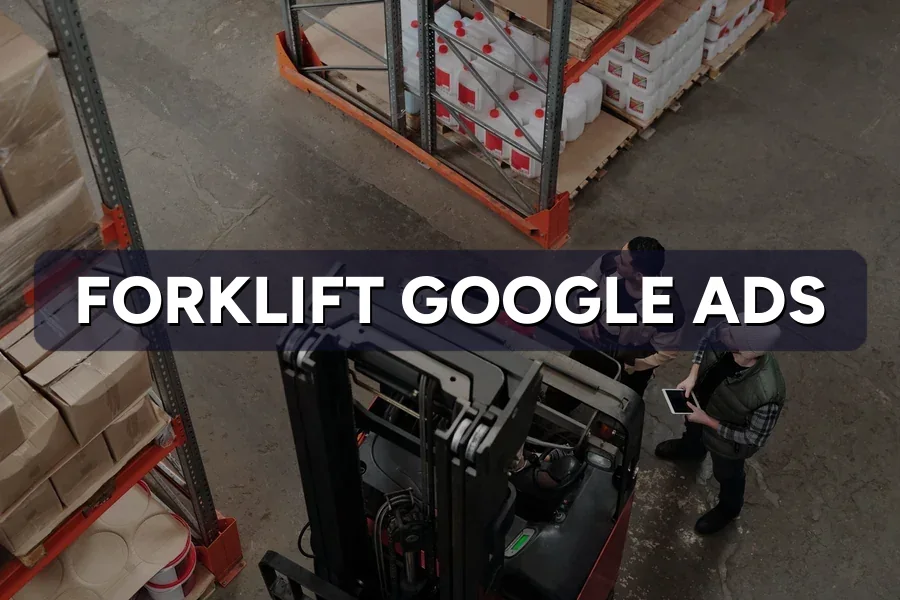
A forklift dies at 9.40am in a Shah Alam warehouse with two containers waiting at the loading bay. The supervisor does not open a catalogue. He searches, calls the first supplier who picks up, and the whole decision is over in eleven minutes.
That is the moment paid search exists for. This guide covers Google Ads for forklift suppliers, rental yards and material handling dealers across Malaysia. It works through account structure, the searches worth paying for, the negative list that protects the budget, and what the landing page must show. Four data sets follow on click costs, cost per hire, seasonality and budget tiers.
ZenWeb runs Google Ads for forklift suppliers and other Malaysian industrial equipment businesses. The account patterns below repeat across almost all of them.
Not sure how much of your forklift budget reaches real buyers?
We read the search terms report against rental intent before touching a single bid. Compare our Google Ads plans →
Before the account structure, a quick look at how paid search works in practice.
Source video: How To Get B2B Leads With Google Ads on YouTube
Quick Answer: A breakdown search wants a machine today, a rental search wants rates by Friday, and a purchase search may take four months. One campaign cannot serve all three, which is why channel planning for forklift suppliers starts with the clock, not the keyword.
Most forklift accounts are built as if every searcher is at the same stage. They are not. Three clocks run at once, and each one needs different bids, different ad copy and a different landing page.
Spend hardest where the clock is shortest. A supplier who answers the breakdown search well will fund the slower purchase pipeline from the rental margin.
Quick Answer: They add a tonnage, a town or the word sewa. “Forklift” alone is browsing. “Sewa forklift 3 ton Klang” and “forklift rental urgent” are buying, and those are the searches worth owning on both paid and organic.
Ready buyers give themselves away with three details: capacity, power type and place. A search with all three is worth several times one without.
Malay-language terms matter here. Warehouse supervisors and store men often search “sewa forklift” while purchasing officers search in English. Both belong in the account, in separate ad groups so the ad text can match the language.
Quick Answer: Separate rental from sale first, then split rental by urgency and by industrial belt. Mixing a supervisor renting a 2.5 tonne unit for a fortnight with a factory buying a fleet wastes both budgets, and match types cannot repair that afterwards.
| Campaign | Match types | Sends traffic to |
|---|---|---|
| Breakdown and urgent hire | Exact and phrase | Standby unit page with a phone number |
| Rental by capacity | Phrase | Rate card page for that tonnage |
| Rental by town or belt | Phrase, tight radius | Location page with delivery times |
| Parts, tyres and battery | Phrase and exact | Parts enquiry page |
| New and reconditioned sales | Exact | Model page with specifications |
Keep the sales campaign on a small, capped budget until the rental side is producing steadily. Sales searches cost less per click and far more per closed deal.
Quick Answer: Forklift keywords sit beside a huge training and jobs market, so an unfiltered account funds course enquiries and job seekers. A disciplined negative keyword list usually saves a quarter of the spend in month one.
No other trade we manage has this much irrelevant volume sitting on top of its commercial terms. Block these groups before you switch anything on:
Then read the search terms report weekly for the first two months. Forklift queries drift fast, and the report always finds something the pre-built list missed.
Quick Answer: Capacity, availability and delivery time, in that order. “3 Ton Diesel, Delivered Same Day, Klang Valley” beats any slogan, because relevance to the exact search is also what lifts Quality Score and lowers the click cost.
Most forklift ads read like a company profile. The buyer does not want a profile at 9.40am. Four elements do the work:
Add call assets and set them to your actual answering hours. A missed call on a breakdown search is a lost hire, not a follow-up.
Ads running but the phone stays quiet?
We rewrite forklift ad copy around tonnage, availability and delivery radius. See how our Google Ads team works →
Quick Answer: Never the homepage. Each campaign needs a page showing the tonnage searched, a day and month rate, delivery charge and what happens if the unit fails — the landing page fixes that lift forklift conversion fastest.
Three failures repeat on almost every forklift website, and all three are cheap to correct:
Put a WhatsApp button beside the form and a phone number in the header. A buyer with a stopped loading bay will call before he types, so the enquiry form should be the second option, not the only one.
Quick Answer: Bid up during shift-change hours and only advertise emergency terms when someone will answer. Paying for a breakdown click at 8pm with a voicemail box waiting is the fastest way to get clicks with no sales.
Warehouse demand is not spread evenly through the day. Enquiries cluster around three points: the morning shift start, the lunchtime handover, and the last hour before a container cut-off. Raise bids 20 to 30 percent across those windows on the urgent campaigns.
Evenings are a judgement call. If your yard runs a genuine after-hours standby line, keep those campaigns live — competition thins and cost per call drops. If nobody answers after 6pm, schedule them off and let the rate card page carry the overnight traffic.
Quick Answer: Not first. Performance Max needs conversion volume to learn, and a yard producing twenty enquiries a month cannot feed it. Add it once Search is stable, the way most Malaysian SMEs should approach PMax.
The failure pattern is consistent. Left unrestricted, PMax finds the cheapest conversions available — which in this industry means training enquiries and job seekers filling in the contact form. Cost per lead looks excellent while the yard books nothing.
If you do run it, gate it hard. Exclude brand terms and the training and jobs audience signals. Set the conversion action to a qualified hire enquiry rather than any form submission, and cap spend near a quarter of the account while smart bidding learns what a real customer looks like.
Quick Answer: Track the signed hire and the contract length, not the form submission. Forklift deals close by phone and on paper, so offline conversion import is what teaches Google which clicks were worth buying.
A one-week hire and a two-year fleet contract arrive through the same form. Optimising on form fills tells the algorithm they are identical, which is precisely wrong.
Four things to fix before scaling spend:
Quick Answer: Urgent hire terms cost about RM 8.40 a click and convert at 9.1 percent. Generic “forklift Malaysia” costs RM 2.40 and converts at 0.7 percent, so the cheap keyword is the expensive one — a pattern repeated across most Malaysian industries.
| Keyword group | Average CPC | Click to enquiry | Enquiry to hire or order |
|---|---|---|---|
| Urgent hire and breakdown | RM 8.40 | 9.1% | 46% |
| Capacity plus town rental | RM 6.90 | 6.7% | 39% |
| Parts, tyres and battery | RM 3.10 | 5.9% | 31% |
| Generic rental terms | RM 5.20 | 3.4% | 25% |
| New and reconditioned purchase | RM 4.60 | 2.6% | 12% |
| Brand and model price terms | RM 3.80 | 2.1% | 9% |
| Generic forklift Malaysia | RM 2.40 | 0.7% | 6% |
Source: ZenWeb client tracking, Malaysian forklift and material handling accounts, 2024–2026.
Quick Answer: Remarketing produces the cheapest enquiries at RM 41, and urgency-matched Search produces the cheapest signed hires at RM 262. Unrestricted Performance Max costs roughly 4.3 times more per hire, which is why campaign mix matters more than bid tweaks.
| Campaign type | Relative cost per hire | Cost per enquiry | Cost per signed hire |
|---|---|---|---|
| Performance Max, unrestricted | RM 198 | RM 1,120 | |
| Search, purchase and price terms | RM 121 | RM 690 | |
| Search, capacity and town rental | RM 78 | RM 340 | |
| Search, urgent hire and breakdown | RM 64 | RM 262 | |
| Remarketing | RM 41 | RM 214 |
Source: ZenWeb client tracking, Malaysian forklift accounts, 2024–2026. Bars show relative cost per signed hire.
Remarketing looks unbeatable until you remember it creates no demand. It only harvests visitors that Search and organic already paid to attract, so treat it as a multiplier rather than a channel of its own.
Paying Performance Max prices for rental enquiries?
We rebuild forklift accounts around urgency and tonnage before adding automation. Compare cost per lead by channel →
Quick Answer: Demand peaks from September to November as warehouses stock for year-end shipping, then collapses over the December and Chinese New Year shutdowns. Clicks get cheaper in that quiet window but enquiries get dearer, which is the opposite of what most monthly budget plans assume.
| Period | Demand index | Average CPC | Cost per enquiry |
|---|---|---|---|
| September to November | 100 | RM 7.60 | RM 74 |
| June to August | 84 | RM 6.50 | RM 68 |
| March to May | 79 | RM 6.10 | RM 66 |
| December to February | 58 | RM 5.20 | RM 91 |
Source: ZenWeb client tracking, Malaysian forklift accounts, 2024–2026. Index set to the September to November peak.
The December to February column is the one worth studying. Clicks are a third cheaper, yet each enquiry costs more because plants are closed and half the traffic is browsing. Trim the budget in that window rather than cutting it, then load spend from late August so the account is already learning when the peak arrives.
Quick Answer: RM 1,500 a month covers one industrial belt and produces roughly 14 enquiries and four signed hires. RM 9,000 reaches the Klang Valley, Johor and Penang belts for about 62 enquiries — with cost per hire rising as coverage widens, which is the trade-off behind our Google Ads plans.
| Monthly media budget | Enquiries | Signed hires | Cost per hire | Realistic coverage |
|---|---|---|---|---|
| RM 1,500 | 14 | 4 | RM 375 | One belt, e.g. Shah Alam to Klang |
| RM 3,000 | 26 | 7 | RM 429 | Klang Valley |
| RM 5,500 | 43 | 11 | RM 500 | Klang Valley plus Nilai and Seremban |
| RM 9,000 | 62 | 15 | RM 600 | Klang Valley, Johor and Penang belts |
Source: ZenWeb client tracking, Malaysian forklift accounts, 2024–2026. Media budget only, excluding management fee.
Quick Answer: Advertise trained operators, serviced machines and documented handover — not certificates the machine does not carry. Under Malaysian rules a forklift is material handling equipment, so the compliance story sits with people and maintenance, a point worth making on your compliance pages too.
The Department of Occupational Safety and Health requires a valid certificate of fitness for hoisting machines. Its guidelines for approval of hoisting machine design expressly exclude manual hoists and material handling equipment. Advertising a “DOSH certified forklift” therefore invites an awkward question from any safety officer who reads it.
What you can say, and what corporate buyers actually check:
Quick Answer: Target the industrial parks your lorry can reach and return from in a day, set location targeting to presence rather than interest, and exclude residential districts. The same logic that makes Maps ads work locally decides whether a hire is even profitable.
A plain radius around the yard is the wrong shape. Warehouses cluster in belts: Shah Alam and Klang, Nilai and Senawang, Pasir Gudang and Senai, Prai and Bukit Minyak. Bid on the belts, not the circle.
Two default settings cause most of the waste. Location targeting includes people merely showing interest in an area, which pulls in overseas equipment traders. And a broad radius spends heavily on housing estates where nobody hires a 3 tonne diesel unit.
Layer delivery cost into the bids too. A hire 90 kilometres away at the same rate is a worse job than one 15 minutes down the road, so it deserves a lower bid.
Quick Answer: Bidding broad, hiding rates, sending every click to the homepage, missing calls, and pausing after one slow month. Each is fixable within a month through a disciplined account review.
The audience is certainly online — Malaysia counted 36.1 million internet users in October 2025, per DataReportal. Whether your settings meet them at the right moment is the part you control, and it is the same discipline behind B2B marketing in Malaysia generally.
Quick Answer: Bid on urgency and tonnage, block the training and jobs traffic, publish rates by capacity, and feed signed hires back into the account. Those four moves carry most of the result in a well-run forklift account.
Google Ads for forklift suppliers rewards discipline rather than budget. The yards that win are not outbidding anyone; they simply refuse to pay for searches that never end with a machine on a lorry.
Start with the breakdown and capacity campaigns, get offline conversions flowing within two months, then let the account tell you which belt deserves the next ringgit. In that order, paid search behaves like a booking pipeline rather than a gamble.
Quick Answer: Forklift suppliers ask most about starting budgets, click costs, how quickly enquiries arrive, and whether ads beat SEO. Plan detail sits on our Google Ads pricing page.
RM 1,500 a month is a workable floor, covering one industrial belt rather than the whole country. That buys roughly 14 enquiries and about four signed hires. Yards serving the Klang Valley plus Johor or Penang usually need RM 5,500 to RM 9,000.
Between RM 2 and RM 9, depending on urgency. Breakdown and urgent hire terms sit at the top, generic browsing terms at the bottom. The dearer clicks usually deliver the lowest cost per signed hire, so judge them on contracts rather than click price.
Often within the first few days, because the demand is already there. Month one is mostly learning. Cost per enquiry settles by month two, once the training and jobs negatives are mature and tracking counts hires rather than form fills.
Run ads first if you need hires this quarter, since organic pages take four to eight months to rank. Ideally run both, then shift budget once organic cost per signed hire drops below paid, typically somewhere between month nine and twelve.
Ready to stop paying for clicks that never book a machine?
Book a free 30-minute strategy session. We review your search terms, rate card page and call tracking, then give you a 90-day plan with realistic cost per hire targets.
Complete the form and our team will contact you to discuss your goals. Let’s grow your business.



Meowketing Specialist
Online


























