Share this post:
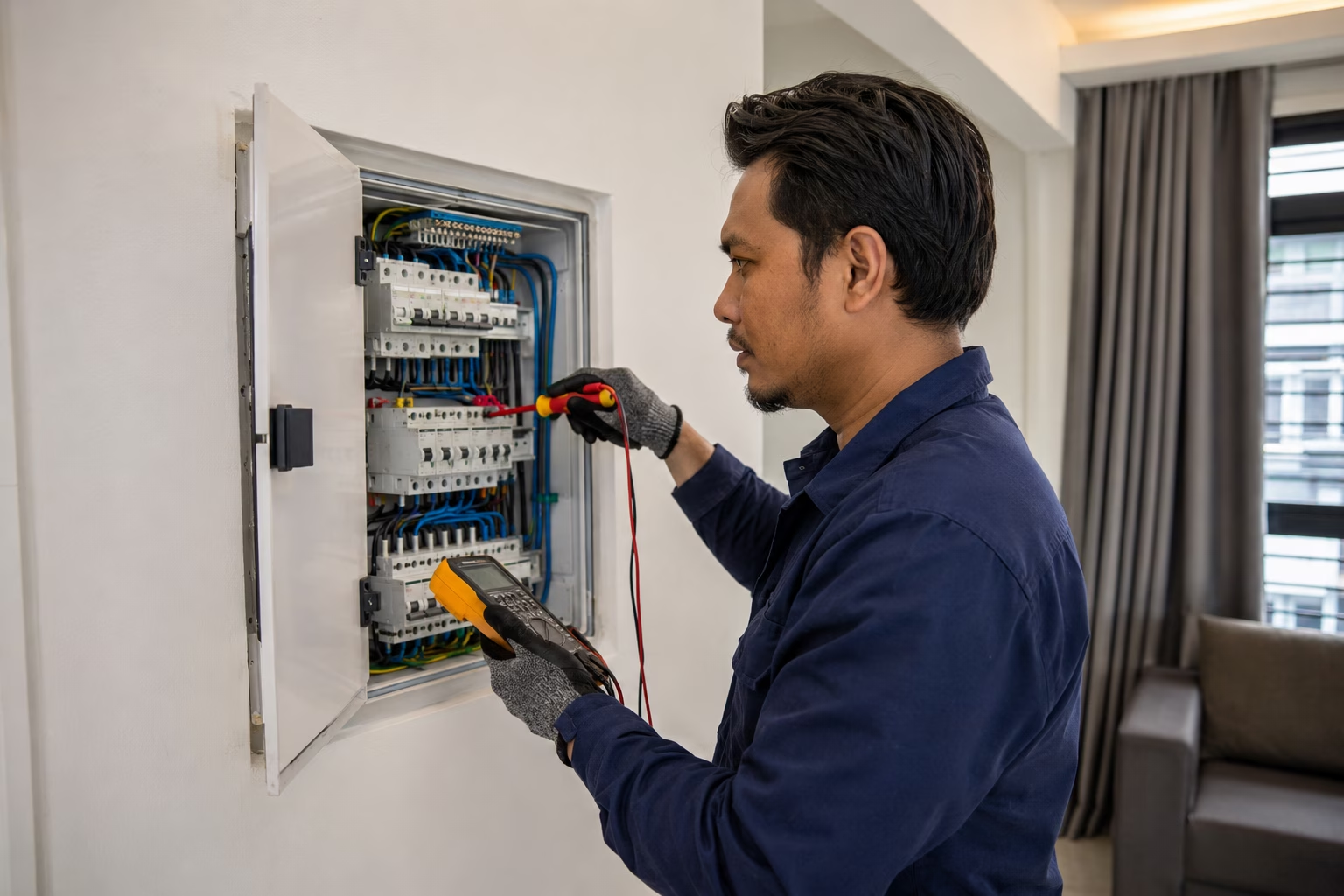
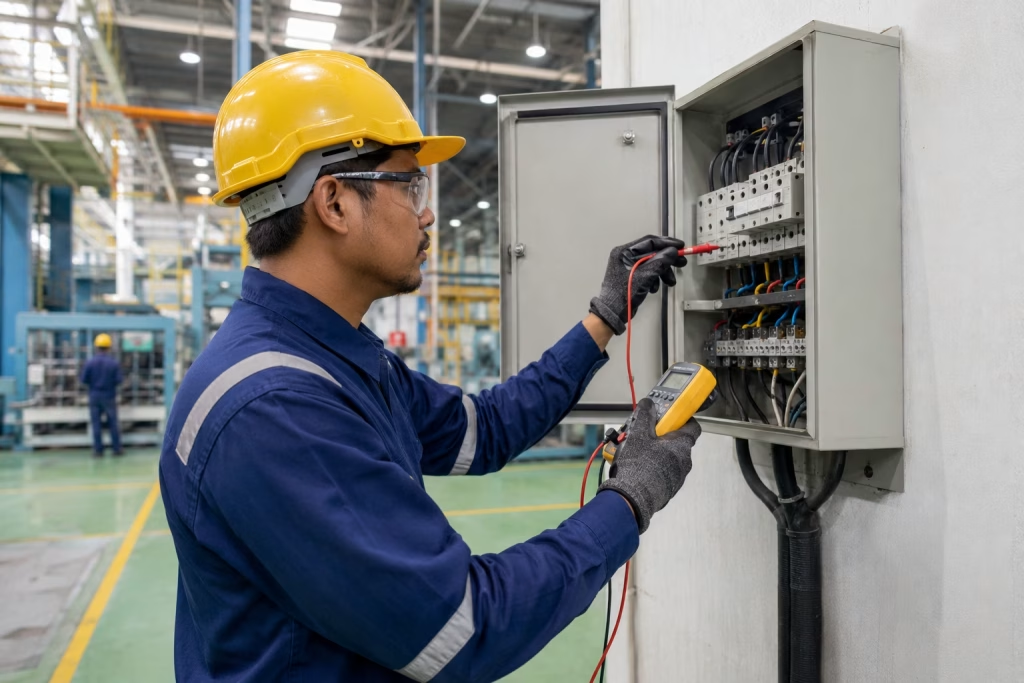
Electricians used to rank by accident — a homeowner typed “electrician Subang Jaya”, landed on a one-page Wix site, called the listed number. That floor is gone. In 2026 search results for “electrician near me” feature an AI Overview, three GBP map-pack pins, two Local Service Ads, two paid Search ads and only then organic listings. Operators that win the click do so because their service-page Quick Answer feeds the AI Overview and their GBP review cadence holds map rank.
This guide is the technical companion to our Digital Marketing Pillar for Electrician Services. We cover keyword tiers, on-page architecture, GBP optimisation, schema, content depth and 2026 GEO/AEO surface placement.
Source video: SEO for Electricians 2026 on YouTube.
Quick Answer: Google Ads CPL keeps climbing each year while SEO + GBP CPL holds roughly flat. Operators that built service-zone pages in 2023 now book at half the cost of operators relying only on paid search.
Electrical search behaviour rewards two assets — a Google Business Profile that owns the map pack and a website that ranks for service-specific queries. Both compound. By month 12 a well-built site books 50–65% of monthly enquiries from organic search at 1.5–2.4x lower CPL than paid. By year three the SEO base often outpaces paid in absolute volume too.
Quick Answer: Three keyword tiers — Tier 1 emergency intent (no power, MCB tripping), Tier 2 question-led (rewiring cost, EV charger installation), Tier 3 brand and review-driven. Build pages in that order.
Tier 1 emergency intent pulls 60–70% of conversion volume — “electrician near me”, “no power Selangor”, “MCB tripping KL”, “juruelektrik Subang Jaya”. CPC is RM 7–22, conversion 9–13% on a clean service page. Tier 2 question-led builds long-tail authority — “rewiring rumah cost Malaysia”, “EV charger installation cost”, “what causes MCB tripping”. CPC is RM 2–7, conversion lower but volume higher. Tier 3 brand and review search — “ABC Electrical review”, “best electrician KL 2026” — protects existing demand and earns repeat customers.
Quick Answer: Build one page per major service — rewiring, MCB/switchboard upgrade, lighting installation, ceiling fan, EV charger installation, commercial maintenance. Each page needs a Quick Answer, transparent fee, real photo and a WhatsApp button.
The single biggest SEO mistake electricians make is one “services” page covering everything. A page that tries to rank for nine services ranks for none. Service-specific pages give Google a clear topical signal and give the buyer a clear booking path. Each page should open with a Quick Answer summarising scope, response time and price band, then carry a service-specific FAQ block of five questions, real on-site photos with descriptive alt text, and an embedded WhatsApp form.
Quick Answer: One page per service zone — Petaling Jaya, Subang Jaya, Cheras, Mont Kiara, Klang, Penang, JB. Each lists drive-time response, real local jobs and a map embed. Avoid “20 cities, same template” pages — Google treats them as doorway content.
A multi-van operator should hold 6–12 service-zone pages, each genuinely localised. Localisation means real photographed jobs in that zone, named neighbourhoods (Bandar Utama, USJ, Taman Tun, Mont Kiara), accurate response time from the nearest van, and references to the local TNB substation context where relevant. Google’s helpful-content system penalises city pages that only swap the city name in a template.
Quick Answer: GBP carries 60–75% of “near me” map-pack traffic. Win it with a verified address, weekly photo posts, three-to-five reviews a month, complete service categories and prompt review responses.
GBP is not a directory — it is a ranking surface. The five inputs that move map-pack rank are physical address verification, primary category set to “Electrician”, weekly photo posts of real jobs, a steady review cadence with photo replies, and complete attributes (24-hour service, free quote, online appointment). Operators that post weekly outpace operators that post monthly by 30–45% on map-pack impressions in ZenWeb tracking. Avoid review gating — Google penalises both fake reviews and review-filtering apps.
Quick Answer: Title under 60 characters with primary keyword and city; meta under 155 characters with call-out fee; H1 matching the title; FAQPage, LocalBusiness and Service schema on every page.
Title formula: “[Service] in [City] — RM [fee] Call-Out, ST-Licensed | [Brand]”. Example: “Rewiring in Petaling Jaya — RM 80 Call-Out, ST-Licensed | ABC Electrical”. Meta formula: clear scope, price band, response time, contact verb. Every service page carries Service schema with a price range; every page carries LocalBusiness schema with SSM number, opening hours and a geo coordinate. The site root carries Organization schema with logo, sameAs links and a contact point.
Quick Answer: Educational articles win AI Overview citations. Write five-question FAQ-led pieces — “how much does rewiring cost in Malaysia”, “what to do when MCB keeps tripping”, “is a home EV charger worth it”, “how to spot bad earthing safely”.
AI Overviews and Perplexity citations reward content with a clean question, a 30–60 word direct answer, supporting paragraphs and a clear source. Electricians that publish six to ten educational articles in year one capture two to four AI Overview surfaces by year two. Avoid “ultimate guides” of 4,000 words — modular articles of 900–1,400 words rank and get cited better in 2026.
Quick Answer: Mobile page load under 2.5 seconds; LCP under 2.5 s; CLS under 0.1; INP under 200 ms. Electrical buyers are on mobile and panicked — anything slower bleeds bookings.
Most electrician sites fail on three counts — uncompressed hero images, render-blocking sliders and missing lazy-loading. Compress photos to WebP at 60–75% quality. Drop sliders for a single hero image with one CTA. Lazy-load below-the-fold images. Use a Malaysian-edge CDN if traffic is national. ZenWeb’s audit on 28 electrician sites in 2025 found 81% failing Core Web Vitals on mobile — fixing this alone lifted organic conversion by 18–34%.
Quick Answer: Citations from TEEAM, ST registered-contractor directory, BBQ.my, Recommend.my, Yellow Pages MY and local-council directories. Backlinks from F&B chain case studies, JMB property-management portals and home-renovation blogs.
Citations matter more than backlinks for electricians — consistent NAP (name, address, phone) across 25–40 directories steadies map-pack rank. Backlinks come from real partnerships: F&B chains that name your firm in a maintenance press release, a renovation contractor who lists you as the recommended electrician, JMB websites that list approved vendors. Avoid paid link schemes — Google’s link-spam update in 2024 wiped most service sites that bought backlinks.
Quick Answer: Aim for three to five new reviews a month, each tagged with the service and a photo. Reply to every review within 48 hours, ideally with a photo from the job (with customer permission).
Volume gets you to the consideration set; velocity holds map-pack rank; photo replies signal real work. Operators with under 20 reviews lose to operators with 50+ reviews even at the same review rating, because GBP weighs review volume. The simplest workflow is a printed thank-you card with a QR code given to the customer at the end of every job.
A weekly photo post and three reviews a month outranks a dormant 5-star profile every time on map-pack queries.
Quick Answer: SEO + GBP delivers the lowest cost per booked job on every electrical service after month six — RM 38 for a general repair, RM 54 for an emergency power trip, RM 134 for a commercial maintenance contract.
| Service Type | Cost per Job (SEO + GBP) | Index vs Google Ads |
|---|---|---|
| General repair | RM 38 | 66 |
| Power trip / emergency | RM 54 | 59 |
| Lighting / switchboard upgrade | RM 46 | 55 |
| EV charger installation | RM 64 | 54 |
| Full house rewiring | RM 78 | 48 |
| Commercial contract | RM 134 | 43 |
Source: ZenWeb client tracking, Malaysian electrician service accounts, 2024–2026. Index = SEO + GBP cost as % of Google Ads cost.
Quick Answer: Five recurring mistakes — single “services” page, identical city pages, missing Quick Answer blocks, no GBP review flow and ignoring schema. Each one caps growth.
Quick Answer: Days 1–30 GBP and technical foundation. Days 31–60 four service pages and three city pages. Days 61–90 educational articles and review flow.
Quick Answer: Five schemas matter — LocalBusiness (NAP + hours + geo), Service (price range per service), FAQPage (questions per page), Review/AggregateRating (real GBP reviews only), and Speakable (TL;DR + Quick Answer selectors).
Schema is the invisible wiring that lets Google and AI engines extract your data cleanly. LocalBusiness on the homepage anchors NAP across the web. Service schema on each service page declares price range and area served. FAQPage on every page with five-question FAQs feeds AI Overview. Review schema is fine if it pulls from real, attributable Google reviews; never invent. Speakable on TL;DR and Quick Answer paragraphs marks them as voice-extract candidates. ZenWeb SEO ships every electrician site with this stack pre-installed via Rank Math.
Quick Answer: Google indexes the mobile version first. If your mobile site is slower than 2.5s LCP or hides content behind tabs, you lose rank — even if desktop is perfect.
Most electrician sites still build “desktop-first, mobile-as-an-afterthought” — the mobile menu hides services, the hero photo blocks the WhatsApp button, the call-out fee disappears below three full screens of scrolling. Google’s mobile-first indexer reads the mobile version. Audit on real Android devices (Realme, Vivo, Xiaomi at 4G — what Malaysian buyers actually use), not Chrome desktop emulator. Hero image WebP under 80KB, defer non-critical JavaScript, lazy-load below-the-fold images.
Quick Answer: Roughly 25–35% of Klang Valley electrical search is BM. Build parallel BM pages for “juruelektrik [city]”, “tukar wiring rumah”, “service elektrik” alongside English equivalents.
BM keywords typically have lower CPC and competition because most Malaysian operators only build English pages. The cleanest implementation is a parallel BM URL structure (`/juruelektrik-petaling-jaya/`, not `/electrician-petaling-jaya?lang=ms`) with `hreflang=”ms-MY”` declared in the page head. Avoid Google Translate for BM — Malaysian readers spot translated copy in two sentences. Hire a Malaysian writer for the BM versions, or skip BM entirely until you can.
Quick Answer: Voice and AI Overview pull 40–60 word direct answers from question-format H2/H3s. Write Quick Answers like a script the assistant could read aloud — direct, factual, source-tagged.
The 2026 search experience is voice-first on mobile and AI Overview on desktop. “Hey Google, find an electrician near me” pulls from GBP first, then service-specific pages with question-format H2s. AI Overview pulls from Quick Answer paragraphs that open with the answer. Avoid burying the answer in the third paragraph — it does not get extracted. Pair every “How much does rewiring cost?” H2 with a 40–60 word Quick Answer that opens with “RM X to RM Y, depending on…”.
Quick Answer: Google Search Console is free and tells you which keywords your site already ranks for, what’s in striking distance, and where you’ve lost rank. Check it weekly.
The lazy operator’s mistake is “set up GSC, never look at it again”. The compounding operator checks GSC weekly — Performance tab for new keywords, Pages tab for thin or duplicate pages, Coverage for indexing errors, Core Web Vitals for mobile speed regressions. Striking-distance opportunities (positions 8–15) are quick wins: a 200-word content addition or an internal link can lift them to page one. GSC also flags manual actions before traffic dies.
Quick Answer: Five tools cover the stack — Google Search Console (free), Google Analytics 4 (free), Rank Math (WordPress, free tier), Ahrefs or Semrush (paid, RM 400/month), and PageSpeed Insights (free).
Skip the bloated 12-tool stacks marketing agencies push. GSC + GA4 + Rank Math + one rank-tracker (Ahrefs Lite or Semrush) is enough for a multi-van operator. Add a free PageSpeed Insights audit monthly to catch Core Web Vitals regressions. The tools are means; the work is publishing service pages, getting reviews, and replying to WhatsApp inside 15 minutes.
Electrical SEO is unglamorous work that compounds. Six service pages, six city pages, a fed GBP, ten educational articles, schema, and a quarterly review cadence — that’s the whole stack. Operators that do it for 12 months book at half the cost of operators relying only on paid search. Operators that do it for 36 months stop competing on call-out fee because their pipeline is full of higher-ticket installs. The trap is treating SEO as a project rather than an operating system. The fix is a monthly cadence — one new service or city page, three educational pieces a quarter, weekly GBP posts, monthly review responses. ZenWeb’s SEO service ships that cadence pre-installed, so the operator focuses on the live work.
First leads from local-intent terms typically arrive in month 3. Service-cluster pages compound in month 5–8. By month 12 a well-built site books 50–65% of monthly enquiries from organic search.
Both. Roughly 65–75% of Klang Valley electrical search is English; the remainder is BM (juruelektrik, tukar wiring, MCB trip). Build BM pages for “juruelektrik [city]”, “tukar wiring rumah” and “service elektrik” alongside English pages.
Not initially. Start with one EV charger installation page covering Tesla, BYD, ABB, Schneider and Wallbox. After month six, split into Tesla-only and universal-AC charger pages once volume justifies it.
RM 1,500–3,500 a month for a single-van operator covering one city. RM 4,000–7,500 for a multi-van operator covering 4–8 zones. Multi-state operators spend RM 9,000+ on multi-zone content and citation management.
Foundation work yes — claiming and posting on GBP, asking for reviews, taking real on-job photos. Service pages, schema and Core Web Vitals are easier with a specialist. Most operators do GBP themselves and outsource the website.
Ready to grow your electrical business?
Book a free 30-minute SEO audit — we’ll review your GBP, your service pages, your city-page coverage and give you a 90-day list of fixes ranked by impact. See ZenWeb SEO and SEO pricing.
Complete the form and our team will contact you to discuss your goals. Let’s grow your business.