

Share this post:
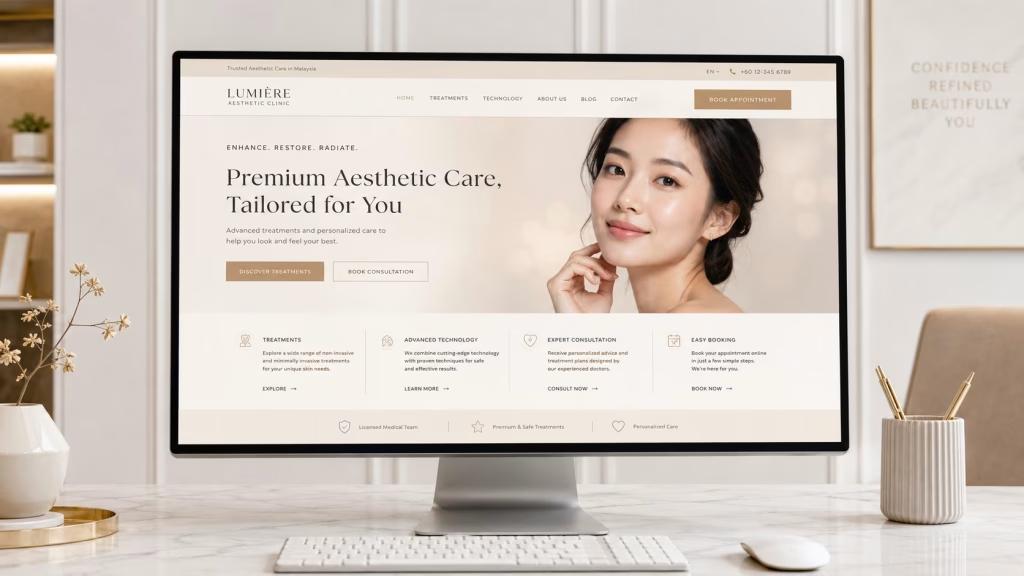
Most aesthetic clinic sites in Malaysia are built like brochures, slider, mission statement, generic stock photo, then a thin “Treatments” page that lumps every procedure together. Patients scroll, leave, and book the clinic next door. The right site is treatment-first, doctor-led, mobile-fast, WhatsApp-ready and structured for Google’s E-E-A-T and AI Overview citations.
This guide is the Web Design deep-dive that sits under our pillar, the Digital Marketing Guide for Aesthetic Clinics in Malaysia. Across 19 numbered sections we cover site architecture, treatment-page templates, mobile speed, WhatsApp integration, KKM and PDPA compliance, schema and four ZenWeb datasets: conversion uplift by element added, page-speed × bounce rate, site investment to traffic and conversion lift, and the 2022–2027 web-design spend trend.
The video below sets up the rest of this guide.
Source video: A Simple Guide to Marketing Your Medical Clinic on YouTube
Quick Answer: Every channel (SEO, Google Ads, Meta Ads, GBP, Instagram) eventually lands on the website. A weak site leaks every channel. A strong site amplifies them. Site quality determines whether the clinic is paying RM 80 per lead or RM 280.
The website is the validation step. A patient who saw a Reel, clicked a Google Ad and clicked a Map listing arrives at the site to verify the clinic, the doctor and the package. If the site loads in 5 seconds, has no WhatsApp button on mobile, and the treatment is buried under a “Services” mega-menu, the patient leaves. That patient cost the clinic RM 12 in Google Ads click-through fee, and produced no consultation.
The compounding cost: a poor site lowers Quality Score on Google Ads (CPL inflates), shortens session duration on SEO pages (rankings drop), and reduces Meta retargeting pool size (because session events fail to fire). The site is not a vanity project. It is the conversion floor under every other channel.
The full pillar context for how the website holds the funnel together is in our Digital Marketing Guide for Aesthetic Clinics. The short version: every campaign launched on Google Ads, Meta Ads or organic SEO eventually pushes traffic into the site. A 35% lift in site conversion translates directly into a 35% lift in cost-effectiveness across every channel. The site is the multiplier, not the brochure.
Quick Answer: Five page types: Homepage, Treatment Pages (one per procedure), Suburb / Branch Pages, Doctor Bio Pages, and Booking / Contact. Plus supporting blog and FAQ. Architecture mirrors how patients search.
The five page types every aesthetic-clinic site needs:
Plus supporting blog content (treatment-explainer articles, FAQ posts) and a closing CTA on every page. The architecture mirrors how patients search.
Quick Answer: Eight elements: H1 with treatment plus city, what-the-patient-feels paragraph, downtime and frequency, package range, doctor performing it (with MMC and LCP-AMP), equipment authenticity, FAQ block, sticky WhatsApp CTA. Order matters: pain and pricing in the first 400 words.
The patient is reading to answer three questions: “Will it hurt?”, “How much?” and “Who does it?”. A treatment page that buries pricing under three scrolls of marketing copy converts at half the rate of one that surfaces a package range in the first viewport. Lead with patient questions, not clinic claims.
Treatment-page word count matters too. Under 600 words reads as thin content to Google; over 1,800 words becomes a wall the patient skims and abandons. The sweet spot is 900–1,400 words, structured as:
Rich enough to rank, scannable enough to convert.
Quick Answer: Each LCP-AMP doctor needs a dedicated bio page with full registered name, MMC number, LCP-AMP credential, qualification list, areas of focus, and links to procedures they perform. AI Overviews cite named clinicians; anonymous clinics are invisible.
The doctor bio page is now an SEO asset, not just a courtesy. Google’s E-E-A-T (Experience, Expertise, Authoritativeness, Trust) signal weights named experts heavily. AI Overviews cite individual doctors by name when answering patient questions about a procedure. Build each doctor’s bio with full credentials, hyperlinks to their treatment pages, and Physician schema markup.
Quick Answer: Largest Contentful Paint under 2.5 seconds, Interaction to Next Paint under 200ms, Cumulative Layout Shift under 0.1. Without these, the site cannot rank and Google Ads Quality Score will sit at 4–5.
The two biggest killers of Core Web Vitals on aesthetic clinic sites:
The four fixes that recover Core Web Vitals on most clinic sites:
Quick Answer: Sticky WhatsApp button on every page, pre-filled message that names the treatment, conversion-tracked link parameters. Adding a sticky WhatsApp button on a clinic site that did not have one lifts enquiries 25%–45% in the first 30 days.
WhatsApp is the primary CTA for Malaysian patients. The button must be sticky on mobile (bottom-right, always visible), fire a tracking event on click, and pre-fill a message that references the treatment page the patient is on (“Hi, I’m enquiring about Pico laser, can I check the package?”). Pre-filled messages reduce front-desk handling time and improve close rate.
WhatsApp Business API integration adds another layer for clinics handling more than 80 enquiries a month. Auto-reply with a 5-second acknowledge (“Thanks for your message, a consultant will reply within 5 minutes”), automated business-hours reply (“Our team is offline; expect a reply by 9am”), and template messages for treatment-package details all reduce front-desk burden. Pair with a CRM (HubSpot, Pipedrive, or Malaysian-specific tools like JomChat or Niagahoster) so each enquiry threads to a sales-pipeline view.
Quick Answer: WhatsApp wins for first enquiry. Calendar booking (Calendly, Acuity, Setmore) wins for confirmed return patients. Form-only sites convert worst. Patients drop off before submission.
The right booking pattern uses three channels in parallel:
Forms with seven fields convert at 30%–50% the rate of three-field forms. Keep the fallback minimal.
Quick Answer: KKM clinic licence number in the footer, MMC and LCP-AMP credential on every doctor bio, equipment brand logos with model names, and a Google review embed. These are required by Akta 586 and they double as conversion levers.
The trust elements that matter most:
Quick Answer: Build a Bahasa Malaysia and Mandarin version of the top six treatment pages and the homepage. Use hreflang and separate URLs (/bm/, /zh/). Multilingual sites lift organic enquiries 30%–45% in mixed-ethnicity suburbs.
Malaysian aesthetic patients search in three languages depending on neighbourhood and demographic. A Bangsar South or Mont Kiara site that ships English-only misses 25%–35% of suburb traffic. The right approach: ship the homepage and top six treatment pages in three languages from launch, then expand to suburb pages and FAQ blocks over months 4–9.
Quick Answer: Privacy policy compliant with the Personal Data Protection Act 2010, cookie consent banner with granular control, and explicit opt-in on every form. Aesthetic clinics handle health data and the PDPA penalties for breach are material.
Malaysian PDPA 2010 requires explicit consent for collection of personal data including health-related enquiries. The cookie banner must let patients refuse non-essential cookies (Meta Pixel, Google Analytics). Privacy policy must list data classes collected, retention period and the data protection officer contact. Breach risks are now actively enforced by the Personal Data Protection Department.
Quick Answer: Six schema types matter: LocalBusiness/MedicalBusiness, MedicalProcedure, Physician, FAQPage, BreadcrumbList and Speakable. Schema is what gets the clinic cited in AI Overviews and ChatGPT.
Schema is no longer optional. AI Overviews and Perplexity cite source pages with structured data far more often than pages without. The six schema types that push the site into the AI citation pool:
Quick Answer: Each conversion element adds measurable lift. Below is the element-by-element uplift we have measured across Malaysian aesthetic-clinic site builds.
| Element added | Conversion uplift | Time to ship |
|---|---|---|
| Sticky WhatsApp button (mobile) | +25%–45% | 2–3 days |
| Treatment-specific landing pages | +35%–60% | 3–5 weeks |
| Package range visible | +18%–32% | 1 week |
| Doctor bio with credentials | +15%–28% | 2 weeks |
| Google review embed | +12%–22% | 3 days |
| Mobile speed under 2.5 seconds | +22%–40% | 2–4 weeks |
| Multilingual content | +30%–45% | 6–10 weeks |
Source: ZenWeb operational data, Malaysian aesthetic-clinic site builds, 2024–2026.
Stack the elements in order of effort-to-uplift ratio. Sticky WhatsApp and Google review embed ship in days. Treatment pages and multilingual content take weeks but compound. The full stack lifts site conversion 80%–140% over a brochure baseline.
Quick Answer: Bounce rate doubles every 2 seconds of additional load time. A site loading in 5 seconds bounces at 58%–68%; a site loading in 2 seconds bounces at 28%–38%.
| Mobile load time | Bounce rate | Avg session duration | Conversion rate |
|---|---|---|---|
| Under 2 seconds | 28%–38% | 2:35 | 5.2%–8.5% |
| 2–3 seconds | 35%–47% | 2:10 | 3.8%–6.2% |
| 3–4 seconds | 45%–58% | 1:42 | 2.5%–4.5% |
| 4–5 seconds | 52%–65% | 1:18 | 1.6%–3.2% |
| Over 5 seconds | 58%–72% | 0:55 | 0.8%–2.0% |
Source: ZenWeb client tracking, Malaysian aesthetic-clinic site analytics, 2024–2026.
The biggest single conversion lift available is moving a clinic site from 4-second load to under 2.5-second load. The cost is image compression, lazy-loading and a leaner page builder: typically 2–4 weeks of work.
Quick Answer: A RM 12,000 site rebuild typically lifts site-driven enquiries 35%–55% within 12 months. A RM 25,000+ rebuild with multilingual and full schema lifts enquiries 75%–120%.
| Site investment (one-time) | Outcomes at month 12 | Bar (enquiry lift) |
|---|---|---|
| RM 6,000 (template + 6 treatment pages) | +18%–28% organic traffic, +15%–25% enquiries | |
| RM 12,000 (custom + 10 pages + WhatsApp) | +38%–58% organic traffic, +35%–55% enquiries | |
| RM 25,000 (full + multilingual + schema) | +78%–122% organic traffic, +75%–120% enquiries | |
| RM 45,000+ (multi-branch + booking integration) | +125%–195% organic traffic, +120%–180% enquiries |
Source: ZenWeb operational data, Malaysian aesthetic-clinic site rebuild outcomes, 2024–2026.
The diminishing-returns curve flattens above RM 25,000 unless the clinic has multiple branches or a complex online booking system. Most single-branch clinics get the best ROI from the RM 12,000–25,000 tier.
Quick Answer: Average aesthetic-clinic website investment in Malaysia has risen from RM 6,500 to RM 14,500 between 2022 and 2026, driven by mobile-first, schema, multilingual and AI-Overview readiness. The 2027 projection has continued growth as conversion-led builds become standard.
| Build tier | 2022 | 2023 | 2024 | 2025 | 2026 | 2027* |
|---|---|---|---|---|---|---|
| Template + treatment pages | RM 4,200 | RM 4,800 | RM 5,400 | RM 5,800 | RM 6,500 | RM 7,200 |
| Custom + WhatsApp + schema | RM 8,500 | RM 9,800 | RM 11,200 | RM 12,500 | RM 14,500 | RM 16,500 |
| Full + multilingual + AI-ready | RM 18,500 | RM 21,000 | RM 23,500 | RM 26,000 | RM 28,500 | RM 32,000 |
Source: ZenWeb client data + Malaysian agency rate cards. *2027 projection. Modeled scenario based on 2022–2026 trend.
The mid-tier (custom + WhatsApp + schema) is where most single-branch Malaysian aesthetic clinics are now investing. The full-tier with multilingual and AI-ready schema is becoming standard for chains and group practices.
WordPress remains the dominant choice for Malaysian aesthetic clinics because it integrates with Rank Math (SEO), WooCommerce (package booking), and a wide ecosystem of medical-clinic themes. Wix and Squarespace work for solo doctor-led practices but cap out on schema flexibility and multilingual control. Custom React/Next.js builds make sense only for multi-branch chains that need a unified booking system.
Five mistakes recur:
Three trends shape the next two years:
Three actions move the needle this month:
If you want a partner that has done this for 500+ Malaysian businesses including LCP-AMP clinics, WhatsApp ZenWeb for a no-obligation site audit. We will benchmark your mobile speed, treatment pages, schema and PDPA compliance against the data above. See the ZenWeb Web Design service or Web Design pricing page.
RM 6,000–8,000 buys a template build with treatment pages. RM 12,000–18,000 buys a custom build with WhatsApp integration and schema. RM 25,000+ supports multilingual content, AI-Overview readiness and online booking. Multi-branch group sites start at RM 40,000.
Template-tier builds ship in 4–6 weeks. Custom-tier builds take 8–12 weeks. Full-tier multilingual builds with online booking and full schema take 12–18 weeks. Plan content (treatment copy, doctor bios, photography) parallel to development to compress timelines.
No. A single site with a Suburb / Branch page per location performs better than fragmented branch sites. Each branch page targets local SEO (“aesthetic clinic Bangsar”, “klinik kecantikan Penang Georgetown”) while the homepage and treatment pages serve the whole group.
The treatment page, not the homepage. Most patients land on a treatment page from Google or Meta Ads, not the homepage. A clinic with strong treatment pages and a weak homepage outperforms a clinic with a beautiful homepage and thin treatment pages.
Both. WhatsApp wins for first enquiries because patients want to ask questions before committing to a slot. Online calendar booking wins for return patients and confirmed-package treatments. The right pattern is a sticky WhatsApp button on every page plus an optional calendar embed on the booking page.
Complete the form and our team will contact you to discuss your goals. Let’s grow your business.



Meowketing Specialist
Online


























