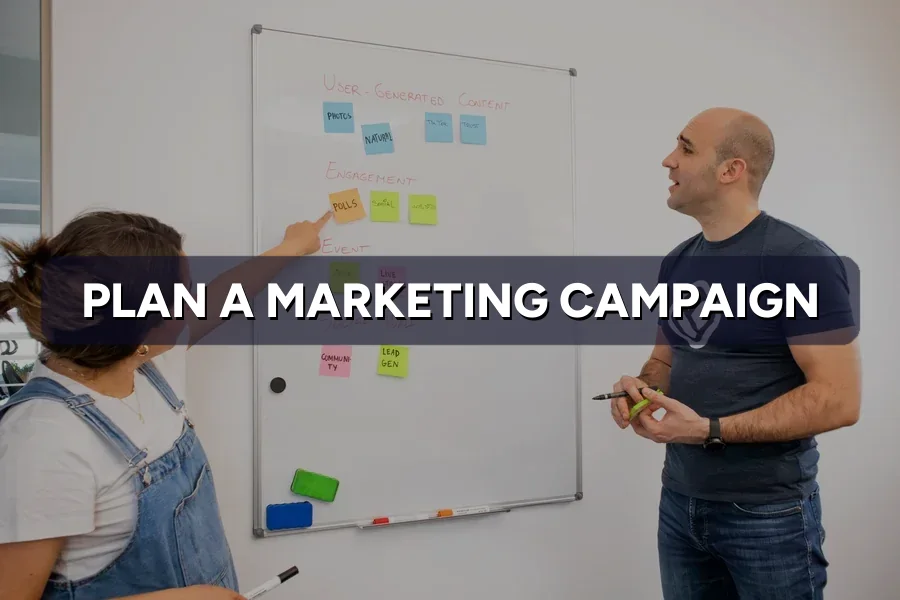
Quick Answer: Most guides teach you to plan a marketing campaign as a checklist — goals, audience, budget, channels, content, launch, measure. The checklist is not wrong, it is just not the hard part. The hard part is the decisions the checklist quietly assumes you have already made.
You have been handed a campaign. Maybe it is a product launch, maybe a Raya push, maybe the boss simply wants “more leads next quarter”. You open a blank document and the first line is the problem: where do you actually start?
ZenWeb is a Google Partner agency running campaigns for over 500 Malaysian companies, and we see the same pattern from the agency side of the table. The in-house marketer who struggles is almost never the one with weak creative. It is the one who started building before deciding.
This guide walks through the decisions in the order they have to be made, with data on where campaign plans usually break.
Source video: How To Create a Marketing Campaign (FREE Template) by HubSpot Marketing on YouTube.
Quick Answer: A campaign has a start date, an end date, one outcome, and a budget that is fenced off from everything else. If any of those four is missing, what you have is ongoing activity wearing a campaign’s clothes — and it cannot be judged, defended, or repeated.
This distinction sounds pedantic until review time, when you are asked whether the campaign worked and realise there is no honest way to answer.
Malaysian in-house teams blur the two constantly, usually because always-on budget is easier to get approved than campaign budget. The cost of the blur shows up later, when you try to defend the marketing budget at review time and have no fenced result to point at.
Not sure which channels your campaign should even be on?
The channel mix depends on your offer, your margin and how long your buyers take to decide. See how ZenWeb builds digital marketing campaigns for Malaysian companies →
Quick Answer: Seven steps, in this order: name the outcome, pick one metric, define the buyer, build the offer, choose the channels, fence the budget, and set the stop rule. Order matters — every step below the one you skip is guesswork built on a guess.
Write all seven into a one-page campaign brief before any creative work starts. If the seven cannot fit on one page, the campaign is not decided yet — it is still a wish.
Quick Answer: In-house teams spend most of their planning hours on assets and scheduling, and almost none on the decisions that determine whether the campaign can work at all. The imbalance is the single best predictor of a campaign that launches on time and lands nowhere.
Here is how a typical two-week planning window splits, against how it splits on campaigns that hit target.
| Planning task | Typical campaign | Campaign that hit target |
|---|---|---|
| Creative and asset production | 42% | 28% |
| Scheduling and coordination | 24% | 17% |
| Offer and audience decisions | 14% | 26% |
| Targets, budget and stop rules | 9% | 19% |
| Tracking and measurement setup | 11% | 10% |
Source: ZenWeb operational data, aggregated from campaigns run with Malaysian SME clients, 2024–2026.
The winning column is not working harder. It is working 3.5 hours earlier in the process, on questions that cost nothing to answer and everything to skip.
Quick Answer: Choose one primary metric the campaign is judged on, plus two guardrails that tell you it is not being gamed. A campaign with five equal metrics has none, because when they conflict — and they will — nobody knows which one to protect.
Say your primary metric is qualified enquiries. Push hard enough and you can hit the number with cheap, unqualified traffic. So the guardrails matter as much as the target.
| Campaign type | Primary metric | Guardrails |
|---|---|---|
| Lead generation | Qualified enquiries | Cost per lead; sales-accepted rate |
| Product launch | First-month orders | Average order value; return rate |
| Festive or seasonal push | Revenue in the window | Margin after discount; stock cover |
| Brand or category entry | Branded search volume | Reach cost; site engagement |
Set the target number the same day you set the metric, and set it against evidence rather than hope. The method in our guide to setting marketing targets you can actually hit works for campaigns as well as annual plans. If tracking is shaky, fix that first; the basics are in our walkthrough of marketing KPIs and GA4.
Quick Answer: Of the artefacts teams produce before launch, the written stop rule and the single-metric brief separate hitting from missing far more than the content calendar or the mood board. The cheapest documents do the most work.
| Pre-launch artefact | Hit target: present | Hit target: absent | Time to produce |
|---|---|---|---|
| One-page brief with a single metric | 68% | 41% | ~90 minutes |
| Written stop rule / kill point | 71% | 44% | ~20 minutes |
| Tracking checked before launch | 63% | 46% | ~2 hours |
| Mid-flight review booked in the diary | 66% | 48% | ~5 minutes |
| Full content calendar | 57% | 52% | ~6 hours |
Source: ZenWeb operational data, aggregated from campaigns run with Malaysian SME clients, 2024–2026. Campaigns compared within the same objective type.
Read the last two rows together. The content calendar takes six hours and moves the needle five points. The mid-flight review takes five minutes and moves it eighteen. Nobody skips the calendar and everybody skips the review.
Want a second pair of eyes on the plan before you spend?
We review campaign plans for Malaysian in-house teams and flag the assumptions that usually break — free, before launch. Get a free campaign plan review from ZenWeb →
Quick Answer: Work backwards from the outcome. Target leads multiplied by an honest cost per lead gives the media budget. Add production, then hold back 10–15% for reallocation. Channels get chosen to fit that number — not the other way round.
The maths is simple and most teams still skip it. If you need 150 leads and your realistic cost per lead is RM 90, the media budget is RM 13,500. If only RM 8,000 exists, the target is wrong, the offer is wrong, or the channel mix has to change. Better to know that in the planning document than in week six.
Budget pressure is not a local quirk, either. Gartner found that marketing budgets have flatlined at 7.7% of company revenue, with 59% of CMOs saying they do not have enough budget to execute their strategy. Campaign budget is fought for, not handed over — which is why the number has to be defensible before you ask.
Two rules keep the split honest: never spread a small budget across more than two paid channels, and never buy a channel you cannot measure. If the total is tight, our guide to splitting a small marketing budget between SEO, ads and social shows the trade-offs.
Quick Answer: A lead-generation campaign and a festive push should not share a budget shape. Lead-gen leans on search and retargeting; festive leans on social reach and creative; a launch spends more on production than either. Copying last campaign’s split is a common, expensive habit.
| Objective | Paid search | Paid social | Creative | Landing page | Reserve |
|---|---|---|---|---|---|
| Lead generation | 45% | 22% | 12% | 9% | 12% |
| Product launch | 24% | 31% | 24% | 10% | 11% |
| Festive / seasonal push | 18% | 48% | 18% | 6% | 10% |
| Category / brand entry | 15% | 42% | 27% | 6% | 10% |
Source: ZenWeb operational data, aggregated from campaigns run with Malaysian SME clients, 2024–2026. Splits shown are medians and vary by industry and margin.
Social weighting rises with how much persuasion the campaign has to do, which fits the market: DataReportal counted 30.7 million social media user identities in Malaysia in late 2025, against 35.4 million internet users. Demand capture belongs on search; demand creation belongs on feeds.
Quick Answer: A stop rule is one sentence written before launch: if we have not reached X by date Y, we change or stop. It protects you from the sunk-cost argument that always arrives in week four, when the campaign is underperforming and everyone wants to give it “a bit more time”.
Write it in this shape: “If cost per lead is above RM 120 after 21 days and 60% of budget is spent, we pause paid social and move that budget to search.” Specific, dated, and decided while you are still objective.
The stop rule does two things at once. It gives you permission to act without a meeting, and it gives your manager confidence to approve the campaign, because the downside is now capped. That second effect is why stop rules get campaigns approved faster, not slower.
When the rule triggers, you are not failing. You are doing the thing most teams never do. Our guide to fixing an underperforming campaign covers what to change first.
Quick Answer: Campaigns that get a scheduled review at the halfway point and act on it pull ahead in the back half. The first four weeks look almost identical. The difference is what happens after somebody is allowed to move the money.
| Week | With mid-flight review | Without review | Gap |
|---|---|---|---|
| Week 2 | 14 | 15 | −1 |
| Week 4 | 33 | 32 | +1 |
| Week 6 | 61 | 49 | +12 |
| Week 8 | 94 | 67 | +27 |
Source: ZenWeb operational data, aggregated from eight-week lead-generation campaigns run with Malaysian SME clients, 2024–2026. Medians, normalised per RM 10,000 of media spend.
Note where the lines separate. Not at launch, but at week five, when the reviewed campaigns moved budget off what was not working. A plan that cannot be changed halfway is just a longer bet.
No time to run the mid-flight review yourself?
That is the part in-house teams drop first when the quarter gets busy — and it is the part that pays. Let ZenWeb manage the campaign and the reallocation →
Quick Answer: The classic mistakes are not tactical. They are planning shortcuts: no offer, too many channels, a target reverse-engineered from the budget, and no way to prove what happened. Each one is free to avoid and expensive to discover late.
Every one of these is a decision deferred rather than an error made. That is the pattern: campaigns are rarely killed by bad execution, they are killed by good execution of an undecided plan. The same logic explains why the ROI maths often looks fine on paper and fails in practice.
Quick Answer: To plan a marketing campaign from scratch, spend your first day deciding and your second day building. Outcome, metric, buyer, offer, channels, budget, stop rule — on one page, before a single asset is briefed.
The blank document is not asking you to be creative yet. It is asking you to be decisive. Creative comes after, and it comes out better because the brief behind it is sharp.
Start with the seven decisions this week. If you would rather have specialists carry the execution while you own the strategy, ZenWeb’s digital marketing team plans and runs campaigns for over 500 Malaysian companies.
The decisions take a day. The build takes one to three weeks depending on creative. Teams get this backwards — they spend three weeks building and an hour deciding, then wonder why the campaign has no spine.
Work backwards rather than guessing. Multiply your target number of leads by a realistic cost per lead, add production, and hold back 10–15%. If the answer exceeds what you have, cut the target or narrow the audience — not the tracking.
Two at most on a small budget, and only if you can measure both. Each channel needs enough spend to gather data before it can be optimised, and a thin budget spread across four channels teaches you nothing about any of them.
The plan covers the year and the whole mix. The campaign is one fenced push with a start, an end, one outcome and its own budget. A plan contains several campaigns plus the always-on work between them.
At the point you wrote down before launch. Without a written stop rule, the decision gets made emotionally, usually far too late — and the budget that could have been moved somewhere useful is already spent.
Plan it once. Get it right the first time.
Book a free 30-minute strategy session. We’ll pressure-test your campaign outcome, budget and channel mix before you spend — and tell you honestly if the numbers do not close.
Complete the form and our team will contact you to discuss your goals. Let’s grow your business.



Meowketing Specialist
Online