

Share this post:
Pest control buyers form a trust judgement in 8–12 seconds on the homepage. The site has to load fast, show real people, and answer “how much” before the buyer has to ask. This is the deep-dive companion to our pest control digital marketing pillar.
Across 19 sections we cover information architecture, the homepage above-the-fold, service-page templates, mobile speed, conversion-rate optimisation, WhatsApp integration and a 60-day build plan.
Source video: Pest Control Marketing on YouTube.
Quick Answer: Every channel (GBP, Google Ads, Meta, SEO) eventually lands the buyer on the website. A site that converts at 6–11% beats one converting at 1–2% by 5x revenue at the same ad spend.
Three roles the website plays. First, it converts paid and organic traffic into WhatsApp enquiries. Second, it carries the trust signals (PCO licence, real photos, real reviews) that GBP and ads cannot. Third, it acts as the SEO container for service-zone and pest-type cluster content. A weak site cannot be fixed by more ad spend; a strong site multiplies every ringgit upstream.
Quick Answer: Homepage → Pest pages (termite, cockroach, rodent, mosquito, ant, bed bug, fumigation, commercial IPM) → Service-zone pages → Educational explainers → About + Reviews + Contact.
The classic mistake is a “Services” mega-menu with 14 items leading to one page. The fix is one URL per pest type and one URL per service zone, with the homepage as a navigational hub. The flat URL structure (/termite-control, /termite-control/petaling-jaya, /termite-control/subang-jaya) outperforms deep nesting (/services/pests/termite/petaling-jaya). Keep navigation no more than two levels deep.
Quick Answer: Five elements above the fold: H1 with city, uniformed-team photo, price band, WhatsApp button, PCO licence number. The buyer should see all five in under 8 seconds.
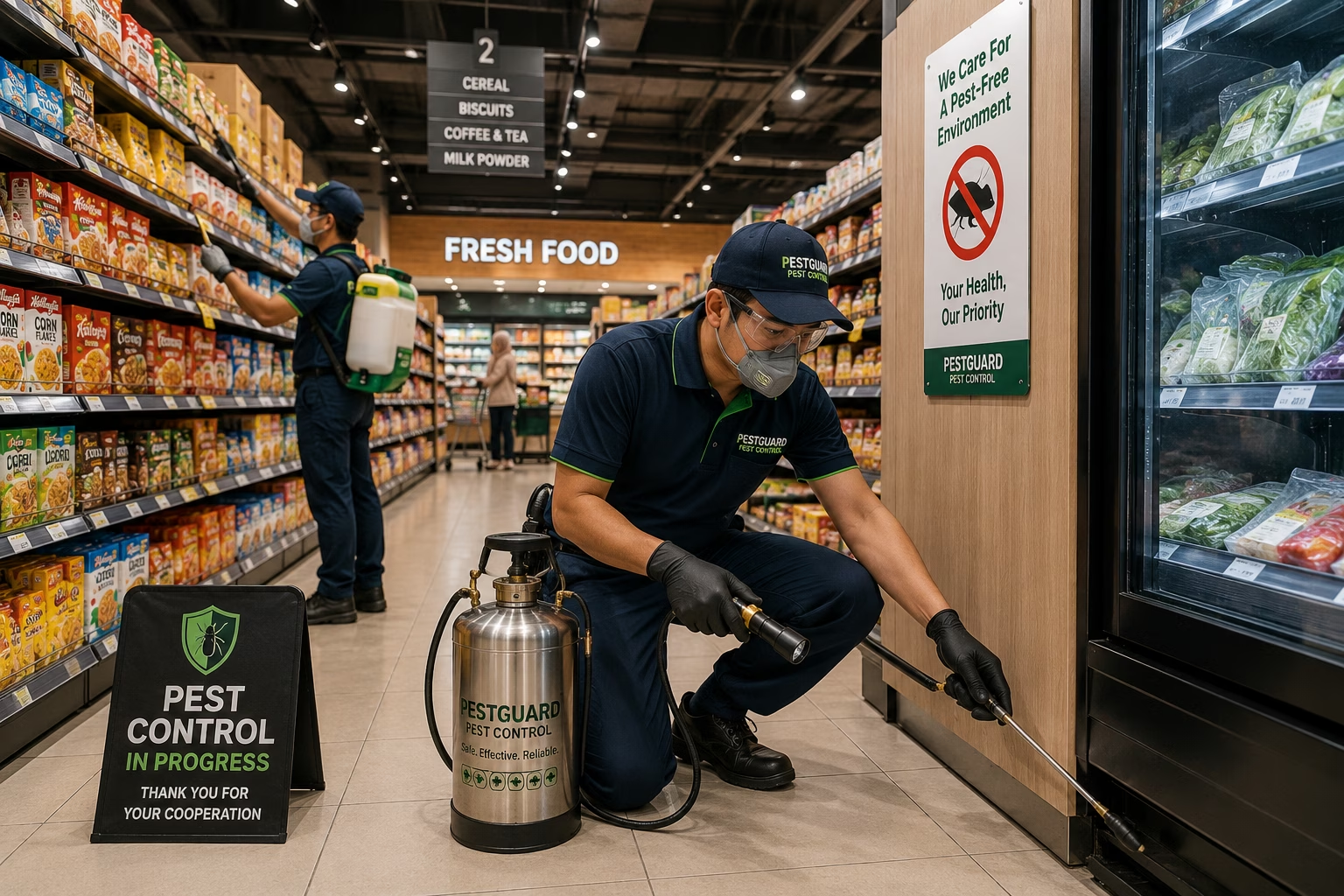
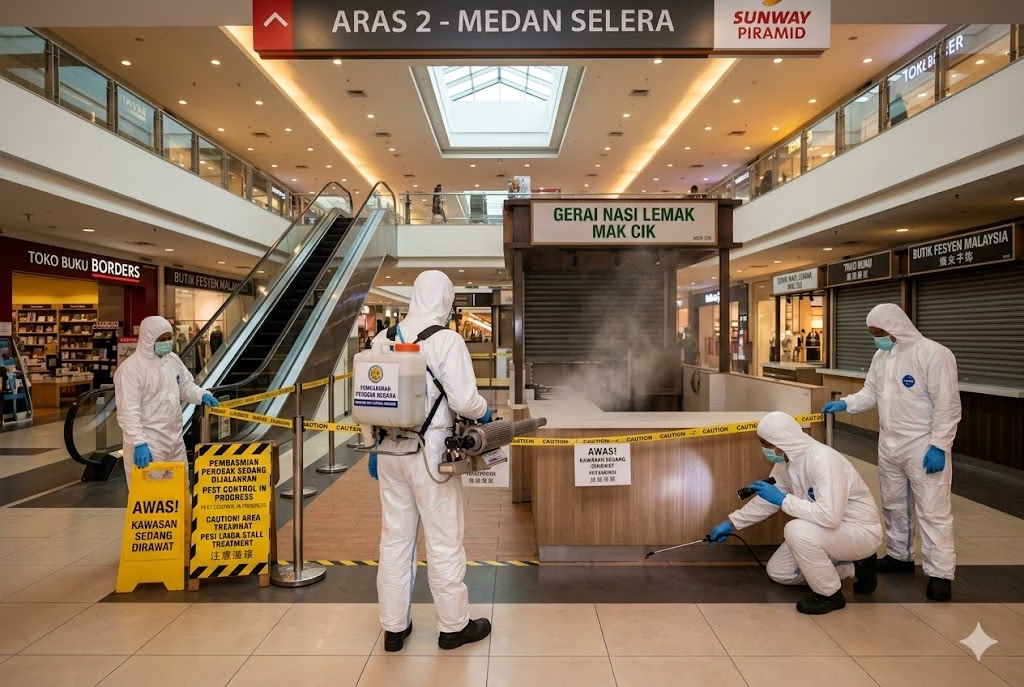
The H1 should read like “Pest Control in [City], Same-Day Inspection from RM 180” not “Welcome to ABC Pest Solutions”. The hero photo should show a real uniformed technician at a real Malaysian door, not a stock cockroach close-up. The WhatsApp CTA button should be sticky on mobile, with pre-filled service-specific message. The PCO licence number is a single-line text element. Buyers do scan for it.
Quick Answer: Eight-block template: H1 + price band, pest biology, treatment SOP, warranty, before-and-after photos, FAQ, reviews block, WhatsApp CTA. Apply identical skeleton to every pest page.
The consistency rewards both Google’s quality signals and the buyer’s mental model: once they understand the layout, they navigate every pest page faster. Block 1 H1 includes service and price band. Block 2 explains the pest in plain English. Block 3 explains the treatment SOP step-by-step. Block 4 sets the warranty term. Block 5 shows real before-and-after with PDPA consent. Block 6 carries 5–8 FAQs. Block 7 pulls the three most relevant Google reviews. Block 8 is the WhatsApp CTA with pre-filled message.
Quick Answer: Mobile LCP under 2.5 s, INP under 200 ms, CLS under 0.1. Every 0.5 s of load time costs 8–12% of WhatsApp conversion in pest emergencies.
The big wins: compress every photo to WebP, lazy-load below-the-fold images, remove unused page-builder bloat, swap heavy chat widgets for a tiny floating WhatsApp icon. Hosting matters: a Singapore or Malaysia POP cuts TTFB by 200–400 ms versus US-hosted WordPress. Avoid heavy carousel sliders on the homepage; they kill LCP and add no measurable conversion.
Quick Answer: The WhatsApp button on each service page should pre-fill a service-specific message (“Hi, I need a termite quote, pls send price and slot”). This lifts conversion 32–48% over a generic chat link.
The mechanic uses wa.me URLs with a pre-filled text parameter. Each service page passes the pest type into the link. The triage admin sees the service in the very first message and can reply with the matching saved-reply template: price band, available slots and warranty. The same setup works for inbound from GBP, ads and SEO.
Quick Answer: Real photos beat stock by 40–60% on dwell time and conversion. Plan a half-day shoot with a uniformed team, branded vehicle, treated areas and process steps.
The shoot list: three uniformed-team angles (full crew, lead technician portrait, two-tech action), two branded-vehicle shots (front, side with logo), six treatment-in-progress shots (gel bait, monitoring station, sealing crack), and four before-and-after pairs with PDPA consent. Process the photos to a consistent colour grade. Avoid AI-generated imagery. Buyers spot it instantly and trust drops.
Quick Answer: Display the PCO licence number on every page (above the fold and in the footer). Embed real Google reviews. Add PCAM logo if a member. Show real customer logos for commercial IPM clients.
The trust hierarchy that pest control buyers respond to: PCO licence number first, Google review count and rating second, real customer logos for commercial IPM third, PCAM membership fourth. Avoid trust-badge clutter (security badges, payment badges) that adds no signal in this category. The single most impactful badge is a real PAL technician’s photo with their full name and licence: it answers “is this a real licensed company”.
Quick Answer: Every form needs an explicit PDPA consent checkbox linked to a published privacy policy. Customer photos require written consent. Email and phone retention should follow the 7-year accounting record rule.
Three PDPA elements every pest control site needs. First, the privacy policy URL covering data classes (name, phone, address, treatment type), purpose (service delivery, marketing follow-up, compliance), retention (7 years post-engagement) and disclosure (none without consent). Second, an explicit consent checkbox on every form, not pre-ticked. Third, written consent for any customer photo or testimonial used in marketing. The Personal Data Protection Department (JPDP) audits enforcement annually.
Quick Answer: LocalBusiness on the homepage, Service on every pest page, FAQPage on every page with FAQ, Review on the reviews block, BreadcrumbList sitewide. Add speakable for AEO eligibility.
The schema sits in BLOCK 4 of every page: no inline microdata, only JSON-LD. Service schema needs name, description, areaServed and offers (PriceSpecification with price band). FAQPage carries every Q-and-A on the page. Review schema needs author, reviewRating and itemReviewed. Don’t fake reviews. Google penalises and the schema gets stripped.
Quick Answer: Six CRO levers: sticky mobile WhatsApp button, exit-intent enquiry capture, urgency badges (“Same-day inspection”), price band display, real review widget, and slot picker on form.
The sticky mobile WhatsApp button alone lifts site conversion 22–35%. Exit-intent enquiry capture (a small popup as the buyer leaves) catches another 4–7%. Urgency badges “Same-day inspection available” lift CTR on the form. The slot picker (letting the buyer choose a tomorrow morning or afternoon slot) converts 1.4x better than an open-ended “we’ll call back” form.
Quick Answer: Five mistakes: one services page, hidden PCO licence, slow mobile, stock cockroach photos, no WhatsApp button.
Quick Answer: Build cost ranges from RM 4,500 (5-page starter) to RM 18,000+ (multi-zone, multi-pest enterprise) across ZenWeb pest control accounts.
| Site Tier | Pages | Build Cost (RM) | Monthly Care |
|---|---|---|---|
| Starter (single-van) | 5 | RM 4,500–6,500 | RM 250 |
| Growth (3–5 van) | 12–18 | RM 8,500–12,000 | RM 450 |
| Multi-zone (5–10 van) | 25–40 | RM 12,000–18,000 | RM 650 |
| Enterprise (regional / franchise) | 50+ | RM 18,000–32,000 | RM 950+ |
Source: ZenWeb client tracking, Malaysian pest control accounts, 2024–2026.
Quick Answer: Sites under 2 s LCP convert at 9–11%; sites at 4 s LCP convert at 4–6%; sites at 6 s+ collapse to 1.5–2.5%.
| Mobile LCP | WhatsApp Conv. Rate | Index vs <2 s |
|---|---|---|
| Under 2 s | 10.2% | 100 |
| 2–3 s | 7.8% | 76 |
| 3–4 s | 5.4% | 53 |
| 4–6 s | 3.2% | 31 |
| Over 6 s | 1.8% | 18 |
Source: ZenWeb operational data, Malaysian pest control client sites, 2024–2026.
Quick Answer: A RM 6,500 starter site driving RM 1,500/month combined ad spend wins 25–45 bookings/month at month 6. A RM 12,000 growth site at RM 4,000/month spend wins 75–125 bookings/month.
| Site Tier | Total Ad Spend (RM/mo) | Month 6 Bookings |
|---|---|---|
| Starter | RM 1,500 | 25–45 |
| Growth | RM 4,000 | 75–125 |
| Multi-zone | RM 8,000 | 155–245 |
| Enterprise | RM 18,000 | 320–520 |
Source: ZenWeb operational data, Malaysian pest control client campaigns, 2024–2026.
Quick Answer: Average pest control site conversion rose from 4.2% in 2022 to 6.8% in 2026 as mobile speed, sticky WhatsApp and price-band display became standard. The 2027 forecast holds steady around 7%.
| Year | Avg Conversion Rate | YoY Change |
|---|---|---|
| 2022 | 4.2% | N/A |
| 2023 | 4.9% | +17% |
| 2024 | 5.6% | +14% |
| 2025 | 6.3% | +13% |
| 2026 YTD | 6.8% | +8% |
| 2027 (projection) | 7.1% | +4% |
Source: ZenWeb operational data, Malaysian pest control client sites, 2022–2026.
Quick Answer: WordPress + a lightweight builder (GeneratePress, Astra) wins for 95% of pest control operators. Custom Next.js or headless makes sense only at enterprise scale (50+ pages, multi-region).
WordPress with a clean child theme handles the SEO requirements (schema, FAQPage, BreadcrumbList) and integrates with WhatsApp, GBP and Pixel out of the box. Avoid bloated themes (Avada, Divi without optimisation). They kill mobile speed. Custom-coded sites win on speed but lose on the operator’s ability to update content; the trade-off is rarely worth it below RM 25,000 build budget.
Quick Answer: Host on a Singapore or Malaysia POP for sub-200 ms TTFB. Care plan should cover daily backup, weekly updates, monthly speed audit and uptime SLA above 99.9%.
The hosting choice is rarely glamorous but always impactful. SiteGround Singapore, Cloudways with a Singapore droplet, or Kinsta on the Tokyo POP all deliver under 200 ms TTFB to KL users. Avoid US-shared hosting. TTFB jumps to 700–900 ms and LCP follows. Care plan essentials: daily backup, plugin and core updates, monthly Core Web Vitals audit, monthly security scan, 99.9% uptime SLA.
Quick Answer: Days 1–14 strategy, content, photography. Days 15–35 design and build. Days 36–50 content load, schema, speed. Days 51–60 QA, PDPA, launch.
RM 4,500–6,500 for a starter (5-page) site, RM 8,500–12,000 for growth (12–18 page) site, RM 12,000–18,000 for multi-zone (25–40 page) site, RM 18,000+ for enterprise. Monthly care plans run RM 250–950 depending on tier.
WordPress with a lightweight theme wins for 95% of operators. It handles SEO, integrates with every Malaysian payment gateway, and updates without a developer. Wix locks you into their ecosystem; Webflow is great for design-heavy sites but scales expensively; custom code only wins at enterprise scale.
No. A simple sticky WhatsApp button beats a chatbot for pest control. Buyers want to talk to a human about a real pest emergency. Chatbots add friction and rarely capture service-type accurately.
Show the number above the fold on the homepage, in the footer of every page, and on the About page next to the company registration. Format: “PCO Licence: PCB/L/2024/XXXX” with a brief explainer link to the Pesticide Board.
Yes, with PDPA written consent. Before-and-after photos lift dwell time and conversion materially, especially for termite, rodent and bed bug pages. Show the treated area and process, not graphic close-ups of the pest itself.
Want a website audit for your pest control company? Contact ZenWeb or see our web design pricing. We’ll audit your current site, mobile speed, schema and conversion path.
Complete the form and our team will contact you to discuss your goals. Let’s grow your business.



Meowketing Specialist
Online


























