

Share this post:
Pest control is the purest “near me” search vertical in Malaysia. Google Business Profile drives 60–75% of map-pack visibility, but the website carries the credentials and price-band block that converts. This guide is the deep-dive companion to our pest control digital marketing pillar.
Across 19 sections we cover keyword tiers, page architecture, Pesticide Board PCO display rules, schema, GBP, link building and an honest 12-month timeline.
Source video: Pest Control Marketing on YouTube
Quick Answer: SEO and GBP together deliver 55–70% of bookings for mature pest control sites at 1.6–2.6x lower cost than paid. The compounding edge comes from service-zone pages and consistent reviews.
Three search realities shape pest control SEO. First, “near me” intent dominates: 71% of Malaysian pest queries include a city, neighbourhood or “near me” modifier. Second, GBP map-pack ranking is roughly 35–45% review-driven, more than any other home-services vertical. Third, service-pest cluster pages compound. Once “termite control [city]” ranks, the next service-pest combination indexes 2–3 weeks faster.
Quick Answer: Tier 1 service intent (“termite control Malaysia”), Tier 2 question-led (“how to get rid of cockroaches”), Tier 3 brand and review-driven. Tier 1 converts; Tier 2 builds memory and topical authority; Tier 3 protects pipeline.
Tier 1: service intent. “Termite control Malaysia”, “cockroach control KL”, “rodent control Selangor”, “mosquito fogging Petaling Jaya”, “pest control Subang”, “fumigation Klang”. CPC RM 8–22. Conversion 6–14% on a service-zone landing page with price band and WhatsApp.
Tier 2: question-led. “How to get rid of termites in wooden floor”, “what attracts cockroaches in kitchen”, “how often should I fog for dengue”, “are baited traps safe for pets”. Lower CPC, lower conversion, but builds topical authority and earns featured snippets.
Tier 3: brand and reviews. “[Operator name] review”, “is [operator name] PCO licensed”. Low volume but defends the bottom of the funnel.
Quick Answer: Build one page per pest type: termite, cockroach, rodent, mosquito, ant, bed bug, fumigation, commercial IPM. Each page has the same skeleton: pest biology, treatment SOP, price band, warranty, before-and-after photos, PCO licence, FAQ, WhatsApp CTA.
The consistency rewards Google’s quality signals: every page passes the same E-E-A-T checks, internal linking and schema. Don’t merge pests. A “termite + cockroach” page splits intent and ranks for neither. Each pest has its own buyer urgency, treatment SOP and warranty length, so the page should reflect that. Service zone pages (KL, PJ, Subang Jaya, Klang, Shah Alam) sit one level below pest pages and share the parent skeleton.
Quick Answer: Optimise GBP before anything else: accurate name/address/phone, every service ticked, 20+ exterior and uniform-team photos, weekly Posts, 3–5 reviews a month with photo replies. Map-pack ranking lifts within 6–8 weeks.
The GBP fundamentals are simple but rarely all done. Verified address with a real signboard photo. Service area listed by city or town, not by postcode. All 24 pest control service categories ticked (termite control, rodent control, mosquito control, etc.). Twenty exterior photos and ten uniform-team photos. Weekly Posts on a service or seasonal pest. Owner replies on every review within 48 hours, even one-star ones. Google rewards engagement.
Quick Answer: Send a WhatsApp review link 24 hours after every paid job, with a templated request that asks for photo, treatment type and city. Aim for three to five new reviews a month, photographed and tagged.
The mechanics matter. WhatsApp request beats SMS by 3.2x; a 24-hour delay beats same-day; a templated message asking for “treatment type + city” earns Google’s most valuable ranking signal: review keyword density. Never offer discounts for reviews. This breaches Google policy and will get reviews removed. Invite the customer to upload a photo of the technician’s vehicle or uniform; reviews with photos rank 1.4x higher.
Quick Answer: Five schema types matter for pest control: LocalBusiness, Service, FAQPage, Review, and BreadcrumbList. Add speakable to TL;DR and Quick Answer blocks for AEO/voice readiness.
LocalBusiness schema covers name, address, geo coordinates, opening hours and PCO licence as additionalProperty. Service schema runs on each pest page: name, description, areaServed, offers (price band as PriceSpecification). FAQPage on the bottom of each page, marked up exactly as displayed. BreadcrumbList for the site hierarchy. Speakable lifts AI Overview and voice-search answer eligibility.
Quick Answer: Mobile LCP under 2.5 s, INP under 200 ms, CLS under 0.1. Pest emergencies happen on mobile in poor connectivity. Every 0.5 s of load time costs 8–12% of WhatsApp conversion.
The big mobile-speed wins come from compressing photos to WebP, lazy-loading below-the-fold images, removing unused page-builder bloat, and serving the WhatsApp button as a tiny floating icon rather than a full chat widget. Clinic-level page weight (under 1 MB) is the target. Hosting on a Singapore or Malaysia POP cuts TTFB by 200–400 ms versus US-hosted WordPress.
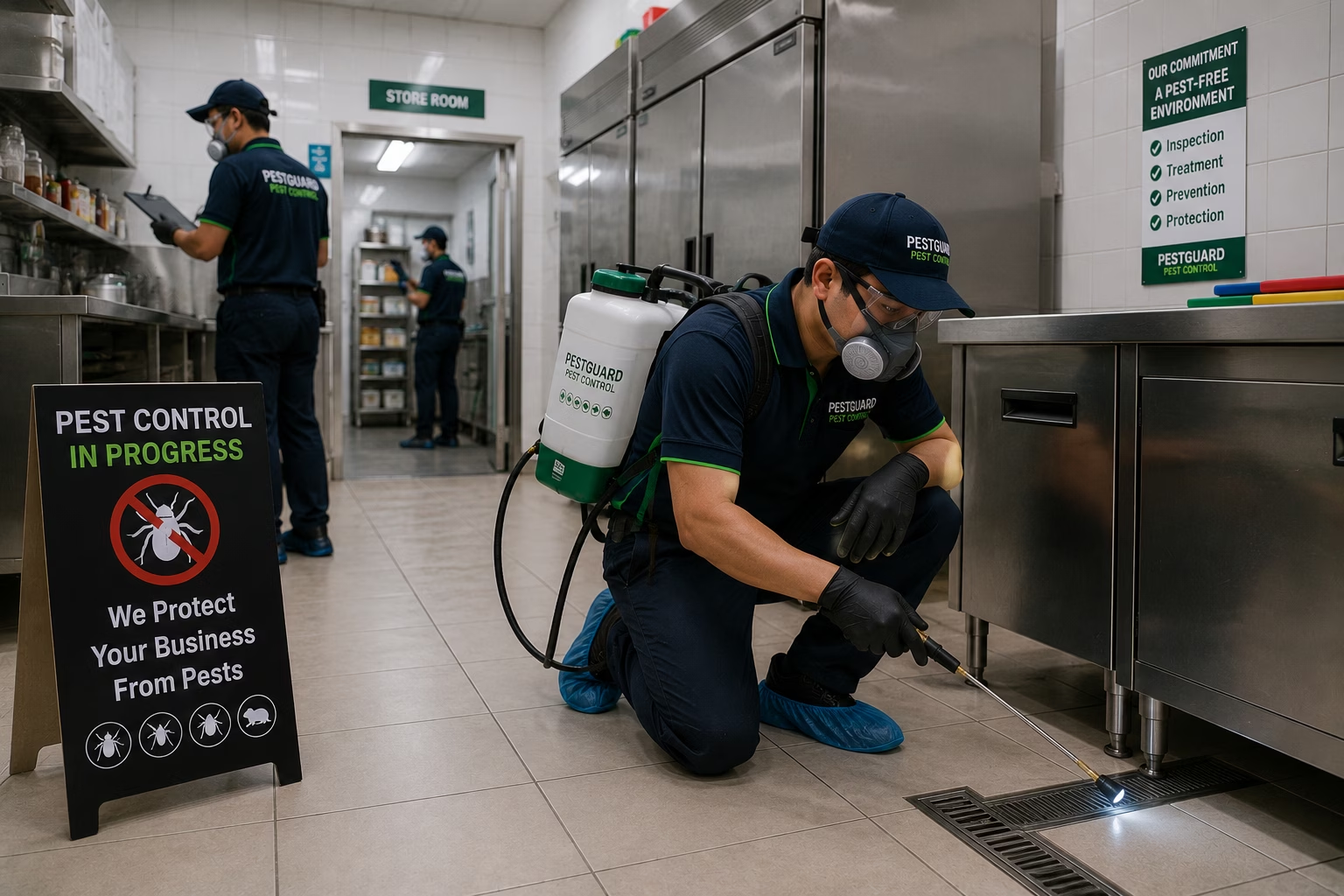
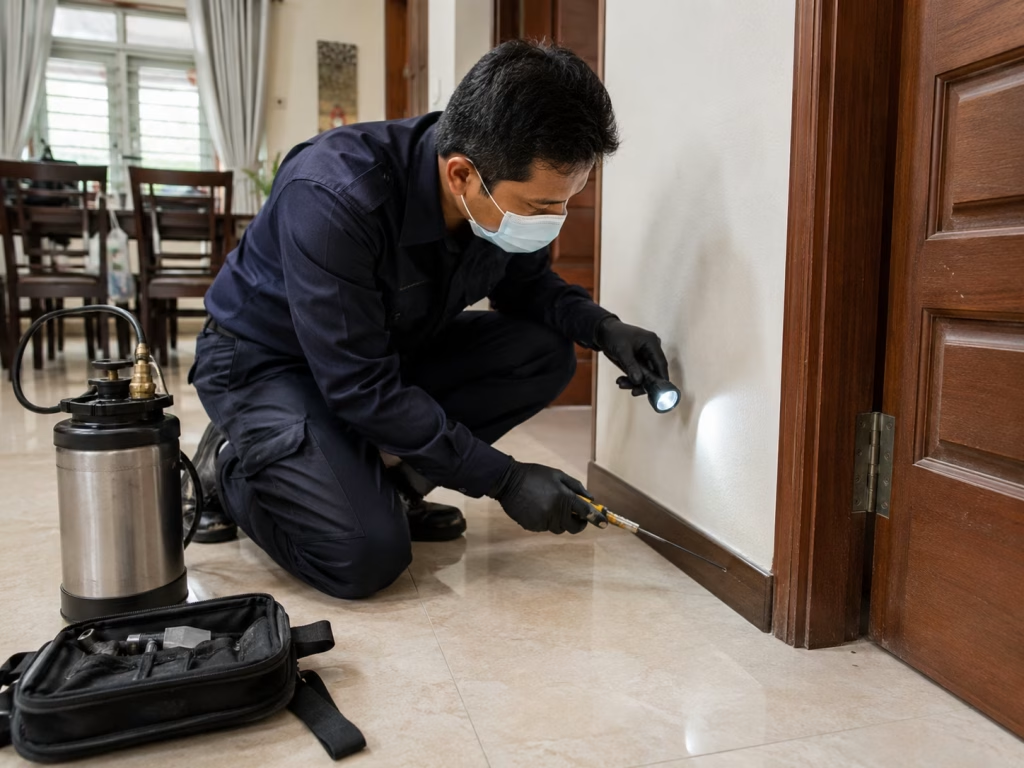
Quick Answer: Real photos of uniformed technicians, branded vehicles and service-in-progress beat stock photography. Replace every stock cockroach close-up with clean home interiors and team shots.
The pest-control website with the highest conversion in our portfolio uses zero stock photos. Every visual is a real technician, a real treatment site (with the client’s PDPA consent), or a real before-and-after. Stock close-ups of insects suppress Meta reach and erode site trust. The single highest-impact photo is a uniformed technician at a real Malaysian door. It answers “is this a real company” in under one second.
Quick Answer: Every pest page links to its three nearest service zones, the IPM pillar, the FAQ hub and the booking page. Every blog explainer links up to its parent pest page. Don’t create orphan pages.
The pattern is hub-and-spoke. Pillar (this digital marketing guide) sits at the top. Pest pages (termite, cockroach, rodent, mosquito, fumigation, commercial IPM) sit below the pillar. City pages sit below each pest page. Educational explainers sit alongside, linking up. Every link uses descriptive anchor text: “termite control in Subang Jaya”, not “click here”.
Quick Answer: Submit consistent NAP (name, address, phone) to PCAM directory, Yellow Pages MY, Recommend.my, ServisHero, Google Maps and 10–15 local-council business directories. Inconsistency cuts map-pack rank.
The fundamentals of local citations have not changed since 2018. Name, address and phone must match exactly across every directory. Use the legal entity name (Sdn Bhd / Enterprise). Don’t list two phone numbers. Avoid auto-generated multi-location pages on directories that allow it. The PCAM member directory carries weight specifically for industry trust signals.
Quick Answer: Three link sources matter: local-council and dengue-fogging coordination press, F&B chain client case studies, and PCAM technical-paper contributions. Skip mass guest posts and blog comments.
Coordinated dengue-fogging campaigns with DBKL, MBPJ or MPSJ during outbreak alerts earn local-news mentions in The Star, Malay Mail or Bernama: high authority, evergreen links. F&B chain case studies with a public-facing logo (with the client’s permission) earn .my partner-page links. PCAM technical-paper contributions earn industry-association links. Avoid private blog networks. Google’s pest control vertical is heavily de-spammed.
Quick Answer: Two pieces a month is the floor: one service-zone page, one educational explainer. Match the seasonal pest cycle (termite swarms April–June, mosquitos June–October, rodents November–January).
The 12-month plan: months 1–3 cover the four core pest pages and three biggest service zones. Months 4–6 add three more service zones and start educational explainers. Months 7–9 layer commercial IPM content. Months 10–12 publish seasonal pieces and case studies. Every piece links to its parent pest page and the WhatsApp form.
Quick Answer: SEO + GBP CPL ranges from RM 38 (general pest in primary service zone) to RM 92 (commercial IPM in secondary zone) across ZenWeb pest control accounts.
| Service Type | Primary Zone | Secondary Zone | Tertiary Zone |
|---|---|---|---|
| General pest | RM 38 | RM 48 | RM 58 |
| Termite control | RM 52 | RM 62 | RM 75 |
| Rodent control | RM 42 | RM 52 | RM 62 |
| Mosquito fogging | RM 48 | RM 58 | RM 68 |
| Commercial IPM | RM 92 | RM 115 | RM 142 |
Source: ZenWeb client tracking, Malaysian pest control accounts, 2024–2026. Primary zone = highest-density service area; secondary = adjacent; tertiary = expansion.
Quick Answer: Map-pack ranking on the primary “near me” term lands in 6–10 weeks at higher spend, 10–18 weeks at moderate spend, and 5–9 months at minimal spend.
| SEO Investment Tier | Primary Term Map-Pack | Service-Zone Cluster Ranking |
|---|---|---|
| RM 1,500/month (foundation) | 5–9 months | 9–14 months |
| RM 3,000/month (moderate) | 10–18 weeks | 5–9 months |
| RM 5,000+/month (aggressive) | 6–10 weeks | 3–5 months |
Source: ZenWeb operational data, Malaysian pest control client SEO campaigns, 2024–2026.
Quick Answer: RM 1,500/month wins 800–1,400 organic visits in month 12; RM 3,000 wins 2,400–4,200; RM 5,000 wins 5,000–8,500. Returns flatten past RM 7,000 unless content cadence rises.
| SEO Spend (RM/mo) | Month 12 Organic Visits |
|---|---|
| RM 800 | 350–650 |
| RM 1,500 | 800–1,400 |
| RM 3,000 | 2,400–4,200 |
| RM 5,000 | 5,000–8,500 |
| RM 7,000+ | 7,500–13,000 (flattens) |
Source: ZenWeb operational data, Malaysian pest control client SEO campaigns, 2024–2026.
Quick Answer: Organic CPL has stayed roughly flat (RM 38 in 2022 to RM 49 in 2026) while paid CPL rose 60–80%. The gap widens further in 2027.
| Year | Organic CPL | Paid CPL (Google Ads) | Gap |
|---|---|---|---|
| 2022 | RM 38 | RM 58 | 1.5x |
| 2024 | RM 45 | RM 78 | 1.7x |
| 2026 YTD | RM 49 | RM 92 | 1.9x |
| 2027 (projection) | RM 51 | RM 102 | 2.0x |
Source: ZenWeb operational data, Malaysian pest control client campaigns, 2022–2026. 2027 projection = trailing 3-year inflation model.
The organic-paid gap widens because every new pest control entrant joins the Google Ads auction, but few build content. SEO compounds; auctions inflate.
Quick Answer: Quotable Quick Answer blocks, FAQPage schema, speakable spec, plain-English numerical answers, and clear question H2s. Citations in Google AI Overviews and Perplexity flow to operators who answer cleanly.
The 2026 SEO frontier is being cited in AI Overviews. Three practices help: write a 35–55 word Quick Answer at the top of every section that directly answers the question, use plain-English numbers (“RM 180–280, 1-year warranty”), and mark up the Quick Answer block with speakable. Avoid sales-y prose in answers. AI Overviews prefer the encyclopaedia voice.
Quick Answer: Five mistakes: one “services” page, no service-zone pages, stock photography, no PCO licence display, and ignoring GBP reviews.
Quick Answer: Months 1–3 fix GBP and core pest pages. Months 4–6 build service-zone pages. Months 7–9 add commercial IPM and educational explainers. Months 10–12 layer schema, link building and AEO.
Foundation tier (RM 1,500/month) sees first leads in month 3 and breaks even on cumulative spend in month 8–10. Moderate tier (RM 3,000) breaks even in month 5–7. Aggressive tier (RM 5,000+) in month 4–6. Annual residential contract value compounds payback into year two and three.
Yes for service-zone pages and educational explainers. The map pack and Page 1 organic together can carry 60–70% of mature pest control bookings. Google Ads still helps in the first 90 days while the GBP and content build authority.
Start with three per pest type (your top three service areas): typically 12 pages for the four core pests. Expand to five zones each by month 9. Don’t over-publish low-volume zones. Empty thin pages dilute topical authority.
Yes, with PDPA consent. Before-and-after photos lift dwell time and conversion materially, especially for termite, rodent and bed bug pages. Avoid graphic close-ups of the pest itself; show treated areas, not the insects.
Indirectly. Google does not read industry membership directly, but PCAM directory listings, certification logos and trust signals improve user dwell time and review rate, which Google measures. Always display the PCO licence number. It earns user trust and can be referenced in AI Overviews.
Want a tailored SEO plan for your pest control company? Contact ZenWeb or see our SEO pricing. We’ll audit your GBP, your service-zone gaps and your competitors’ content depth.
Complete the form and our team will contact you to discuss your goals. Let’s grow your business.



Meowketing Specialist
Online


























