

Share this post:
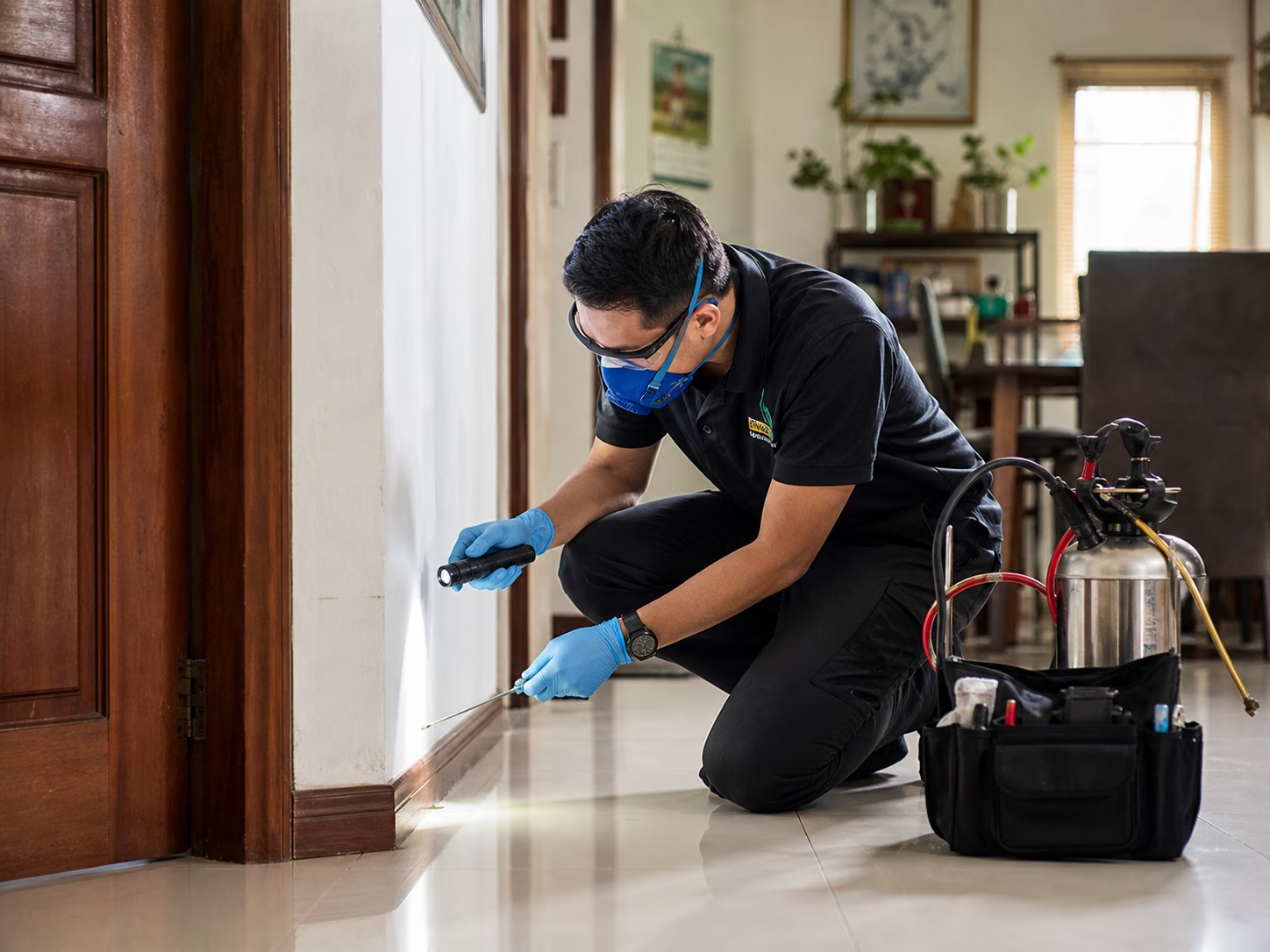
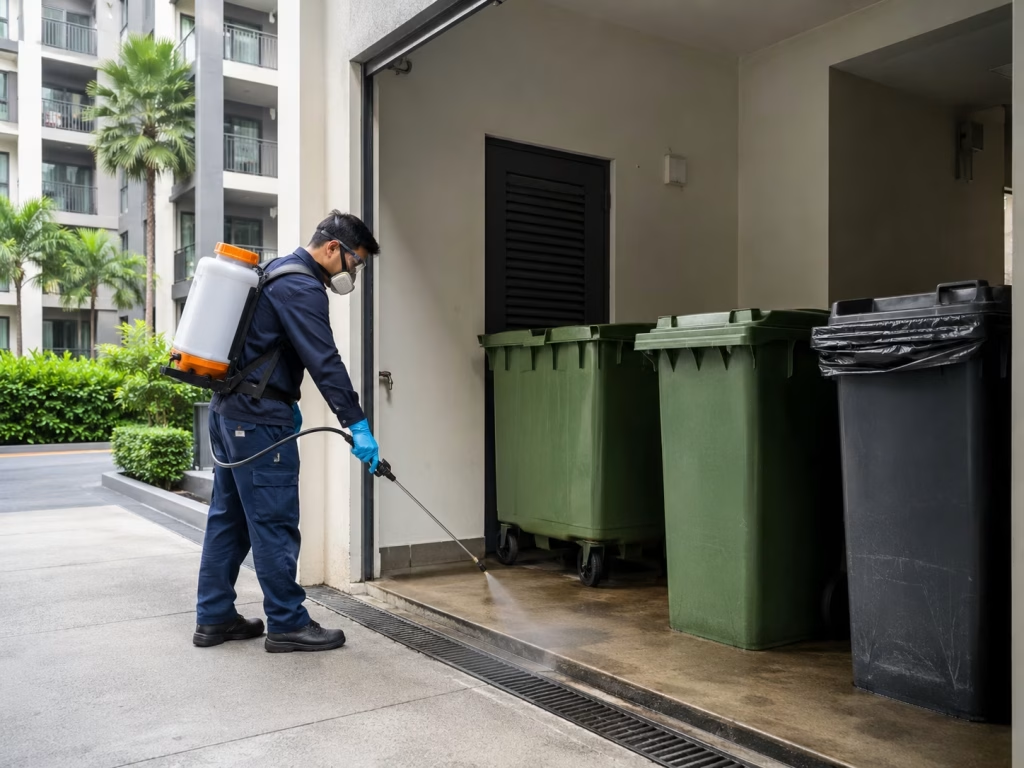
Pest control buyers in Malaysia move fast. A homeowner who spots termite mud tubes at 9 pm searches Google by 9:05, messages three operators on WhatsApp by 9:15, and books whoever replies first with a clear price band. Commercial buyers — F&B, warehousing, schools — shortlist on credentials, MeSTI / GMP audits and the PCO licence. The Department of Agriculture licenses operators through the Pesticide Board under the Pesticides Act 1974.
This guide is for pest control contractors, franchise owners and multi-van operators across residential and commercial work in the Klang Valley, Penang and JB. Across 19 sections we cover buyer behaviour, channel mix, Pesticide Board and PCAM compliance, and four ZenWeb datasets on cost per booked inspection.
Source video: Pest Control Marketing Strategy on YouTube
Quick Answer: Malaysian buyers shortlist three to five operators on Google and WhatsApp before any site visit. Companies with no GBP, no service-specific pages and slow first replies lose the booking inside 30 minutes.
The 2026 buyer is a homeowner with cockroaches, a property manager with a termite report, or an F&B operator with an MeSTI audit looming. Every one starts on Google. “Pest control near me” carries RM 8–18 CPC; “termite control” sits at RM 12–22. GBP map-pack visibility moves the needle on every “near me” query, and operators replying within 15 minutes book 2.4x more inspections than next-day repliers (ZenWeb tracking).
Pesticide Board rules permit factual advertising, but operators must display their Pest Control Operator (PCO) licence number and avoid unreproducible claims. ZenWeb runs the full stack across SEO, Google Ads, Meta Ads and web design.
Quick Answer: Five steps: pest sighting, Google or GBP search, two or three quotes via WhatsApp, price-and-licence check, then site inspection or treatment. Most operators are won at the first reply and the price-band block.
Three buyer archetypes drive bookings: the homeowner (cockroach, ant, mosquito), the property manager (termite, rodent, annual contract), and the commercial operator (F&B, warehousing, school running an IPM contract under MeSTI / HACCP). Homeowners start on Google. Property managers compare two or three before renewing. Commercial buyers run a tender on a 30–60 day cycle.
Quick Answer: Fund a Google Business Profile and a credentials-first website first, Google Ads second for emergency-intent terms, SEO third for service-specific depth, Meta fourth for residential retargeting and annual-contract upsell.
Pest control is hyper-local emergency search. GBP carries 60–75% of “near me” map-pack traffic; the website handles credentials, price band and WhatsApp click. Google Ads buy ranking on urgent terms. SEO compounds for service-specific clusters and “pest control [city]” pages. Meta builds memory for annual contracts and dengue-season fogging.
The trap most operators fall into is buying Google Ads before fixing GBP, the price band and WhatsApp. Paid traffic landing on a vague “we kill all pests” page converts at 1–2%; the same traffic on a service-specific page with a price band converts at 6–11%.
Quick Answer: Pest control SEO rests on three pillars: service-specific pages (termite, cockroach, rodent, mosquito), city/town landing pages for service zones, and educational pest-identification content. Deep dive: SEO Guide for Pest Control.
Three keyword tiers matter. Tier 1 service intent (“termite control Malaysia”, “cockroach control KL”) carries the highest CPC and conversion. Tier 2 question-led: “how to get rid of termites”, “are fogging chemicals safe”. Tier 3 brand and review-driven search. Floor: Core Web Vitals in good range, FAQPage and Service schema, PCO licence display, real photos. Pair with ZenWeb SEO or SEO pricing.
Quick Answer: Google Ads work best on three campaign types: Search on emergency intent, Local Service-style geo for “near me”, and Performance Max for brand discovery. Start at RM 2,500–6,000 a month per service line or RM 12,000+ for a multi-van regional operator.
Search splits into three tiers. Tier 1 emergency (“termite emergency”, “cockroach urgent”) converts at 8–14% at RM 8–18 CPC. Tier 2 service-specific: “termite control quote”, “rodent package”. Tier 3 brand protection. Sitelinks like “Same-Day Inspection”, “PCO Licensed”, “RM 180 Termite Treatment” lift CTR. Avoid “100% pest-free guarantee” claims and chemical brand names in headlines. Full playbook: Google Ads Guide for Pest Control or ZenWeb Google Ads.
Quick Answer: Meta builds memory for residential annual contracts and dengue-season fogging: short Reels showing real treatment, before-and-after photos with no insect close-ups, and condo-resident testimonials.
The Meta angle in 2026 is education-led. A 30-second Reel on “what termite mud tubes look like and why ignoring them costs RM 6,000” beats a discount banner. Audience: 28–55, Klang Valley/Penang/JB, layered with homeowner and property-manager stacks. Past-customer lookalikes outperform interest stacks by week six. Avoid graphic insect close-ups. Meta suppresses reach. Full playbook: Meta Ads Guide and ZenWeb Meta Ads.
Quick Answer: A site that books has six elements: service-specific page per pest type, transparent price band, PCO licence number block, WhatsApp button, service-zone map, and a PDPA notice. Mobile speed under 2.5 seconds is non-negotiable.
The classic mistake is one “pest control services” page. The booking alternative is service-led: visitors pick termite, cockroach, rodent, mosquito or commercial IPM and land on a page with treatment method, warranty, price band and a WhatsApp form. Trust elements: PCO licence number, uniform-team photos, real Google reviews. Full architecture: Web Design Guide.
Quick Answer: Malaysian pest control operators are licensed by the Pesticide Board under the Pesticides Act 1974, work alongside KKM under vector-control rules, may join PCAM for industry standards, and must follow PDPA 2010 for client data.
The Pesticide Board issues three licence classes: Pest Control Operator (PCO, company), Pesticide Applicator Licence (PAL, technician) and Assistant PAL. PCO renews every two years at RM 400. PCAM trains technicians for the Pesticide Board exam twice a year. KKM enforces vector-control duties under the Destruction of Disease-Bearing Insects Act 1975. PDPA 2010 covers every enquiry form and treatment record.
Quick Answer: Reply within 15 minutes and inspection booking conversion roughly doubles versus next-day. Most operators miss this because field technicians juggle WhatsApp between jobs.
Enquiries cluster at 7–9 am, 12–2 pm and 7–10 pm: pre-work, lunch and after-dinner sightings. ZenWeb tracking shows 71% of enquiries land in those windows and 62% of lost enquiries waited over an hour. The fix is structural: a shared WhatsApp Business inbox triaged by an admin, technicians called in after price band and address are captured. Saved replies cover prices, SOP, warranty and PDPA notice. Section 14 quantifies the lift.
Quick Answer: A single-van operator needs RM 1,500–4,000 a month to keep two technicians fully booked. A 3–8 van regional operator scales to RM 8,000–20,000 a month. Multi-state franchises spend RM 25,000+ on multi-zone GBP and Search campaigns.
Single-van split: 35% Google Ads, 25% SEO + GBP, 15% Meta, 25% web. 3–8 van split: 30% Google Ads, 35% SEO + GBP, 15% Meta, 20% web. Annual contracts beat one-off jobs: one F&B IPM contract at RM 14,400/year outperforms 60 cockroach treatments at RM 250. Spend the first RM 1,500 on uniform-team photography, GBP optimisation and three service pages before scaling paid media.
Quick Answer: Track six KPIs: cost per WhatsApp enquiry, enquiry-to-inspection rate, cost per booked inspection, inspection-to-paid-job close rate, average revenue per residential customer per year, and 24-month renewal rate.
Cost per enquiry sets the funnel ceiling. Enquiry-to-inspection rewards reply speed. Inspection-to-paid-job reflects technician trust and price clarity. The 24-month renewal rate protects long-run pipeline: a residential contract retained two years has 3.4x the lifetime value of a one-off job. Mature operators retain 65–78% of contracts year-on-year and run 35–48% of new bookings from referrals after year three.
Quick Answer: Five mistakes drain pipelines: generic “pest control services” pages, no PCO licence display, slow WhatsApp replies, no price band, and using stock graphic-insect imagery that suppresses Meta reach.
Quick Answer: Across ZenWeb pest control accounts 2024–2026, cost per booked inspection ranges from RM 38 for a general pest enquiry via SEO to RM 215 for a commercial IPM contract via Google Ads. SEO + GBP wins long-term on every service; Google Ads wins urgent termite and cockroach work.
| Service Type | Google Ads | Meta Ads | SEO + GBP |
|---|---|---|---|
| General pest (cockroach, ant, mosquito) | RM 62 | RM 48 | RM 38 |
| Termite control (anti-rayap) | RM 95 | RM 72 | RM 52 |
| Rodent control (rats, mice) | RM 78 | RM 58 | RM 42 |
| Mosquito fogging (residential / community) | RM 88 | RM 65 | RM 48 |
| Commercial IPM contract (F&B / warehousing) | RM 215 | RM 158 | RM 92 |
| Fumigation (warehouse / shipping) | RM 185 | RM 132 | RM 78 |
Source: ZenWeb client tracking, Malaysian pest control accounts, 2024–2026. Klang Valley, Penang and Johor Bahru focus.
SEO and GBP undercut paid by 1.6–2.6x on every service after six to nine months. Commercial IPM carries the highest paid CPC because tenders are won on credentials, not clicks.
Quick Answer: A reply within 15 minutes converts WhatsApp leads to booked inspections at 56–62%. After 8 hours, conversion falls below 18%.
| First Reply Time | Inspection Booking Rate | Index vs <15 min |
|---|---|---|
| Under 15 minutes | 59% | 100 |
| 15 min – 1 hour | 42% | 71 |
| 1–4 hours | 28% | 47 |
| 4–8 hours | 17% | 29 |
| Next day or later | 9% | 15 |
Source: ZenWeb client tracking, Malaysian pest control accounts, 2024–2026, n = 4,210 paid WhatsApp enquiries.
Quick Answer: RM 1,500/month wins 18–28 bookings; RM 4,000 wins 45–70; RM 8,000 wins 85–130; RM 18,000 wins 180–280. Returns flatten past RM 22,000 unless a second crew is added.
| Monthly Spend (RM) | Bookings / Month |
|---|---|
| RM 800 | 8–14 |
| RM 1,500 | 18–28 |
| RM 4,000 | 45–70 |
| RM 8,000 | 85–130 |
| RM 18,000 | 180–280 |
| RM 22,000+ | 220–340 (flattens) |
Source: ZenWeb operational data, Malaysian pest control client campaigns, 2024–2026.
Returns flatten past RM 22,000. A single crew of two technicians caps near 280 bookings a month. The next investment is a second van and PAL, not more ads.
Quick Answer: Google Ads CPL is up roughly 60% since 2022; Meta CPL up about 80%; SEO + GBP CPL up 28%. Operators that built service-zone content in 2023 hold the lowest blended CPL today.
| Year | Google Ads | Meta Ads | SEO + GBP |
|---|---|---|---|
| 2022 | RM 58 | RM 38 | RM 38 |
| 2023 | RM 68 | RM 48 | RM 42 |
| 2024 | RM 78 | RM 58 | RM 45 |
| 2025 | RM 85 | RM 65 | RM 47 |
| 2026 YTD | RM 92 | RM 68 | RM 49 |
| 2027 (projection) | RM 102 | RM 78 | RM 51 |
Source: ZenWeb operational data, Malaysian pest control client campaigns, 2022–2026. 2027 projection = modelled scenario based on trailing 3-year channel inflation.
SEO + GBP is the only channel where CPL has stayed roughly flat since 2024. The 2026 winners built service-zone cluster pages in 2023, before national operators flooded “near me” auctions.
Quick Answer: Authority compounds slower than ads but never resets. Build it through consistent GBP reviews, PCAM technical contributions, dengue-fogging coordination with local councils, and case studies from F&B chain clients.
Three authority moves carry weight. A consistent GBP review cadence (three to five reviews a month with photo and treatment type tagged) moves map-pack ranking faster than backlinks. PCAM membership and technical-paper participation earn industry credibility. Coordinated dengue-fogging campaigns with DBKL, MBPJ or MPSJ win local-news mentions. F&B chain case studies (with the client’s permission) earn direct B2B enquiries.
Quick Answer: Smart trap monitoring and AI-driven pest identification compress on-site visit hours; integrated pest management (IPM) replaces calendar spraying. Operators that productise IPM contracts hold margin; operators competing on per-spray price lose it.
The 2026 buyer wants outcomes, not chemicals. Smart rodent traps with IoT sensors report bait events in real time, cutting unnecessary site visits by 35–45%. AI-assisted pest identification routes residential customers to the right service in under 30 seconds. Growth lives in IPM contracts for F&B and warehousing, where MeSTI and HACCP audits demand monitored data. Operators that productise fixed-fee annual IPM convert at 2x the rate of per-visit billing.
Quick Answer: Days 1–30 fix GBP and the credentials site. Days 31–60 launch SEO content for the four core pests. Days 61–90 layer Google Ads on emergency intent and start a Meta retargeting cadence.
A single-van operator starts at RM 1,500–4,000 a month for GBP + SEO + Google Ads + a service-zone site. A 3–8 van regional operator scales to RM 8,000–20,000 a month for multi-zone campaigns. The split is roughly 30–35% Google Ads, 25–35% SEO + GBP, 15% Meta, 20–25% web infrastructure.
Yes. Every operator must hold a valid Pest Control Operator (PCO) licence from the Pesticide Board under the Pesticides Act 1974, and technicians must hold a Pesticide Applicator Licence (PAL). The PCO number must be displayed in advertising and on the website. Treatment claims must be reproducible.
Residential wins with GBP + Google Ads + SEO: buyers book on price-band clarity. Commercial wins with SEO + LinkedIn + case studies: buyers run a 30–60 day tender on credentials, IPM SOP and MeSTI/HACCP fit. Annual residential contracts respond well to Meta retargeting after a one-off treatment.
Critical. GBP map-pack ranking is roughly 35–45% review-driven. Operators with 50+ reviews at 4.5 stars book 2–3x the volume of those with under 20 reviews, even at the same ad spend. A three-to-five-reviews-a-month flow with photo tagging is the highest ROI activity for a one-van operator.
First leads typically arrive in month 3 from local-intent terms. Service-pest cluster pages compound in month 5–8. By month 12 a well-built site books 55–70% of monthly enquiries from organic search at 1.6–2.6x lower cost than paid.
Want a tailored plan for your pest control company? Contact ZenWeb for a free 30-minute strategy session. We’ll review your GBP, your Google ranking, your competitors, and give you a concrete 90-day plan with realistic CPL and bookings-per-month targets.
Complete the form and our team will contact you to discuss your goals. Let’s grow your business.



Meowketing Specialist
Online


























