

Share this post:
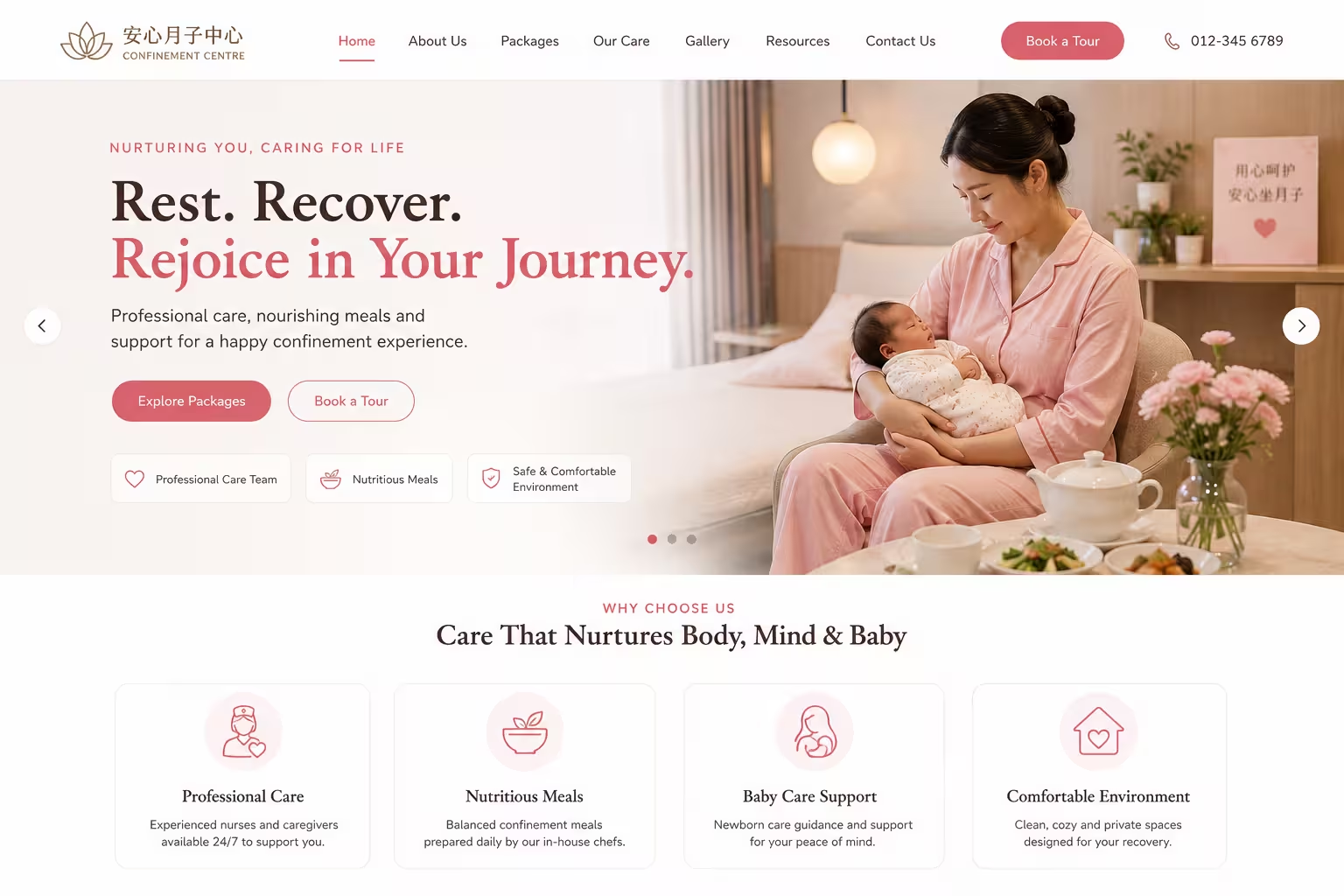
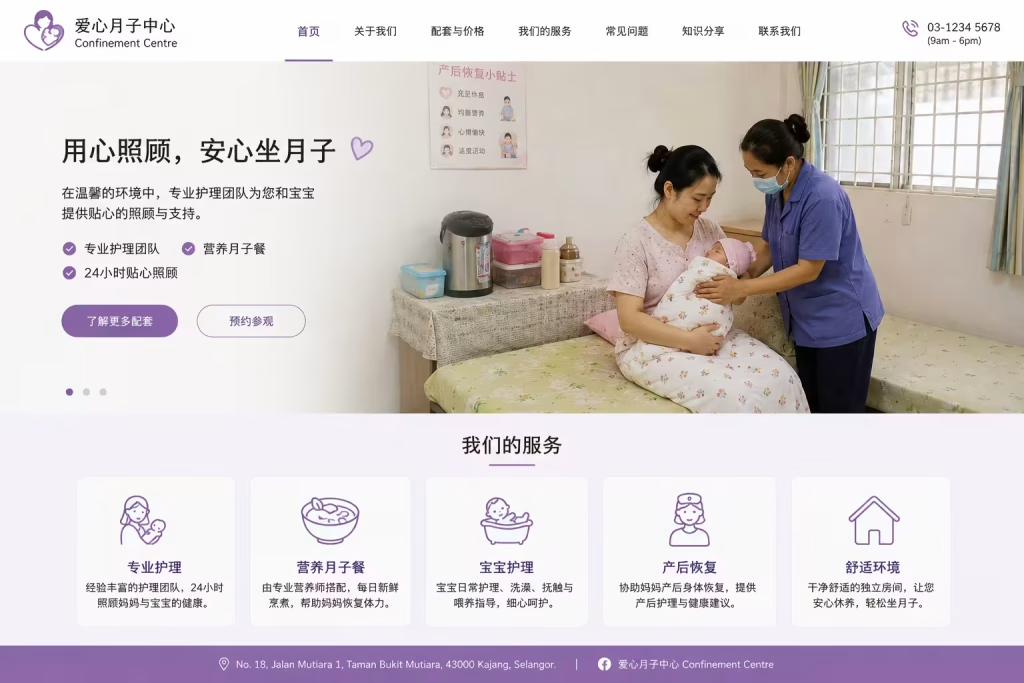
Web design for confinement centres is critical as search and social drive Malaysian mums to a confinement-centre site at the validation stage.Once she clicks through, she has 8–15 seconds to decide whether to message. DataReportal’s Digital 2025 Malaysia report records mobile-first behaviour for service queries, with 97.4% internet penetration. A site that loads slowly, hides pricing or buries the WhatsApp button leaks 35%–55% of the patient enquiries that paid acquisition just paid for.
This guide is the Web Design deep-dive that sits under our pillar: the Digital Marketing Guide for Confinement Centres in Malaysia. Across 19 numbered sections we cover information architecture, mobile-first design, package-page templates, trust elements, accessibility, multilingual structure, technical performance and four ZenWeb datasets: conversion rate by site type, page-load impact, mobile vs desktop split, and 2022–2027 web-tooling trends.
The video below sets up the rest of this guide.
Source video: A Simple Guide to Marketing a Health and Wellness Practice on YouTube
Quick Answer: The site is where every channel converts. SEO ranks the page, Google Ads sends the click, Meta sends the Reel-warmed mum, but if the site loads slowly or hides pricing, none of those channels turn into deposits.
A typical Malaysian confinement-centre brochure site converts at 1%–2%. A purpose-built booking site converts at 4%–7%. The difference compounds across every channel, that 3× lift means your CPL drops by half without spending a Ringgit more on ads. The site is the cheapest performance lever in the whole funnel, and it is the one most centres ignore for years.
The reason the lift is so big is that confinement is a high-trust, high-spend purchase. Mums need to verify cuisine, room type, nurse ratio, doctor schedule, JAKIM-halal status (where used) and live availability before they message. Each of those checks happens on the site. Sites that make those checks fast and obvious convert; sites that hide them lose. The pillar context is in our Digital Marketing Guide for Confinement Centres, and the ZenWeb Web Design service handles design, build and Core-Web-Vitals tuning end-to-end.
Quick Answer: Six page types — Home, Packages (one URL per tier), Cuisines, Rooms, About (head nurse + on-call doctor), Contact/Tour-Booking. Skip generic “Services” pages — they confuse Google and the mum.
The right architecture is shallow and intent-mapped. Home introduces the centre and routes to package and cuisine pages. Each package tier (Standard, Mid-tier, Premium, Halal-certified) gets its own URL with full inclusions, sample meals, room photos, price and FAQ. Each cuisine option (Chinese-tradition, halal-Malay, hybrid Malaysian) gets its own URL with sample weekly menu and dietary notes. Rooms get a gallery page broken down by room type. About covers the head nurse, on-call doctor and any traditional-medicine practitioner. Contact merges into the tour-booking flow with WhatsApp, calendar and phone.
The mistake to avoid is a single “Services” or “Packages” page that lumps every tier together. Google cannot rank it for any specific query, and the mum cannot scan it for the package she wants.
Quick Answer: 78% of confinement-centre traffic is mobile, mostly Android. Design for the mum’s thumb on a 6-inch screen first; desktop is a layout adaptation, not the primary canvas.
The mobile design floor: tap targets at least 44 px tall, body text at least 16 px, contrast above WCAG AA, no horizontal scroll, sticky bottom WhatsApp bar visible at all times. Heroes that work on desktop often fail on mobile, replace 4MB hero images with WebP-compressed alternatives under 200 KB.
The other mobile-first rule is: do not gate price behind a form. Mums on mobile leave instantly when a “Request Quote” form pops up before pricing. Show the package range up front; the form gates downstream tour booking, not pricing visibility.
Quick Answer: Eight blocks in this order: H1 with package and city, package-and-price hero, what’s included, sample weekly menu, room photos, head nurse credentials, FAQ block, sticky WhatsApp tour-booking CTA.
The package page is the single most important page on a confinement-centre site. Get this template right and every other channel performs better. The H1 sets intent (“Premium 28-Day Confinement Suite in Mont Kiara: Halal Cuisine, En-suite, Doctor-on-Call”). The hero block shows the package name, price and a primary photo of the room or meal. The “what’s included” block lists every component: number of meals, snacks, massages, doctor visits, lactation sessions.
The sample weekly menu and room photos do the trust work. Show four to six photos of the room type the mum is buying, plus a downloadable PDF of the four-week menu cycle. The head-nurse block carries her photo, name, qualification and years of experience. The FAQ block answers six to eight real-mum questions. The sticky WhatsApp button stays visible through the whole scroll.
Quick Answer: JAKIM-halal certificate scan (where genuine), local-authority licence number in the footer, registered nurse-team list with credentials, on-call doctor MMC number, food-safety badges, Google reviews embed, parents’ written-consent compliance under PDPA.
Trust signals are conversion levers, not legal box-ticks. Mums verify each one before they message. Display the JAKIM certificate scan on the homepage, the menu page and at the bottom of every halal package page where the centre genuinely runs a halal kitchen. Surface the on-call doctor’s MMC number and the head nurse’s qualification under each photo. Embed Google reviews near the bottom of each package page (eight to twelve recent reviews, refreshed automatically).
The privacy and consent layer matters too. Every form needs a PDPA-compliant consent checkbox, every photo of a mum or baby needs documented written consent, and the privacy policy must list what data is kept and for how long. Build this into the template once and every channel benefits.
Quick Answer: Sticky bottom bar on mobile, sticky right-edge on desktop, inline buttons after every major section, plus context-specific deep-links (e.g. “WhatsApp us about the Premium Suite”).
The single highest-impact change to most confinement-centre sites is a sticky WhatsApp button with deep-link pre-fill. A button that opens WhatsApp with “Hi, I’d like to book a tour of your Premium Suite for an EDD in October” pre-typed converts at 1.6–2.2× the rate of a generic “WhatsApp Us” button. Set six variations, one per package, plus one generic on the homepage.
Quick Answer: A simple form with EDD month and package tier, returning live availability or a waitlist option, lifts deposit conversion by 25%–40%. Mums book ahead because they fear missing the slot.
The EDD-matcher is the design innovation that distinguishes 2026 confinement sites from 2022 ones. The mum picks her EDD month from a dropdown, picks a package tier, and the page shows whether suites are available, partly available or waitlisted. This single feature drives urgency without pushy copy and lifts deposit conversion measurably. Build it as a small JavaScript widget tied to the centre’s booking spreadsheet or PMS.
Quick Answer: Largest Contentful Paint under 2.5 seconds on mobile 4G. Every additional second drops conversion by 12%–18%. Compress images, ship in WebP, lazy-load below the fold, host on a Malaysian or Singapore CDN.
Two technical fixes deliver most of the speed gain. First, replace heavy uncompressed JPGs with WebP at 75–85% quality (typical 70%–85% file size reduction). Second, lazy-load every image below the fold and inline-defer non-critical CSS. A site moving from 5.5-second LCP to 2.0-second LCP routinely lifts WhatsApp click-through by 30%–45%.
Quick Answer: Use folder-based language paths: /ms/, /zh/, /en/, with hreflang tags. Translated content, not auto-translation. Each path mirrors the package-and-cuisine architecture.
Multilingual confinement sites outperform English-only sites by 30%–50% in suburb queries, especially in Penang and Johor. Use folder paths, hreflang declarations and human-translated content (not Google Translate). The Mandarin path is essential in Klang Valley premium-suite traffic; the Bahasa path is essential for halal-tier traffic across Selangor, Penang and Johor.
Accessibility is both compliance and SEO. Sites meeting WCAG 2.2 AA, colour contrast above 4.5:1, alt text on every image, keyboard navigation, focus indicators, rank better and reach more mums. Aim for AA across all package and cuisine pages.
WordPress with Elementor or a clean child theme remains the right default for most centres, fast to update, easy for non-technical staff, integrates with Google Analytics 4, Meta Pixel, Conversions API and Rank Math. Custom Next.js or similar makes sense only at multi-branch group scale. Avoid drag-and-drop builders that bloat output HTML.
Quick Answer: Brochure homepages convert at 1%–2%. Package-page-led booking sites convert at 4%–7%. Sites with EDD-matcher and live availability hit 6%–9%.
| Site type | Visit→WA conv | Visit→Tour conv | Index |
|---|---|---|---|
| Brochure homepage | 1.2%–1.8% | 0.4%–0.8% | 22 |
| Package-page-led | 3.8%–5.5% | 1.5%–2.4% | 68 |
| + Sticky WhatsApp + speed < 2.5s | 5.0%–6.8% | 2.2%–3.4% | 85 |
| + EDD matcher + multilingual | 6.2%–8.8% | 2.8%–4.5% | 100 |
Source: ZenWeb operational data, Malaysian confinement-centre web design accounts, 2024–2026.
Quick Answer: Each additional second of LCP cuts WhatsApp conversion by 12%–18%. Going from 5s to 2s typically lifts deposits by 35%–55%.
| Mobile LCP | Conv rate | Bounce | Index |
|---|---|---|---|
| Under 2.0s | 5.8% | 38% | 100 |
| 2.0–2.5s | 4.6% | 45% | 79 |
| 2.5–4.0s | 3.1% | 56% | 53 |
| Over 4.0s | 1.6% | 71% | 28 |
Source: ZenWeb client tracking, Malaysian confinement-centre site analytics, 2024–2026.
Quick Answer: 78% mobile, 21% desktop, 1% tablet. Mobile dominates discovery; desktop dominates the husband-comparison stage.
| Device | Traffic share | Conv rate | Avg session |
|---|---|---|---|
| Mobile | 78% | 4.2% | 2:14 |
| Desktop | 21% | 5.5% | 3:48 |
| Tablet | 1% | 3.8% | 2:32 |
Source: ZenWeb client tracking, Malaysian confinement-centre site analytics, 2024–2026.
Quick Answer: Confinement-centre sites have moved from static HTML/Wix to WordPress + Elementor as the dominant stack. By 2027 the trend tilts toward Next.js for multi-branch groups.
| Stack | 2022 | 2024 | 2026 | 2027* |
|---|---|---|---|---|
| WordPress + Elementor | 42% | 55% | 62% | 61% |
| Wix / Squarespace | 28% | 22% | 18% | 15% |
| Static HTML | 22% | 14% | 8% | 5% |
| Next.js / headless | 3% | 5% | 8% | 12% |
| Other | 5% | 4% | 4% | 7% |
Source: ZenWeb client onboarding audits + DataReportal Malaysia. *2027 projection.
Five tools belong on every confinement-centre site: Google Analytics 4 with enhanced measurement, Meta Pixel and Conversions API, Google Tag Manager for clean event firing, Microsoft Clarity for session recording, and a basic CRM ingest for WhatsApp leads. Wire each event correctly once and the data pays back across SEO, Google Ads and Meta.
Five mistakes recur. First, a brochure homepage with no package landing pages. Second, prices hidden behind a form. Third, no sticky WhatsApp button. Fourth, hero images at 4MB-plus that destroy mobile speed. Fifth, no multilingual paths in mixed-language catchments.
Three trends will reshape confinement-centre web in 2026–2027. AI Overviews increasingly read structured data, so schema (LocalBusiness, LodgingBusiness, Service, FAQPage) and Speakable markers on TL;DR and Quick Answer blocks earn cited mentions. Voice search will rise from 12% to roughly 22% of confinement queries by 2027, natural-language FAQ blocks win that traffic. Visual search through Google Lens will pick up sites with descriptive alt-text and on-page captions, so keep image accessibility tight.
Three actions move conversion this quarter. One: ship a dedicated package landing page per tier with the eight-block template. Two: install a sticky WhatsApp button with deep-link pre-fill on every page. Three: compress every image to WebP under 200 KB and lazy-load below the fold to hit sub-2.5-second LCP.
If you want a partner that has done this for 500+ Malaysian businesses, Contact ZenWeb for a no-obligation web design audit. See our Web Design service and Web Design pricing.
A purpose-built booking site with package pages, EDD matcher and multilingual paths runs RM 12,000–28,000 to build, plus RM 250–600/month for hosting and maintenance. The lift in conversion rate typically pays back inside 3–6 months.
Yes. A single “Packages” page that lumps every tier together cannot rank for any specific query, and mums cannot scan it for the package they want. One URL per tier, plus one URL per cuisine, is the right structure.
WordPress with Elementor or a clean child theme remains the right default for most centres. Custom Next.js or similar makes sense at multi-branch group scale. Avoid drag-and-drop builders that bloat output HTML.
Critical. Largest Contentful Paint under 2.5 seconds on mobile is non-negotiable. Each additional second of LCP cuts WhatsApp conversion by 12%–18%. Compress images to WebP, lazy-load below the fold, and host on a regional CDN.
Folder-based language paths with hreflang tags outperform English-only sites by 30%–50% in suburb queries, especially in Penang and Johor. Use translated content rather than auto-translation.
Complete the form and our team will contact you to discuss your goals. Let’s grow your business.



Meowketing Specialist
Online


























