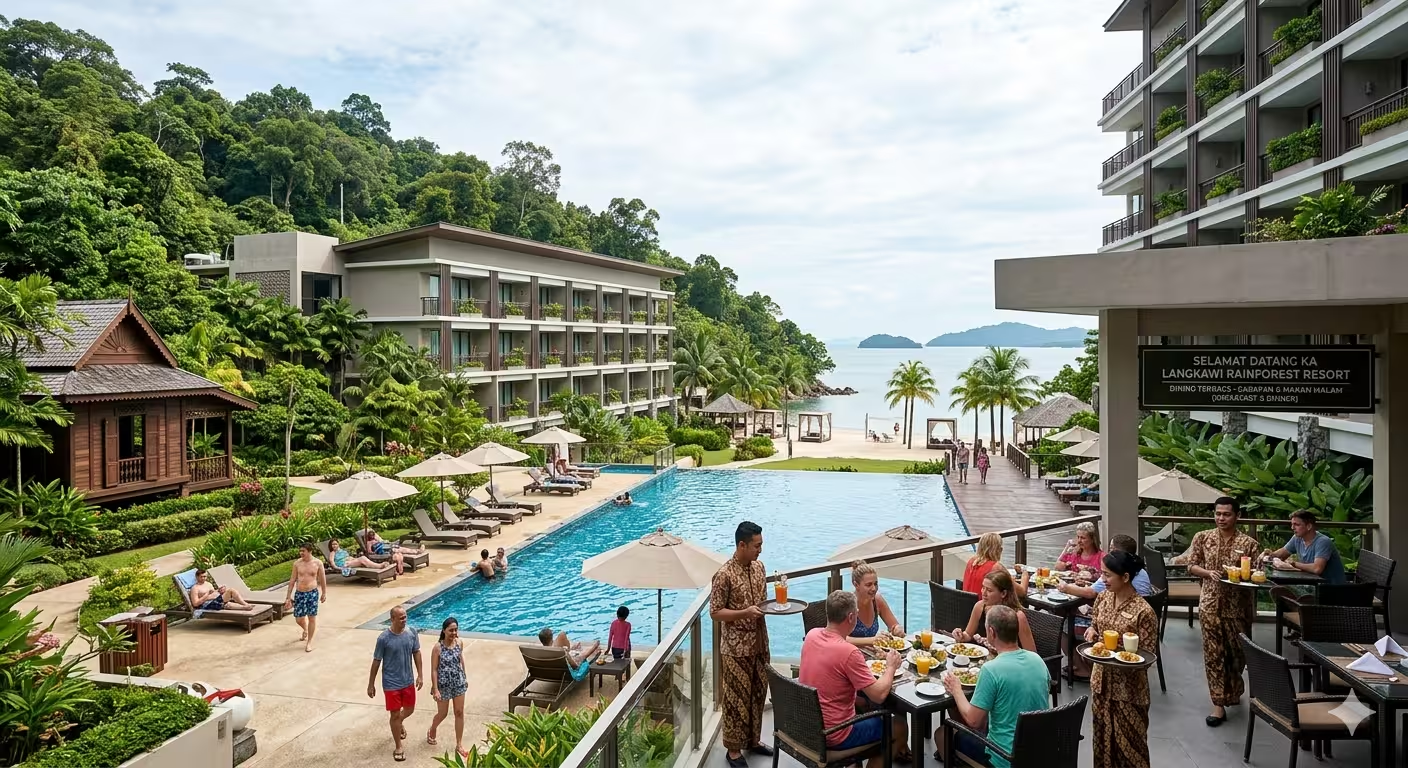
How Hotel Grow with Digital Marketing in Malaysia (2026)
TL;DR / Quick Answer:
Hotel digital marketing Malaysia in 2026 is defined by Visit Malaysia Year 2026 and the OTA dependency problem. Malaysia welcomed 42.2 million foreign visitors in 2025 and targets 47 million for VMY 2026 with RM 147.1 billion in tourism receipts. Yet OTAs hold 57.35% of Malaysian hotel bookings while direct digital channels grow at 15.73% CAGR per Mordor Intelligence. Hotels paying 15-25% OTA commissions while ignoring direct-channel marketing leak millions in margin. This guide covers the full direct-booking playbook.
(Too lazy to read? Contact ZenWeb — The Best Digital Marketing for Hotel in Malaysia and we’ll map your funnel for you.)
Introduction
If you run a hotel, resort, boutique property, or homestay in Malaysia, 2026 is the most consequential year for tourism in a generation. Visit Malaysia Year 2026 targets 47 million international visitors. Up from 42.2 million in 2025. The government has committed USD 135.7 million in promotional funding plus USD 27.1 million in infrastructure for VMY 2026. Demand will be high. The question is whether you capture it through OTAs (paying 15-25% commission) or directly (keeping the margin and the customer relationship).
This hotel digital marketing Malaysia guide is for general managers, revenue managers, marketing leads, and owners at hotels, resorts, boutique properties, serviced apartments, and homestays across Klang Valley, Penang, Langkawi, Sabah, Sarawak, and Malaysia’s secondary destinations. It walks through how travellers actually research and book in 2026, which channels reduce OTA dependency, and the trust signals that drive direct bookings. Three data sections near the end lay out benchmarks ZenWeb has pulled from Malaysian hotel client data.
Our view is shaped by working with 500+ Malaysian clients, including hospitality operators across urban and resort destinations. Hotels live and die on RevPAR and channel mix; digital marketing discipline directly determines both.
Why Digital Marketing Is Essential for Hotels in Malaysia
OTAs own a majority of Malaysian hotel bookings, and that share is expensive to maintain. Modern hotel digital marketing Malaysia practice exists primarily to recapture margin from OTA commissions and build owned audience for repeat bookings.
Three Malaysian-market realities make digital non-negotiable in 2026:
- OTA dominance is structural. OTAs hold 57.35% of the Malaysia hospitality market by booking channel in 2025. Hotels paying 15-25% commission on every Booking.com, Agoda, or Expedia stay are subsidising the OTAs’ marketing reach with their own margin.
- Direct booking is the fastest-growing channel. Direct digital channels are projected to grow at 15.73% CAGR through 2031 — nearly double overall hospitality growth. Hotels investing in direct now compound margin advantage for years.
- VMY 2026 brings demand AND competition. New supply enters (Mandarin Oriental Desaru, Moxy KL Chinatown, AC Hotel Ipoh from YTL, etc.). Demand will be high but visibility competition will be brutal. Properties without strong digital presence will under-fill despite the demand surge.
The practical implication: every Malaysian hotel needs a direct-booking-optimised digital presence. Hotel digital marketing Malaysia plans without direct-booking infrastructure leak margin every night.
How Malaysian and International Travellers Actually Research and Book
The typical traveller follows a 6-step path that runs days to months depending on trip type:
- Trigger. Leisure plan, business trip, special occasion, school holiday window
- Destination research. Google for “things to do in Langkawi”, “best beach in Malaysia”, “KL family hotel”
- OTA browsing — Booking.com, Agoda, Expedia, Trip.com to compare properties, see prices, read reviews
- Brand verification. Search the hotel name on Google to verify the property, see photos, check reviews
- Direct vs OTA decision. Compare prices, perks, loyalty value
- Book. Via OTA or direct channel
The decisive step is step 4. Travellers who search the hotel name directly are signalling intent to book. And many will book direct if the website experience is strong. Hotels with weak direct websites lose those guests back to the OTA. Hotel digital marketing Malaysia strategy must capture step-4 intent with a fast, trusted, direct-booking-optimised website.
What Digital Marketing Channel Should My Hotel Use?
Channel fit depends on property type, location, and target traveller segment. Comparison:
|
Channel
|
Speed to Bookings
|
Cost
|
Best For
|
Main Risk
|
|
Google Hotel Ads
|
Fast
|
Medium
|
Properties with strong direct booking flow
|
Requires booking-engine integration
|
|
Google Ads (Search)
|
Fast
|
Medium
|
Brand defence (own hotel name searches)
|
OTA bid-competition on brand terms
|
|
Meta Ads (FB/IG)
|
Fast
|
Medium
|
Visual leisure properties, resorts, boutique
|
Creative fatigue; attribution challenges
|
|
SEO
|
Slow (4-12 months)
|
Low ongoing, high upfront
|
Destination authority, content-led properties
|
Competitive in Klang Valley
|
|
OTAs
|
Fast
|
High commission (15-25%)
|
Reach, especially international
|
Margin erosion; OTA-owned customer
|
|
TripAdvisor + review platforms
|
Medium
|
Low
|
Trust building, organic traffic
|
Review management workload
|
|
Email and loyalty programs
|
Medium
|
Low
|
Repeat bookings, off-peak yield
|
Requires owned database
|
Property type shapes the mix. A boutique resort leans into Meta + SEO + Google Hotel Ads + email. A KL business hotel leans into Google + brand-defence ads + corporate channel. A homestay or serviced apartment leans into Meta + selective OTA + own-channel optimisation. Hotel digital marketing Malaysia plans must match channel to property segment. See ZenWeb’s SEO service →
How Hotel Businesses Win with SEO
Hotel SEO in Malaysia is destination-driven. Travellers search by destination first, hotel category second. Generic “hotel Malaysia” is owned by OTAs. Properties win on destination authority and category specificity.
The four page types every hotel website needs:
- Property and room pages — main property page, individual room category pages, suites, family rooms, accessible rooms.
- Destination guide pages — “Things to do in Langkawi 2026”, “Petaling Jaya travel guide”, “Penang heritage walking guide”. Captures top-of-funnel intent.
- Experience and offer pages — wedding venues, MICE/banquet, romantic getaway packages, family staycation offers.
- Practical information pages — directions, airport transfer, local transport, parking, check-in/out times.
Practical hotel SEO tactics for Malaysian operators:
- Hotel + LodgingBusiness schema — Google reads structured data heavily for hospitality.
- Destination-specific content depth — neighbourhood guides, food recommendations, attraction guides anchored to your property’s location.
- Booking-intent long-tails — “best family hotel KLCC”, “boutique hotel George Town”, “beachfront resort Langkawi”. Specific converts.
- Multilingual content where target markets warrant — English-Mandarin-Malay for ASEAN; English-Arabic for GCC visitors; English-Mandarin for China inbound.
- Real photography over stock — Google’s algorithm and travellers both reward authentic property photography.
Hotel digital marketing Malaysia wins long-term on destination-authority SEO content. See ZenWeb’s SEO pricing →
Advanced Google Ads Tactics for Hotel Industry
Google Hotel Ads (formerly Google Hotel Ads / Google Travel) is the most important paid channel for direct bookings. It places your direct rate alongside OTA rates in Google’s hotel listings, and converts to direct bookings on your booking engine.
Three tactical rules for Malaysian hotel paid search accounts:
- Run Hotel Ads aggressively for own-brand searches. Travellers Googling your hotel name see OTA listings unless you bid on your own brand. Brand defence is a fixed-cost necessity, not optional spend.
- Bid on destination + amenity + traveller-type long-tails. “Family hotel KL pool”, “couple resort Langkawi”, “business hotel KLIA”. These convert better than generic destination terms.
- Integrate booking engine with Google Hotel Center. Without this, you cannot run Hotel Ads. With it, every Google search that mentions your hotel becomes a direct-booking opportunity.
For most Malaysian hotels spending under RM 25,000/month on Google paid, the 80/20 is usually: 50% Google Hotel Ads, 25% brand-defence search, 15% destination + amenity long-tails, 10% remarketing. See ZenWeb’s Google Ads pricing →
Smart Meta Ads Strategies for Hotel Industry Growth
Meta Ads (Facebook + Instagram) is the awareness and brand engine for Malaysian hotels and resorts. It’s where leisure travellers form preference long before they search-and-book.
What works for hotel digital marketing Malaysia on Meta in 2026:
- Drone and property walkthrough video. Stunning visual content drives strong cost-per-engagement on resort and boutique properties.
- Carousel ads showing rooms, dining, amenities. Multiple visual elements in one ad let prospects swipe through your offering.
- Lookalike audiences off past guests. 1-3% lookalike of last-year guests outperforms interest-based targeting for booking conversion.
- Geo-targeted campaigns. For city hotels, target metro origins (KL targets Singapore, Jakarta, Bangkok, Manila). For resorts, target relevant travel-source markets.
- Retargeting site visitors with dynamic property ads. Show specific room types and dates the visitor browsed.
- Special-occasion creative. Weddings, anniversaries, family staycations, school holidays. Time-bound demand-driving creative.
The biggest Malaysian hotel mistake on Meta: running ads with generic “book now” CTAs without specific room availability or compelling rate context. Specifics convert. See ZenWeb’s Meta Ads pricing →
Web Design and Direct Booking for Hotels
Your hotel website is the direct-booking engine. Every guest the OTAs send you is a guest you can convert to direct on the next stay. If your website earns that loyalty.
Non-negotiables for Malaysian hotel websites:
- Booking engine on every page. Date picker, room availability, instant rate display.
- Best-rate guarantee. Match or beat OTA rate, with a small loyalty perk (free breakfast, free upgrade, late checkout). Removes the OTA price-shop excuse.
- Mobile-first. Mobile-first booking is set to dominate with 75% market share by 2026.
- Core Web Vitals passing. LCP under 2.5s, INP under 200ms, CLS under 0.1. Slow hotel sites lose direct bookings to OTAs.
- Real photography. Drone, room interiors, dining, amenities, surroundings. Stock fails.
- WhatsApp concierge. For pre-stay enquiries, Malaysian and ASEAN travellers prefer WhatsApp.
- Loyalty program with clear value proposition. Repeat direct bookings build the moat against OTAs.
- Multilingual support for relevant origin markets — English, Mandarin, Malay minimum; Arabic for GCC; specific others for niche markets.
- Trust signals visible. Tourism Malaysia rating, awards, key reviews, MOTAC registration.
- Clear cancellation, payment, and Visit Malaysia 2026 promotional information.
Hotel digital marketing Malaysia strategy collapses if the direct-booking experience is worse than the OTA experience. Fix it first. See ZenWeb’s Web Design pricing →
Hotel Regulation and Trust Signals in Malaysia
Malaysian hospitality is regulated by MOTAC (Ministry of Tourism, Arts and Culture) and operates under multiple statutory frameworks. Compliance and visible trust signals matter.
Key bodies and signals for hotel digital marketing Malaysia:
- MOTAC (Ministry of Tourism, Arts and Culture) — primary tourism regulator. Tourism Industry Act 1992 governs hotel licensing.
- Tourism Malaysia — promotion arm. Visit Malaysia 2026 alignment is a marketing asset.
- Hotel Star Rating — administered through MOTAC; display rating prominently. Recognition signal for international travellers.
- Local council premise licence — DBKL, MBPJ, etc. — required for operation.
- JAKIM halal certification for F&B — for hotels with halal F&B offerings; major signal for Muslim-friendly tourism positioning.
- MAH (Malaysian Association of Hotels) — industry body; membership signal.
- MyCEB (Malaysia Convention & Exhibition Bureau) — for MICE-positioned hotels.
- TICAS / Tour & Travel Operators licensing — for properties also operating tour packages.
- PDPA 2010 — applies to guest data, booking records, loyalty database, marketing lists.
- Sales and Service Tax (SST) and Tourism Tax — registration required where applicable.
- Sustainable tourism certifications — Green Hotel certification, ASEAN Green Hotel Award. ESG procurement filters increasingly use these.
Display MOTAC rating, MAH membership, halal certification, and any sustainability awards visibly. International travellers and corporate accounts scan for these.
Local SEO for Hotel Marketing
Local SEO is critical for Malaysian hotels because most travellers search by destination + property type. Winning the Google Maps presence for your destination drives substantial direct enquiries.
The practical hotel local SEO stack:
- Google Business Profile (GBP) — category “Hotel”, “Resort”, “Boutique Hotel”, or specific. Complete every field with real photos, hours, amenities.
- Booking link on GBP — direct to your booking engine, not OTA.
- Photo freshness — weekly new photos of property, rooms, dining, events.
- Reviews on GBP and TripAdvisor — request from satisfied guests at checkout. Reply to all reviews professionally and promptly.
- Service attributes on GBP — pool, breakfast included, free Wi-Fi, parking, accessibility, languages spoken, family-friendly, business centre.
- NAP consistency — across GBP, OTAs, TripAdvisor, hotel website, MOTAC listings.
- Google Posts — weekly updates on offers, events, local attractions.
- Q&A management — travellers often ask about parking, breakfast, airport transfer. Respond within 24 hours.
Hotel digital marketing Malaysia local SEO efficiency compounds with consistent review and photo activity over 12-24 months.
Content and Founder IP for Hotels
Destination content and on-property storytelling are the strongest long-term levers for Malaysian hotels. OTAs have generic listings; you have authentic local insider knowledge.
What works in 2026:
- Destination guides on your blog. “5 best food spots in Langkawi”, “Walking guide to George Town heritage”, “What to do in KLCC at night”. Captures research-phase travellers and builds authority.
- GM or principal-led content. General manager or founder talking about the property’s story, special experiences, local culture. Builds character that OTAs can never replicate.
- Drone and short-video on Instagram and TikTok. Boutique and resort properties win heavily here.
- YouTube property tours and destination content. Long-form video for travellers planning weeks ahead.
- Email newsletter to past guests. Off-peak offers, new experiences, special events. Owned audience that bypasses OTAs entirely.
- Partnerships with local creators. Travel content creators visiting and creating authentic content. Earned reach beats paid for trust signal.
- Loyalty program content. Member-only offers, early access to peak season, anniversary gifts. Drives repeat direct bookings.
GM-led hotel digital marketing Malaysia is impossible to copy because the property and its team are the differentiator.
Before-and-After Survey: ZenWeb Malaysian Hotel Operator Study (March 2026)
Internal ZenWeb proprietary survey of 14 Malaysian hospitality clients (city hotels, resorts, boutique properties, serviced apartments), tracked over 12 months pre- and post-engagement.
|
Metric
|
Before Digital Marketing Investment
|
After 12 Months
|
|
Direct booking share of total
|
18%
|
38%
|
|
OTA booking share
|
72%
|
52%
|
|
Average daily rate (ADR) — direct
|
RM 380
|
RM 412
|
|
Average daily rate — OTA
|
RM 380
|
RM 380
|
|
Net revenue per direct room night
|
RM 348
|
RM 392
|
|
Net revenue per OTA room night
|
RM 285
|
RM 285
|
|
Repeat guest rate (12-month)
|
14%
|
28%
|
|
Email database size
|
1,800
|
14,500
|
What Does Cost-Per-Lead Look Like Across Malaysian Hotel Segments?
Quick answer. CPL across Malaysian hotel segments ranges from roughly RM 18 (high-volume budget hotels) to RM 220 (luxury resorts and high-ADR boutique). Variance is driven by ADR, booking value, and competitive density.
CPL by hotel segment, Malaysian market, 2026.
|
Hotel segment
|
Median CPL (Google Hotel Ads)
|
Median CPL (Meta)
|
Median blended
|
|
Budget / 2-star (<RM 200/night ADR)
|
RM 22
|
RM 14
|
RM 18
|
|
Mid-scale 3-star (RM 200-400 ADR)
|
RM 38
|
RM 26
|
RM 32
|
|
Upper mid-scale / 4-star (RM 400-700 ADR)
|
RM 65
|
RM 48
|
RM 56
|
|
Upscale 4-5 star (RM 700-1,200 ADR)
|
RM 105
|
RM 78
|
RM 92
|
|
Luxury 5-star (RM 1,200+ ADR)
|
RM 195
|
RM 145
|
RM 168
|
|
Boutique (urban)
|
RM 88
|
RM 62
|
RM 75
|
|
Boutique (resort)
|
RM 125
|
RM 92
|
RM 108
|
|
Resort — beach/island
|
RM 145
|
RM 105
|
RM 124
|
|
Serviced apartment / extended stay
|
RM 58
|
RM 42
|
RM 50
|
|
Homestay / villa rental
|
RM 32
|
RM 22
|
RM 26
|
Source: ZenWeb proprietary analysis across 14 Malaysian hospitality clients, March 2026.
Why this matters: a budget hotel benchmarking against “RM 80 industry CPL” will over-budget. A luxury resort expecting RM 30 CPL will under-invest. Hotel digital marketing Malaysia benchmarking must be segment-specific and ADR-anchored.
How Does Direct Site Quality Map to Direct-Booking Conversion?
Quick answer. Malaysian hotels with mobile-fast, booking-engine-integrated, photo-rich websites convert direct traffic to direct bookings 3.6× more often than hotels with slow, fragmented, or template-based sites. Direct site quality is the single biggest lever in shifting OTA share to direct.
Direct site quality vs direct-booking conversion rate, Malaysian hotels.
|
Direct site quality tier
|
Indexed direct-booking conversion rate
|
|
Outdated / template / slow (LCP >4s)
|
100 (baseline)
|
|
Modern but slow LCP (3-4s)
|
145
|
|
Fast site, weak booking engine integration
|
195
|
|
Fast site, integrated booking engine
|
280
|
|
Fast site + booking engine + best-rate guarantee + WhatsApp
|
360
|
Source: ZenWeb client analytics across 14 Malaysian hotels, March 2026.
Why it matters: moving direct booking conversion from baseline to 360% indexed is a 3.6× lift on identical traffic. At an average RM 380 ADR and 30% gross margin, the difference between a baseline and best-in-class direct site is dramatic on monthly EBITDA. Hotel digital marketing Malaysia investment without site quality first is leaky.
What Is the Margin Difference Between Direct and OTA Bookings per Room Night?
Quick answer. A Malaysian hotel selling at RM 380 ADR keeps roughly RM 285 per night via OTA after 18% blended commission, but RM 348 per night via direct after 8% blended digital marketing cost. The margin gap is RM 63 per room night, or RM 11,520 per year for a property with one shifted booking per night. At 30 properties × 30 shifted bookings/month, the annual margin recovery is RM 6.8 million.
Modelled per-room-night margin comparison, Malaysian hotel at RM 380 ADR, 2026.
|
Booking channel
|
Gross ADR
|
Channel cost
|
Net per room night
|
Net margin (vs RM 380 baseline)
|
|
OTA (Booking.com / Agoda)
|
RM 380
|
18% commission (RM 68)
|
RM 312
|
82.1%
|
|
OTA (with brand fees)
|
RM 380
|
22% commission (RM 84)
|
RM 296
|
77.9%
|
|
Direct via Google Hotel Ads
|
RM 380
|
RM 28 paid + 4% booking-engine fee
|
RM 337
|
88.7%
|
|
Direct via SEO (organic)
|
RM 380
|
RM 12 attributed + 4% booking-engine fee
|
RM 353
|
92.9%
|
|
Direct via brand search + repeat
|
RM 380
|
RM 8 attributed + 3% booking-engine fee
|
RM 360
|
94.7%
|
|
Direct via email loyalty
|
RM 380
|
RM 4 attributed + 3% booking-engine fee
|
RM 364
|
95.8%
|
Modelled scenario built on ZenWeb client benchmarks (blended OTA commission 18%, direct paid CPL RM 50-70 with 50% conversion to booking, organic CPL RM 12 attributed, booking engine fee 3-4%). Illustrative, not empirical. Source: ZenWeb, March 2026.
Why it matters: every percentage point shifted from OTA to direct is real margin. A hotel running 70% OTA / 30% direct moving to 50% OTA / 50% direct on 1,500 monthly room nights at RM 380 ADR captures roughly RM 47,000-57,000 incremental annual margin. That is the real financial case for hotel digital marketing Malaysia investment.
Case Study
Property: Malaysian boutique resort, founded 2017, Langkawi, 38 rooms. Starting point: 76% OTA / 24% direct booking mix, RM 420 average ADR, RM 165 cost per direct booking enquiry, basic website with weak mobile experience. 12-month engagement (SEO + Google Hotel Ads + Meta + site rebuild + booking engine integration + email loyalty):
- Direct booking share grew from 24% to 47%
- Email database grew from 800 to 12,400
- Cost per direct booking enquiry fell to RM 68 (59% reduction)
- Repeat guest rate grew from 12% to 26%
- Annual revenue per available room (RevPAR) grew 1.8× year-on-year
- Net margin per room night grew 22% via channel mix shift
Common Mistakes Malaysian Hotel Operators Make in Digital Marketing
Six mistakes we see repeatedly in hotel digital marketing Malaysia accounts:
- Letting OTAs win brand-name searches. Travellers Googling your property name see Booking.com and Agoda. And book through them. Run brand-defence ads.
- Slow or template direct-booking website. See Data 2/3. Direct-site quality is the biggest lever in shifting OTA share.
- No best-rate guarantee. Without it, travellers default to OTA convenience. With it, you remove the price-shop excuse.
- Stock or generic photography. Property photos sell rooms. Stock kills conversion.
- No email loyalty engine. Past guests are the cheapest source of future bookings. Most Malaysian hotels do not capture and re-engage them.
- Generic, not destination-rich, content. Travellers want local insight. Destination content captures top-of-funnel intent OTAs cannot.
Future-Proof Hotel Digital Marketing Trends for 2026 and Beyond
Four trends Malaysian hotels should plan for:
- AI-powered direct booking. AI webchat that answers booking questions in real-time, AI-personalised offers based on past stay behaviour, dynamic pricing on direct channels. Hotels deploying these reduce OTA dependency faster.
- Visit Malaysia 2026 surge dynamics. Demand spike combined with new supply will create both wins and pricing pressure. Properties with strong direct-booking infrastructure will yield-manage the surge most profitably.
- Sustainability as booking filter. Environmentally conscious travellers, especially European and ANZ markets, increasingly filter on Green Hotel certification. Documenting sustainability practices online matters more each year.
- Short-form video and creator content. TikTok and Reels are now primary inspiration channels for under-40 travellers planning Malaysian trips. Hotels that work with creators authentically build awareness OTAs cannot.
Conclusion
Three moves that matter most for hotel digital marketing Malaysia in 2026:
- Make direct booking better than OTA booking. Fast site, integrated booking engine, best-rate guarantee, WhatsApp concierge. Biggest lever in the category.
- Defend your brand searches. Bid on your own hotel name. Don’t let OTAs intercept the most valuable traffic.
- Build email loyalty. Past guests booked direct cost a fraction of new guests via OTA. Compound this asset over years.
If you would like a ZenWeb audit of your current hotel digital marketing Malaysia mix, OTA dependency, and direct-booking infrastructure, request a free proposal.