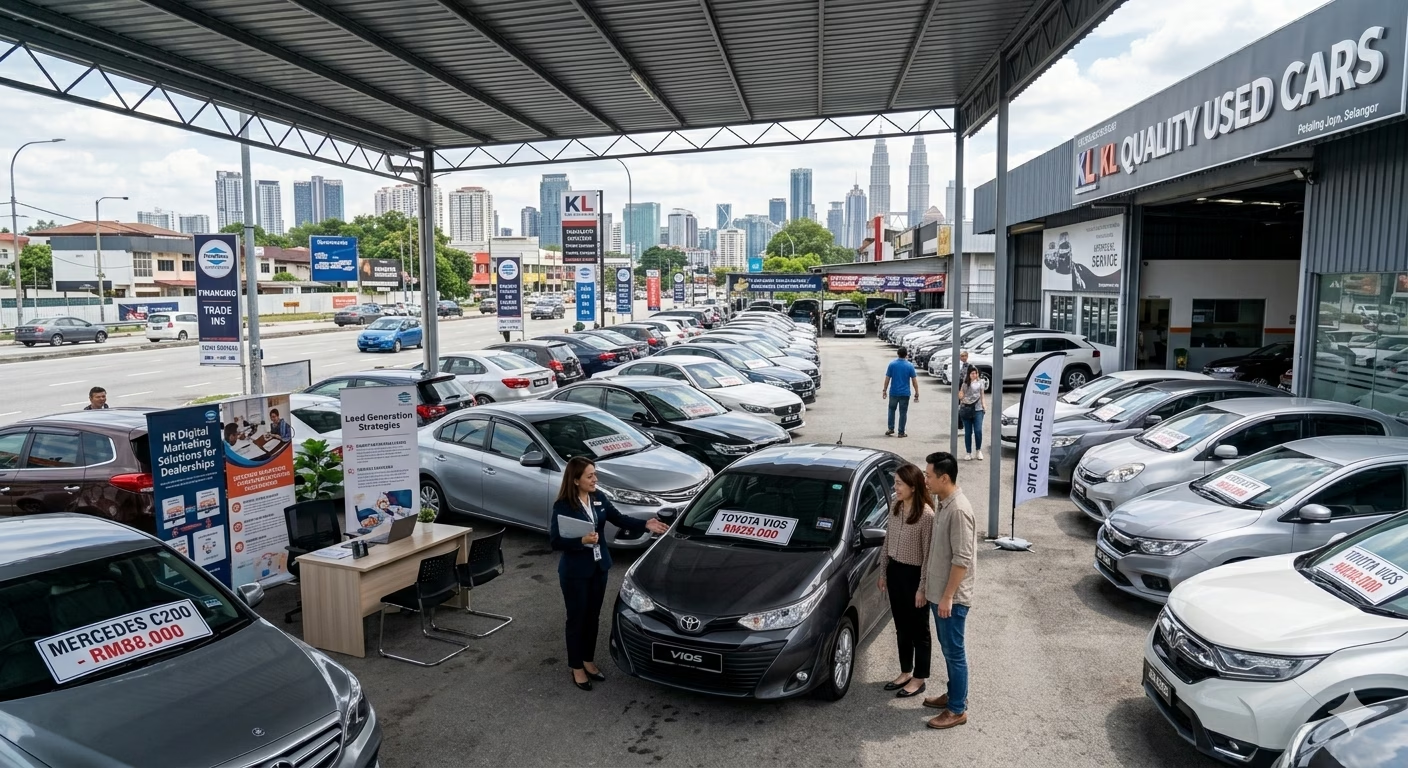
Automotive Digital Marketing in Malaysia 2026
TL;DR / Quick Answer:
Automotive digital marketing Malaysia in 2026 is no longer about who spends most on Carlist banner slots. Malaysia hit a record monthly TIV of 90,716 units in December 2025, with passenger vehicle sales reaching 759,098 units for the full year, and EV sales grew 109% year-on-year to 30,848 units. Buyers now research on Google, YouTube, TikTok, and WhatsApp before they walk into a showroom. This guide covers the full automotive digital marketing Malaysia playbook for new car dealers, used car dealers, and workshops.
(Too lazy to read? Contact ZenWeb — The Best Digital Marketing for Automotive Industry in Malaysia and we’ll map your funnel for you.)
Introduction
If you run a car dealership, used car lot, or workshop in Malaysia, 2025 was a tale of two markets. Passenger vehicle sales hit 759,098 units and EV sales doubled to 30,848 units per the Malaysian Automotive Association, yet most dealers and workshops say acquisition costs are rising and showroom foot traffic has moved online. The path from first search to signed sales agreement now runs through Google, YouTube, Instagram, TikTok, and WhatsApp before the customer ever sets foot on your premises.
This automotive digital marketing Malaysia guide is for managers and owners at new-car franchised dealerships, used car dealers, independent workshops, tyre shops, and related automotive service businesses. It walks through how Malaysian car buyers actually decide in 2026, which channels produce qualified test drives and service bookings, and the regulatory signals that matter for automotive trust.
Our view is shaped by working with 500+ Malaysian clients, including automotive dealers and service operators across Klang Valley, Penang, and Johor. Automotive is where digital marketing discipline is the difference between 2 test drives a week and 20.
Why Digital Marketing Is Essential for Automotive in Malaysia
Every Malaysian car buyer does substantial digital research before stepping into a showroom. In 2026, the test drive is the closing move, not the opening one.
Three Malaysian-market realities make automotive digital marketing Malaysia non-negotiable:
- Research depth has grown. Malaysian buyers now watch multiple YouTube reviews, scroll Instagram reels, read Carlist/Mudah listings, check Google reviews, and WhatsApp sales advisers before a showroom visit. Dealers invisible across these channels are filtered out.
- EV segment changes the buyer profile. EV sales grew 109% year-on-year in 2025. EV buyers over-index on digital research, comparing Proton e.MAS, BYD, Tesla, and Jaecoo models heavily online before visiting any showroom.
- Used car and workshop competition is intense. The fragmented used car and workshop segment has thousands of operators. Winning the local Google Maps pack and Facebook Marketplace presence is often the difference between thriving and surviving.
The practical implication: modern automotive digital marketing Malaysia strategy runs SEO, paid search, Meta, YouTube, and local Maps presence simultaneously. Single-channel dealers (e.g. “we just use Carlist”) leak leads to multi-channel competitors.
How Malaysian Car Buyers Actually Research and Decide
Malaysian car buyers follow a 6-step path that typically runs 4-12 weeks for new cars and 1-3 weeks for used:
- Trigger — family change, finance change, end of current car’s useful life, or specific brand launch
- Broad exploration — YouTube reviews, Instagram/TikTok comparisons, Mudah browsing, Carlist shortlisting
- Price and specification check — dealer websites, finance calculators, insurance and road tax estimates
- Local dealer shortlist — Google Maps for “[brand] dealer near me” or “[car model] Malaysia”
- WhatsApp enquiry — 3-5 dealerships, asking about stock, promotions, test-drive slots
- Test drive and close — 1-2 shortlisted dealers; decision usually within a week of the first test drive
The under-appreciated step is step 4. Malaysian buyers compare dealers on Google reviews, photos, and location before contacting any of them. A dealership with 25 reviews, outdated photos, and a weak website gets filtered out before the WhatsApp even arrives. Automotive digital marketing Malaysia practice must invest in step 4 infrastructure before scaling paid channels.
What Digital Marketing Channel Should My Dealership or Workshop Use?
No single channel wins. Mix depends on segment (new/used/workshop), location, and brand specialisation.
|
Channel
|
Speed to Sales/Service
|
Cost
|
Best For
|
Main Risk
|
|
Carlist / Mudah listing portals
|
Fast
|
High per-lead
|
Used cars, quick exposure
|
Expensive; limited brand building
|
|
Google Ads (Search)
|
Fast (days)
|
Medium–High
|
Model-specific, service-specific intent
|
CPC inflation in top brands
|
|
Google Business Profile + Local SEO
|
Medium (weeks)
|
Low
|
Showroom and workshop walk-ins
|
Needs consistent review flow
|
|
Meta Ads (FB/IG)
|
Fast
|
Medium
|
New launches, promotions, EV buyer research
|
Creative fatigue; leaky attribution
|
|
YouTube Ads / organic
|
Medium
|
Variable
|
Consideration-phase nurturing
|
Time-intensive production
|
|
TikTok / Reels
|
Medium
|
Time-heavy
|
Younger buyers, EV enthusiasts
|
Trend-dependent results
|
Segment shapes the mix. A franchised new-car dealer leans into Google + Meta + YouTube plus Carlist. A used car dealer leans into Mudah + Carlist + Facebook Marketplace + Maps. A workshop leans into local SEO + Google Ads for service-specific intent + Maps reviews. Automotive digital marketing Malaysia plans must match channel to segment. See ZenWeb’s SEO service →
SEO for Automotive
Automotive SEO in Malaysia splits by segment. New car franchised dealers compete on brand + model + location. Used car dealers compete on model + price-range + location. Workshops compete on service-type + location.
The four page types every automotive website needs:
- Model pages (new-car dealers) — one per model (Perodua Bezza, Toyota Vios, Proton X50, BYD Atto 3, etc.). Specs, variants, pricing, financing options, test drive CTA.
- Inventory pages (used car dealers) — individual listings with Vehicle schema, photos, mileage, condition, price.
- Service pages (workshops) — one per service: engine diagnostic, brake service, tyre replacement, aircon service, battery, wheel alignment, etc.
- Location pages — for dealers with multiple outlets, one per location with Google Business Profile link.
Practical automotive SEO tactics for Malaysian operators:
- AutoDealer + AutomotiveBusiness + Vehicle schema — Google rich results for automotive are highly structured.
- Inventory SEO with proper photo alt text and structured data — used car dealers who structure their inventory feed rank for long-tail model searches.
- EV-specific content cluster — Malaysian EV search volume grew heavily in 2025. Dedicated content on range, charging, tax incentives, and model comparisons captures a growing intent pool.
- Service area pages for workshops — “BMW service Petaling Jaya”, “tyre shop Shah Alam”. Local intent + service specificity.
- Genuine video reviews on-site — embed your own YouTube walkthroughs on each model page. Dwell time and ranking both benefit.
Automotive digital marketing Malaysia that skips SEO is renting every lead. See ZenWeb’s SEO pricing →
Google Ads is a core channel for Malaysian automotive, especially for model-specific and service-specific intent. The buyer typing “Proton X50 price Malaysia” or “BMW service Petaling Jaya” is ready to engage.
Three tactical rules for Malaysian automotive Google Ads accounts:
- Bid on model + location and service + location. “Perodua Myvi dealer PJ”, “BYD Atto 3 Malaysia price”, “aircon service Damansara”. These convert. Generic “car dealer” does not.
- Separate new-car, used-car, and service campaigns. Different buyers, different conversions, different landing pages.
- Use negative keywords aggressively. “Jobs”, “how to”, “manual”, “DIY” pulled in wrong context burn budget. Audit weekly for the first 90 days.
For most Malaysian dealerships spending under RM 25,000/month on Google Ads, the 80/20 is usually: 55% model + location long-tails, 25% service queries (for workshops or after-sales), 10% branded, 10% remarketing. Automotive digital marketing Malaysia accounts that don’t separate campaigns underperform materially. See ZenWeb’s Google Ads pricing →
Meta Ads (Facebook + Instagram) drives awareness and consideration-stage nurturing for Malaysian automotive. It is not typically the direct-response workhorse of Google — but it is where brand preference forms.
What works for automotive digital marketing Malaysia on Meta in 2026:
- Short vertical walkthrough videos. 30-60 second videos of the car exterior, interior, dashboard, and key features. Outperforms still photos by wide margins.
- Launch-event campaigns. New model launches, KLIMS, dealership openings. Meta’s reach makes it ideal for event-driven spikes.
- Promotion creative with clear price and financing. Malaysian buyers respond strongly to visible monthly instalment figures and clear promotion terms.
- Lookalike audiences off past buyers. Once you have 1,000+ historical buyer contacts, lookalikes outperform interest-based targeting consistently.
- Retargeting with dynamic inventory ads. Used car dealers in particular benefit from showing visitors the specific vehicles they viewed.
- Facebook Marketplace for used car inventory. Free to list, substantial organic reach, well-used by Malaysian buyers.
Meta creative fatigue is aggressive in automotive — refresh creative every 2-3 weeks to avoid rising cost per engagement. See ZenWeb’s Meta Ads pricing →
Your dealership website is a conversion engine, not a corporate brochure. Every visitor is evaluating stock, price, financing, and trust. A slow or broken site leaks test drives to competitors.
Non-negotiables for Malaysian automotive websites:
- Inventory search with working filters. Model, year, price range, mileage, transmission, fuel type. Broken filters cause instant bounce.
- Individual vehicle pages with Vehicle schema. Model, variant, price, mileage, photos, walkthrough video, test drive CTA.
- Finance and road-tax calculators. Buyers want monthly instalment estimates before they call.
- Mobile-first. Most Malaysian automotive research happens on phones.
- Core Web Vitals passing. LCP under 2.5s, INP under 200ms, CLS under 0.1.
- WhatsApp CTA everywhere. Malaysian buyers prefer WhatsApp over forms and email for test-drive booking and stock enquiry.
- Real photos and video of actual inventory. Stock manufacturer photos read as generic. Photos of your actual unit win.
- Google review integration on homepage and dealer-page.
Automotive digital marketing Malaysia strategy collapses if the website is broken. See ZenWeb’s Web Design pricing →
Automotive Regulation and Trust Signals in Malaysia
Malaysian automotive is regulated across several bodies. Compliance is both legal requirement and trust signal on marketing materials.
Key bodies and signals for automotive digital marketing Malaysia:
- JPJ (Road Transport Department) — vehicle registration, roadworthiness, number plates. Display JPJ test registration dates for used cars where relevant.
- Puspakom — mandatory inspection for used cars and commercial vehicles before transfer. A “Puspakom Pass” mention on used car listings is a trust signal.
- MAA (Malaysian Automotive Association) — industry body tracking TIV and sector trends.
- MIROS (Malaysian Institute of Road Safety Research) — safety research authority.
- SSM (Suruhanjaya Syarikat Malaysia) — business registration. Footer display.
- SST / service tax — applies to after-sales services and certain automotive transactions. Display SST status where registered.
- Consumer Protection Act 1999 + Hire Purchase Act 1967 — apply to vehicle sales. Transparent pricing, clear warranty terms, clear financing terms.
- MITI / MIDA incentives for EVs — CKD EV tax breaks, road tax exemptions. Updates matter for marketing copy.
Local SEO for Automotive
Local SEO is the single highest-ROI channel for Malaysian automotive service businesses. Buyers searching “car service near me”, “tyre shop Petaling Jaya”, or “Proton service centre Shah Alam” see the Maps 3-pack first. Winning that pack drives walk-ins.
The practical automotive local SEO stack:
- Google Business Profile (GBP) — category “Car Dealer”, “Used Car Dealer”, “Auto Repair Shop”, “Tire Shop”, or more specific. Complete every field.
- Reviews pipeline — ask every satisfied customer at checkout. Automotive customers are more willing to review than most service categories if asked.
- Photo freshness — upload new showroom, inventory, and service bay photos weekly. Google’s algorithm rewards active profiles.
- Service / product attributes on GBP — models serviced, brands stocked, amenities (waiting area, free Wi-Fi), languages spoken.
- NAP consistency — across GBP, Carlist dealer page, Mudah profile, Facebook, website footer.
- Google Posts — weekly promotions, new stock arrivals, service packages.
- Q&A management — Malaysian buyers often ask model availability and price ranges in GBP Q&A. Respond within 24 hours.
Automotive digital marketing Malaysia efficiency compounds hardest on well-run local SEO plus a steady review flow.
Content and Founder IP for Automotive
Content marketing for Malaysian automotive has shifted sharply toward short-form video and dealer-principal-led thought leadership. Static car photos lose to 60-second walkthroughs.
What works in 2026:
- Dealer-principal or senior sales rep on camera. Walkthroughs, model comparisons, “3 things you should know about the new X50”. Malaysian buyers trust a visible human over anonymous brand voice.
- YouTube comparisons and explainers. “Proton X50 vs Honda HR-V”, “Is the BYD Atto 3 worth buying in 2026”. Long-form compounds for years.
- TikTok for EV content. Malaysian EV buyers skew younger and consume short-form video heavily. Early TikTok-first dealers are building significant audiences.
- Facebook Group engagement — model-specific owner groups, brand enthusiast groups. Sales advisers who participate genuinely (not spam) build warm leads.
- Email and WhatsApp lists — service reminders, promotion alerts, new model previews. Owned audience, algorithm-proof.
- Service education content — “How often should you change engine oil in Malaysia”, “What to do if your battery dies” — workshops win trust with genuinely useful content.
Dealer-led automotive digital marketing Malaysia is hard to copy because the human is the differentiator.
Before-and-After Survey: ZenWeb Malaysian Automotive Operator Study (March 2026)
Internal ZenWeb proprietary survey of 21 Malaysian automotive clients (franchised dealers, used car dealers, workshops), tracked over 12 months pre- and post-engagement.
|
Metric
|
Before Digital Marketing Investment
|
After 12 Months
|
|
Monthly qualified enquiries
|
42
|
138
|
|
Cost per qualified enquiry
|
RM 185
|
RM 78
|
|
Enquiry-to-test-drive conversion
|
31%
|
52%
|
|
Test-drive-to-sale conversion
|
38%
|
51%
|
|
Google review count
|
47
|
215
|
|
Portal-only lead share
|
72%
|
41%
|
|
Owned-channel lead share
|
28%
|
59%
|
What Does Cost-Per-Lead Look Like Across Malaysian Automotive Segments?
Quick answer. CPL across Malaysian automotive segments ranges from roughly RM 28 (high-volume workshop service enquiries) to RM 320 (premium/luxury new car enquiries). Variance is driven by vehicle value, buyer intent, and competitive density.
CPL by automotive segment, Malaysian market, 2026.
|
Segment
|
Median CPL (Google)
|
Median CPL (Meta)
|
Median blended
|
|
Workshop service (routine)
|
RM 32
|
RM 24
|
RM 28
|
|
Tyre shop
|
RM 38
|
RM 28
|
RM 32
|
|
Used car (sub-RM 50k)
|
RM 48
|
RM 35
|
RM 42
|
|
Used car (RM 50k-150k)
|
RM 72
|
RM 52
|
RM 62
|
|
Used car (premium >RM 150k)
|
RM 165
|
RM 120
|
RM 140
|
|
New car (national brand — Perodua, Proton)
|
RM 52
|
RM 38
|
RM 45
|
|
New car (mass market — Toyota, Honda)
|
RM 92
|
RM 68
|
RM 80
|
|
New car (EV — BYD, Tesla, Proton e.MAS)
|
RM 140
|
RM 105
|
RM 120
|
|
New car (premium/luxury — BMW, Mercedes)
|
RM 380
|
RM 250
|
RM 315
|
Source: ZenWeb proprietary analysis across 21 Malaysian automotive clients, March 2026.
Why this matters: a Perodua dealer benchmarking against “RM 200 automotive industry CPL” will wildly over-budget. A luxury dealer expecting RM 50 CPL will under-invest. Automotive digital marketing Malaysia benchmarking must be segment-specific to be useful.
How Does Video Walkthrough Presence Map to Test-Drive Book Rate?
Quick answer. Malaysian dealership listings with a 60+ second walkthrough video book test drives 3.2× more often than listings with only static photos. Video is not optional in 2026 automotive marketing.
Video presence vs test-drive book rate, Malaysian dealership inventory.
|
Listing content type
|
Indexed test-drive book rate
|
|
Basic (under 5 photos, no video)
|
100 (baseline)
|
|
Good photos (10-15, no video)
|
175
|
|
Good photos + short video (<30s)
|
235
|
|
Good photos + full walkthrough (60-120s)
|
320
|
|
Full walkthrough + dealer-principal video
|
385
|
Source: ZenWeb client analytics across 1,400+ Malaysian automotive listings, March 2026.
Why it matters: the cheapest automotive digital marketing Malaysia upgrade is not more ad spend — it is filming proper walkthroughs of every unit. A salesperson with a RM 3,000 smartphone and a stabilizer gimbal produces content that doubles conversion, at zero incremental media cost.
What Is the Cost Impact of Portal-Only vs Multi-Channel Lead Strategy?
Quick answer. A Malaysian used car dealer reliant on Carlist/Mudah portals pays roughly RM 85-120 per qualified lead. The same dealer with a balanced channel mix (portals + Google + Meta + SEO + Maps) typically pays RM 45-65 per qualified lead — a 40-50% cost reduction at similar or higher volume.
Modelled per-lead cost comparison, Malaysian used car dealer at 80 leads/month.
|
Channel mix
|
Portal spend
|
Paid search/social
|
SEO/content
|
Avg cost per qualified lead
|
|
100% portals
|
RM 8,000
|
—
|
—
|
RM 100
|
|
70% portals / 30% paid search
|
RM 5,600
|
RM 1,400
|
—
|
RM 88
|
|
50% portals / 35% paid search / 15% SEO
|
RM 4,000
|
RM 1,800
|
RM 800
|
RM 73
|
|
30% portals / 40% paid / 30% SEO
|
RM 2,400
|
RM 2,400
|
RM 1,800
|
RM 58
|
Modelled scenario built on ZenWeb client benchmarks (portal CPL RM 100, paid CPL blended RM 52, SEO blended CPL RM 30 mature state). Illustrative, not empirical. Source: ZenWeb, March 2026.
Why it matters: portal presence is useful for exposure. It is expensive as a sole channel. Every ringgit shifted from portal-only to a balanced mix lowers blended CPL by 30-45% over 12 months. That is the real financial case for broader automotive digital marketing Malaysia investment.
Case Study
Dealer: Malaysian used car dealership, founded 2019, Klang Valley, 45 units average inventory. Starting point: 78% leads from Carlist/Mudah, RM 118 blended cost per qualified lead, 34 Google reviews, 3.9 rating, 22-day average days-on-lot. 12-month engagement (SEO + Google Ads + Meta + Maps optimisation + site rebuild + inventory video workflow):
- Portal dependence dropped from 78% to 42%
- Blended CPL fell to RM 54 (54% reduction)
- Google reviews grew to 186 at 4.7 rating
- Inventory days-on-lot fell to 13 (41% faster turnover)
- Monthly unit sales grew 2.1× year-on-year
Common Mistakes Malaysian Dealerships Make in Digital Marketing
Six mistakes we see repeatedly in automotive digital marketing Malaysia accounts:
- Over-reliance on Carlist/Mudah. High per-lead cost, limited brand building, portal-owned customer.
- Thin inventory listings. Single photos, no walkthrough video, vague description. See Data 2/3 — this is the cheapest fix in the category.
- Ignoring Google Business Profile. Workshop and dealer Maps listings drive more walk-ins than most paid campaigns, and most dealers under-maintain them.
- Slow WhatsApp response. Buyers compare 3-5 dealers via WhatsApp and pick the one that replies first.
- Generic Meta creative. Stock manufacturer photos in ads underperform dealer-shot real inventory by wide margins.
- No EV content. EV segment doubled in 2025 and continues growing. Dealers without dedicated EV content miss growing intent.
Future-Proof Automotive Digital Marketing Trends for 2026 and Beyond
Four trends Malaysian automotive operators should plan for:
- AI Overviews for model research. Buyers ask ChatGPT and Google AI Overviews “best SUV under RM 150k Malaysia” or “Proton X50 vs Chery Omoda 5”. Structured content, clear specs, and expert commentary earn citations.
- Short-form video becomes default discovery. TikTok and Reels are where model preference forms among under-35 buyers. Early movers win for years.
- EV-specific search intent growth. Range, charging, tax incentives, total cost of ownership — each is a content cluster on its own.
- WhatsApp Business API for automated lead qualification. Auto-replies, stock lookups, test-drive booking flows. Lets solo-sales-adviser dealers compete on response time with bigger operators. Automotive digital marketing Malaysia leaders are already implementing these.
Conclusion
Three moves that matter most for automotive digital marketing Malaysia in 2026:
- Video every unit. Walkthrough video on every listing is the single highest-ROI upgrade in the category.
- Reduce portal dependence. Build owned channels (SEO, Maps, email/WhatsApp). Every ringgit moved off Carlist lowers blended CPL.
- Ask for reviews relentlessly. Every satisfied buyer and service customer. Reviews compound into Maps-pack dominance.
If you would like a ZenWeb audit of your current automotive digital marketing Malaysia mix, portal dependency, and inventory conversion, WhatsApp us or request a free proposal.