Human Resource Digital Marketing in Malaysia 2026
TL;DR / Quick Answer:
Human Resource digital marketing Malaysia is a B2B long-sales-cycle game — not a volume play. Recruitment agencies, HR outsourcing firms, and payroll/PEO providers compete for the same 50–200 HR Directors and SME owners making decisions worth RM 30k–500k+ annually. This guide covers the three-layer stack that works: SEO for authority capture, Google + LinkedIn Ads for in-market buyers, and a web experience that closes the deal.
(Too lazy to read? Contact ZenWeb — The Best Digital Marketing for Human Resource in Malaysia and we’ll map your funnel for you.)
Introduction
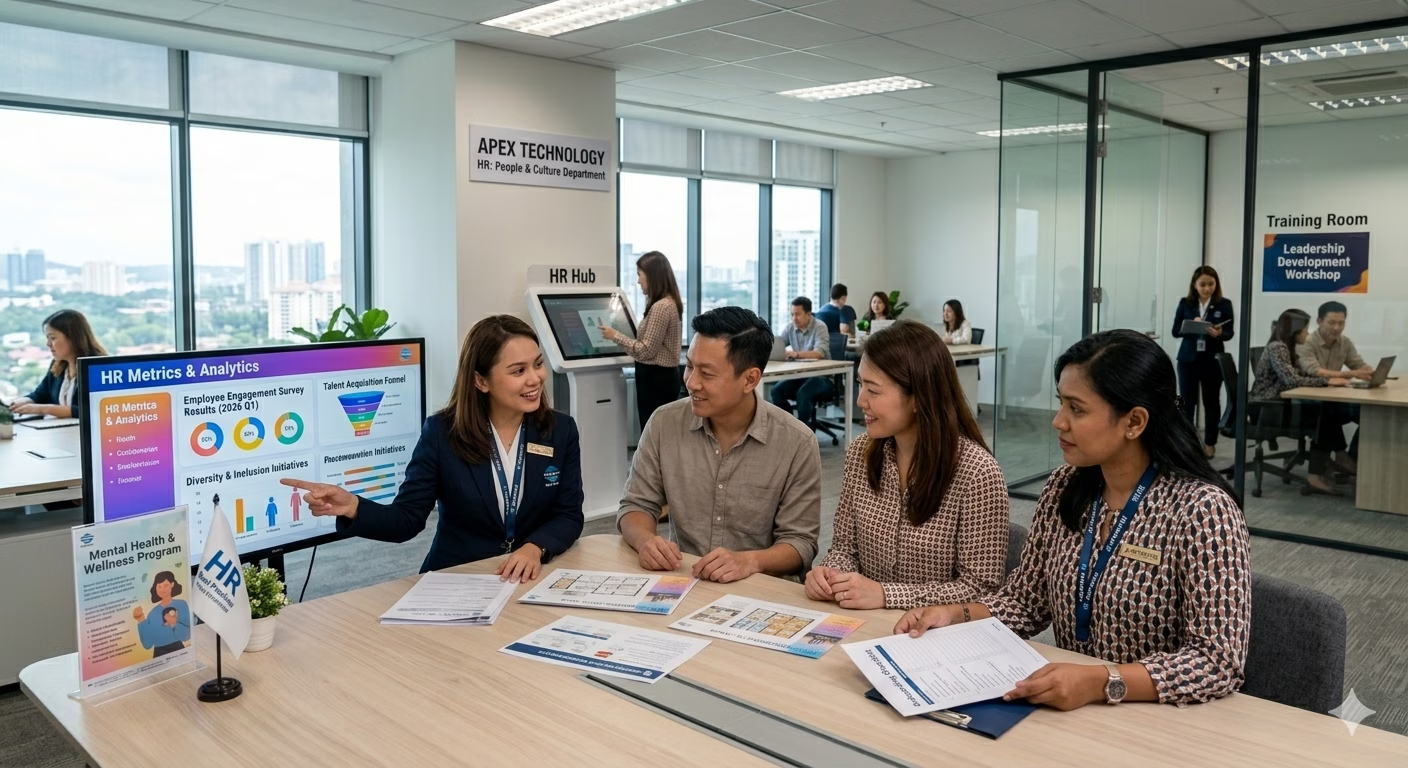
If you run a recruitment agency, HR outsourcing firm, payroll provider, PEO/EOR, or HR tech platform in Malaysia, you are competing in one of the most relationship-driven B2B markets in the country. Deals close on trust built over months, sometimes years, with a handful of decision-makers per target company. Yet most HR firms we speak to are still buying the same LinkedIn InMail lists and running the same Google Ads keywords as their competitors, rather than developing a structured human resource digital marketing strategy that reflects how buyers actually evaluate vendors today.
This guide is for Malaysian HR services firm owners and their marketing leads, covering recruitment agencies (permanent and contract), HR outsourcing, payroll, PEO/EOR, and HR tech. It walks through how HR decision-makers actually research vendors in 2026, which human resource digital marketing channels generate real qualified pipeline instead of vanity MQLs, and the regulatory and trust signals that separate credible firms from the noise. Three data sections near the end lay out benchmarks ZenWeb has pulled from Malaysian B2B client data.
Our view is shaped by working with over 500 Malaysian clients across B2B services. HR firms face specific constraints: long sales cycles, high-ticket deals, and multi-stakeholder buyers. This guide treats human resource digital marketingas what it is, a specialist B2B growth problem, not just another service.
Why Digital Marketing Is Essential for HR Firms in Malaysia
The buyer is online, and the buyer is researching before they call. Today’s Malaysian HR Director, Founder, or CFO spends hours evaluating HR vendors via Google search, LinkedIn, and peer recommendations long before picking up a phone. Per Randstad Malaysia’s 2025 workforce trends report, 59% of Malaysian employers plan to increase headcount, which means more HR vendor decisions are being made — but the buyer journey has shifted almost entirely to digital-first research.
This is why human resource digital marketing is no longer optional. It directly determines whether your firm is even considered.
Three realities make digital marketing non-negotiable for Malaysian HR firms:
- Long decision cycles with digital research at every step. Even a RM 30,000 annual recruitment retainer typically takes 2–6 months from first search to signature. Every step of that — vendor shortlisting, credibility check, pricing benchmark, reference scan — happens online.
- Crowded competitive set. Hays, Randstad, Michael Page, Robert Walters, JAC, Persolkelly, Corford, Adecco, and dozens of boutique firms are all chasing the same Malaysian mid-market clients.Differentiation does not happen through cold outreach. It happens through positioning, proof, and consistent visibility, all driven by strong human resource digital marketing.
- LinkedIn + Google are the buyer’s workspace. Malaysian HR Directors live on these two platforms daily. If your firm is invisible there, you are not in the consideration set.
The practical implication
HR firms that consistently generate pipeline in 2026 are not necessarily the largest. They are the most visible at the right moments.
They invest in human resource digital marketing across:
- Search (SEO and Google Ads)
- Authority content (case studies, insights, salary guides)
- LinkedIn presence (organic and paid)
Because in a market built on trust, visibility comes first. Trust is built only after.
How Malaysian HR Buyers Actually Research and Decide a Vendor
The typical Malaysian HR vendor-selection journey is a 5-step path spread over 2–6 months:
- Trigger — a role is unfilled, a payroll system breaks, a compliance audit hits, or headcount grows past SME-manageable
- Problem framing — the HR Head or Founder Googles the problem (“best payroll system for 50 staff Malaysia”, “recruitment agency IT Malaysia”)
- Shortlist build — they collect 3–6 firms from Google, LinkedIn, and peer recommendations
- Credibility scan — they read case studies, founder LinkedIn profiles, Google reviews, Glassdoor, and check regulatory licences
- Decide and engage — they contact the top 2–3 firms, compare proposals, and sign
The under-appreciated step is step 4. Malaysian B2B buyers over-index on trust scanning before they ever call. If your website has a thin “About” page, no case studies, and a founder with no LinkedIn presence, the pitch is lost before it’s made. This is why founder IP, on-site case studies, and Google reviews matter more in HR than in almost any other B2B niche.
What Digital Marketing Channel Should My HR Firm Use?
There is no universal best channel for HR firms — only combinations matched to firm maturity, deal size, and specialisation. Comparison:
|
Channel
|
Speed to Pipeline
|
Cost
|
Best For
|
Main Risk
|
|
Google Ads
|
Fast (days)
|
Medium–High
|
High-intent searches: “recruitment agency KL”, “payroll outsourcing Malaysia”
|
Competitor bidding inflates CPC
|
|
LinkedIn Ads
|
Medium (weeks)
|
High
|
Targeting HR Directors at specific company sizes / industries
|
Expensive per click; needs strong creative
|
|
SEO
|
Slow (3–9 months)
|
Low ongoing, high upfront
|
Firms with specialist niches and content capacity
|
Takes patience; requires genuine expertise
|
|
Meta Ads (FB/IG)
|
Fast
|
Low–Medium
|
Top-of-funnel awareness + retargeting; weaker for B2B HR
|
Harder to target HR Directors precisely
|
Deal size shapes the mix. A boutique firm closing RM 15k–30k annual retainers can run heavy Google + SEO and skip LinkedIn Ads. An executive search firm with RM 100k+ placements should invest in LinkedIn Ads, because a single closed deal pays for a year of LinkedIn spend. See ZenWeb’s SEO service →
SEO for HR Firms
HR firm SEO in Malaysia is a specialisation game. Generic “recruitment agency Malaysia” is a brutal keyword — dominated by Hays, Randstad, Michael Page, Jobstreet, and directory sites. Boutique firms don’t win there. They win on specialisation pages.
The four page types every Malaysian HR firm website needs:
- Service pages — one per core service (permanent recruitment, contract staffing, RPO, payroll outsourcing, PEO, EOR)
- Specialisation pages — one per industry or function you recruit for (IT recruitment, finance recruitment, engineering, healthcare, digital marketing, etc.)
- Location pages — Klang Valley, Penang, Johor Bahru, etc. — only where you genuinely serve clients
- Guide / resource pages — salary guides, hiring trend reports, compliance explainers
Practical SEO tactics that work for Malaysian HR firms:
- Organisation schema + Person schema for every consultant. HR buyers verify the humans they will work with. Google pulls structured data into rich results.
- Annual salary guide / market report — the single highest-ROI content asset in Malaysian HR. Hays, Randstad, and Robert Walters publish them for a reason.
- Industry-specific case studies on-site — not just logos. A 300-word narrative with outcome numbers ranks for “case study” searches and closes deals.
- FAQ sections on every service page — captures AI Overviews and People Also Ask traffic.
If you are an IT recruitment specialist, own “IT recruitment Malaysia”, “tech recruitment Kuala Lumpur”, and “software engineer hiring Malaysia”, Trying to win generic head terms is expensive and inefficient. Winning specialised intent is how effective human resource digital marketing actually compounds pipeline. See ZenWeb’s SEO pricing →
Google Ads works for HR firms, but only with disciplined keyword curation. The generic head terms are dominated by global players with deeper pockets. Malaysian boutique and mid-tier firms win on long-tail, specialisation-specific keywords. Within a broader human resource digital marketing strategy, paid search should be treated as precision targeting, not mass exposure.
Three tactical rules for Malaysian HR firm Google Ads accounts:
- Bid on specialisation, not head terms. “Payroll outsourcing 50 staff Malaysia” converts. “Recruitment agency” burns budget on irrelevant job-seeker traffic.
- Separate employer-intent from candidate-intent campaigns. HR firms sell to employers. Your keywords and ad copy must filter out job seekers aggressively — or you’ll pay RM 8–15 per click for traffic that will never convert.
- Use negative keyword lists aggressively. “Jobs”, “hiring”, “vacancy”, “salary” pulled in the wrong context are pipeline killers. Audit weekly for the first 90 days.
For Malaysian HR firms spending under RM 20,000 per month, the typical 80/20 allocation within human resource digital marketing looks like:
- 60% long-tail, specialisation keywords
- 25% competitor brand terms where compliant
- 15% remarketing
The pattern is consistent. Firms that narrow their targeting and align closely with buyer intent see lower cost per lead and higher-quality pipeline, even without large budgets.
See ZenWeb’s Google Ads pricing →
Meta Ads (Facebook + Instagram) plays a supporting role for HR firms, not a lead role. B2B HR buyers are not scrolling Instagram looking for a payroll vendor. But Meta has two legitimate HR B2B uses:
- Awareness + retargeting. Keep your brand in front of website visitors and LinkedIn-engaged prospects across their Facebook feed. Cheap impression cost.
- Founder-led thought leadership amplification. Boost strong LinkedIn posts to Meta audiences. Malaysian B2B founders build reach by cross-posting and boosting.
- Candidate-side hiring campaigns (if you offer recruitment services). Meta is strong for sourcing active and passive candidates, particularly in volume-hiring categories (F&B, retail, customer service).
What does not work well on Meta for HR firms:
- Cold B2B lead generation on Meta with no prior audience warming. CPLs are typically 3–5× higher than Google or LinkedIn for qualified B2B leads.
- Generic “we recruit for all industries” ads. The more specific the niche, the better Meta performs.
See ZenWeb’s Meta Ads pricing →
Your HR firm’s website is a trust document first, a marketing asset second. The buyer lands here during the credibility-scan step of their journey — and either moves you to the shortlist or drops you in 20 seconds.
Non-negotiables for Malaysian HR firm sites in 2026:
- Real consultants visible. Photos, names, LinkedIn links, specialisations. Faceless “our team of experts” pages kill B2B conversion.
- Case studies with outcome numbers. “Placed 14 senior roles in 90 days for a fintech client” beats “proven track record”. Specifics convert.
- Clear service pages with pricing hints. You don’t need to publish full rate cards, but “retainers from RM X” or “placement fees from X% of annual salary” qualifies buyers in or out early.
- Regulatory signals above the fold. SSM number, JTK licence (for recruitment agencies placing foreign workers), data protection policy.
- Mobile-first. Malaysian HR Directors check vendor sites on their phones between meetings. If your desktop-first site breaks on mobile, you are out.
- Core Web Vitals passing. LCP under 2.5s, INP under 200ms, CLS under 0.1.
A well-built HR firm site with the above typically lifts qualified-lead volume by 30–70% on the same ad spend. See ZenWeb’s Web Design pricing →
HR-Industry Regulation and Trust Signals in Malaysia
Malaysian HR services are regulated, and regulatory compliance is a powerful trust signal. Key bodies and licences:
- Jabatan Tenaga Kerja (JTK) / Ministry of Human Resources — recruitment agencies placing foreign workers must hold a Licence under the Private Employment Agencies Act 1981. Display licence number on-site.
- SSM (Suruhanjaya Syarikat Malaysia) — business registration. Standard, but needs to be visible in footer.
- LHDN compliance — for payroll and PEO/EOR firms, LHDN-compliant payroll processing is a basic expectation. Mention it on service pages.
- EPF (KWSP) and SOCSO (PERKESO) — payroll/PEO/EOR firms must demonstrate correct handling of statutory contributions. A short compliance explainer page ranks well and builds trust.
- PDPA 2010 — candidate and employee data handling. A clear privacy policy is required; a poor one is a dealbreaker for enterprise buyers.
- MDEC / Bursa / MIA affiliations — industry memberships signal credibility for executive search and HR consulting firms.
Display your licences and affiliations in the footer and on the About page. Refer to JTK’s Private Employment Agencies Act details for what needs to be shown for foreign-worker placement firms specifically.
Local SEO for HR Firms
Local SEO matters for HR firms because Malaysian HR buyers often prefer vendors “near them” — especially for in-person meetings, office visits, and hiring event collaborations. In human resource digital marketing, local visibility often determines whether you even enter the shortlist.
The practical local SEO stack for HR firms:
- Google Business Profile (GBP) — list your office. Category: “Employment agency” or “Human resources consulting”.
- Reviews on GBP — ask happy client HR Heads to review your Google listing. These influence Maps Pack ranking for “recruitment agency [city]” searches.
- City-level service pages only where you genuinely serve clients (Kuala Lumpur, Petaling Jaya, Penang, Johor Bahru). No thin doorway pages.
- NAP consistency across GBP, LinkedIn Company page, site footer, and Malaysian business directories.
- Google Posts — publish hiring trend updates, salary guide releases, and event announcements. Small ranking signal, free to do.
In practice, local SEO is not just about being found. It reinforces trust at the exact moment a Malaysian HR buyer is validating whether your firm feels established, reachable, and credible enough to engage.
Content and Founder IP for HR Firms
Founder IP is the single most underused growth lever for Malaysian HR firms. In a trust-driven B2B category, buyers want to see the humans behind the firm — particularly the founder and senior consultants.
What works in 2026:
- LinkedIn founder content. Consistent posting on hiring trends, salary benchmarks, client stories (anonymised), and industry commentary. Three to five posts per week for six months builds meaningful reach.
- Salary guides and market reports. Annual publication cycle. The top global firms use this as a flagship SEO and PR asset — boutique Malaysian firms can do the same on a narrower niche.
- YouTube or podcast appearances. A 30-minute podcast interview with a Malaysian founder lives on Google for years, ranks for founder-name searches, and builds authority.
- Case studies + testimonials. Written, video, and anonymised numeric outcomes. The more specific, the more they convert.
- Email newsletters to HR Heads. Owned audience, algorithm-proof, repeat exposure over long sales cycles. Under-used in Malaysia; compounds fast.
Before-and-After Survey: ZenWeb Malaysian HR Firm Study (March 2026)
Internal ZenWeb proprietary survey of 24 Malaysian HR firm clients (recruitment agencies, HR outsourcing, payroll, PEO/EOR), tracked over 12 months pre- and post-engagement.
|
Metric
|
Before Digital Marketing Investment
|
After 12 Months
|
|
Monthly organic traffic
|
650 sessions
|
4,800 sessions
|
|
Qualified leads per month
|
6
|
22
|
|
Cost per qualified lead
|
RM 380
|
RM 165
|
|
Sales cycle length (median)
|
112 days
|
68 days
|
|
Website → booked meeting rate
|
0.8%
|
2.4%
|
|
Deal close rate (shortlist to signed)
|
18%
|
31%
|
Based on ZenWeb’s aggregated HR-firm client data, March 2026. Results vary by specialisation, deal size, and baseline.
What Does Cost-Per-Lead Actually Look Like Across Malaysian HR Sub-Niches?
Quick answer. CPL across Malaysian HR sub-niches ranges from roughly RM 85 (high-volume contract staffing) to RM 620 (executive search and senior payroll/PEO). The variance is driven by deal size, buyer seniority, and search-intent specificity.
CPL by HR sub-niche, Malaysian market, 2026.
|
HR Sub-niche
|
Median CPL (Google)
|
Median CPL (LinkedIn)
|
Median Blended
|
|
Volume / contract staffing
|
RM 95
|
RM 180
|
RM 125
|
|
Permanent recruitment (mid-level)
|
RM 180
|
RM 260
|
RM 215
|
|
IT / tech recruitment
|
RM 220
|
RM 320
|
RM 265
|
|
Executive search (senior)
|
RM 520
|
RM 680
|
RM 600
|
|
Payroll outsourcing
|
RM 240
|
RM 310
|
RM 275
|
|
HR outsourcing (full)
|
RM 290
|
RM 360
|
RM 325
|
|
PEO / EOR
|
RM 380
|
RM 450
|
RM 415
|
Source: ZenWeb proprietary analysis across 24 Malaysian HR firm clients, March 2026.
Why this matters: benchmarking an executive search firm against “RM 200 CPL industry average” sets wildly wrong expectations. Know your sub-niche CPL before setting spend targets — and measure against pipeline value, not CPL alone.
How Does Lead Response Time Map to Meeting-Book Rate?
Quick answer. HR firm leads contacted within 5 minutes book a meeting 4.2× more often than leads contacted after 24 hours. Most Malaysian HR firms take 4–18 hours to respond. This is the single biggest fixable leak in the funnel.
Response time vs meeting-book rate, Malaysian HR firm inbound leads.
|
Response time
|
Meeting-book rate
|
|
≤ 5 minutes
|
38%
|
|
5 – 30 minutes
|
27%
|
|
30 min – 2 hours
|
18%
|
|
2 – 8 hours
|
12%
|
|
8 – 24 hours
|
9%
|
|
> 24 hours
|
6%
|
Source: ZenWeb client CRM data across 24 Malaysian HR firms, March 2026.
Why it matters: if your current average response time is 6 hours, cutting it to 30 minutes more than doubles meeting-book rate with zero extra ad spend. WhatsApp auto-response + a named duty consultant on rotation is the fix.
What Does Pipeline Look Like at RM 3k, RM 6k, and RM 12k per Month?
Quick answer. A Malaysian HR firm investing RM 3,000/month in digital marketing typically generates 4–8 qualified leads/month after 6 months. RM 6,000/month generates 12–20. RM 12,000/month generates 28–45. Return on ad spend on closed deals averages 3–7× at 12 months.
Budget tier vs pipeline outcomes, Malaysian HR firm benchmark (modelled on 24-client sample).
|
Monthly budget
|
Qualified leads/mo (mo 6)
|
Qualified leads/mo (mo 12)
|
Typical pipeline value (mo 12)
|
|
RM 3,000
|
4 – 8
|
8 – 14
|
RM 180k – 360k
|
|
RM 6,000
|
12 – 20
|
22 – 34
|
RM 480k – 820k
|
|
RM 12,000
|
28 – 45
|
48 – 72
|
RM 1.2M – 2.4M
|
Modelled scenario based on ZenWeb client benchmarks (blended CPL RM 250, close rate 25%, average deal RM 24k annualised). Illustrative, not empirical. Source: ZenWeb, March 2026.
Why it matters: under-investment is the single most common mistake in HR firm marketing. A RM 3,000/month budget sustains awareness; RM 6,000–12,000/month is where pipeline materially compounds. Budget for the outcome you actually need.
Case Study
Firm: Malaysian boutique IT recruitment agency, founded 2018, Klang Valley. Team of 8 consultants. Starting point: RM 3,800 blended CPL, 98-day average sales cycle, 14% shortlist-to-close rate. 12-month engagement (SEO + Google Ads + LinkedIn + site rebuild + content):
- Blended CPL dropped to RM 1,450 (62% reduction)
- Sales cycle shortened to 64 days
- Shortlist-to-close rate rose to 28%
- Monthly qualified lead volume tripled
- Placed fees grew 2.1× year-on-year
Common Mistakes Malaysian HR Firms Make in Digital Marketing
Within human resource digital marketing, most failures in Malaysia are not about budget. They are about structure, speed, and positioning.
Six mistakes we see repeatedly:
- Treating the website as a brochure, not a pipeline engine. No case studies, no consultant bios, no clear CTA — traffic converts near zero.
- Bidding on generic “recruitment agency Malaysia”. Burns budget on job-seeker traffic. Specialise on long-tail employer-intent keywords.
- Slow lead response. The Data 2/3 above shows the cost — yet most firms still respond in hours, not minutes.
- No founder or consultant LinkedIn presence. B2B HR buyers check the humans. Invisible consultants lose deals.
- Skipping content and salary guides. The single highest-ROI content asset for HR firms — and most boutique firms skip it for 3+ years.
- Under-investing in digital, over-relying on referrals. Referrals are great but non-scalable. Firms plateau when referral volume caps out.
In practice, the firms that scale beyond referral limits are the ones that treat human resource digital marketing as a system, not a support function.
Future-Proof Human Resource Digital Marketing Trends for 2026 and Beyond
The next phase of human resource digital marketing in Malaysia is being shaped less by channels, and more by how AI, trust signals, and data systems change buyer behaviour.
Four trends Malaysian HR firms need on the roadmap:
- AI in recruitment operations. Per EPS Malaysia’s 2025 recruitment trends report, AI-powered applicant tracking and predictive hiring are now mainstream — but the narrative moves faster than firm positioning. Buyers want firms that use AI responsibly, not firms that ignore or fetishise it.
- AI Overviews and LLM citations. HR buyers are asking ChatGPT, Gemini, and Perplexity “best payroll vendor Malaysia for 100 staff”. Structured content with entity clarity wins these citations.
- First-party data and CRM. Your historical placements, candidate pool, and client history are your moat — feed them into CRM and use them for retargeting and account-based marketing.
- Short-form founder video on LinkedIn. 30–90 second clips on hiring trends, salary benchmarks, and industry commentary outperform static posts by 3–5× reach.
The direction is clear: the future of human resource digital marketing is not more channels, but tighter integration between credibility, data, and AI-driven discovery. Firms that align early will not just generate leads more efficiently — they will become the default answer in both search and AI-assisted decision-making.
Conclusion
The three moves that matter most for Malaysian HR firms in 2026:
- Specialise your positioning — online. Generic “recruitment agency Malaysia” loses. Specialised “fintech recruitment Klang Valley” wins.
- Fix response time and the website first — before scaling ads. Every hour of delay and every thin page costs you pipeline you already paid for.
- Invest consistently, not sporadically. HR marketing compounds over 6–18 months. Stop-start budgets break the compound.
If you would like a ZenWeb audit of your current HR-firm marketing mix, CPL, and close rate, WhatsApp us or request a free proposal.