

Share this post:
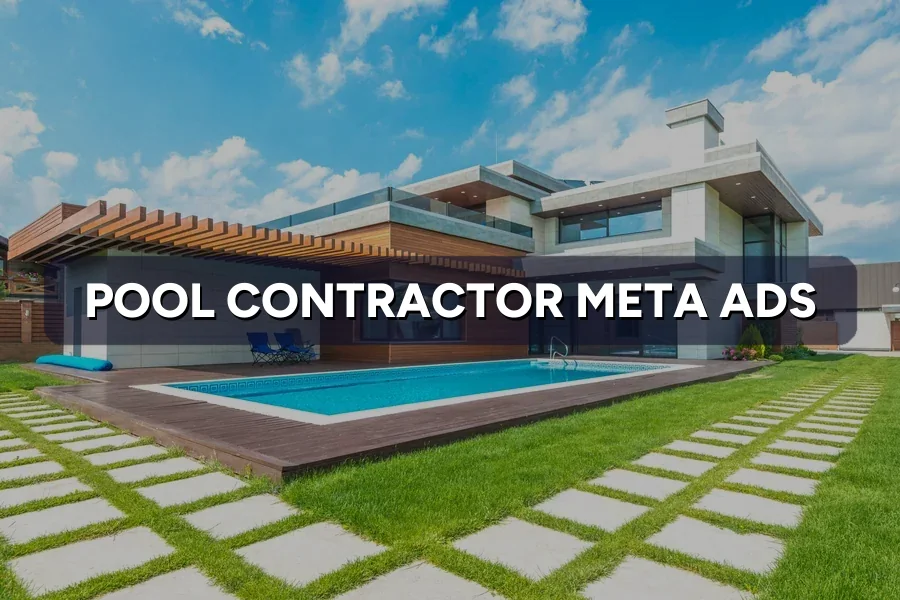
A pool contractor in Klang Valley boosted a post of a finished infinity pool, spent RM 400, and got 61 comments asking for price. Not one of them owned a house with space for a pool.
That is the shape of the problem. Meta will happily show your pool to two million Malaysians, and almost all of them live in a condominium where the pool already exists downstairs. The buyers you want are landed-property owners in a renovation mood — a narrow group that Meta cannot target by checkbox, because “owns a bungalow with eight metres of spare garden” is not an interest you can tick.
This guide covers what solves it: creative that filters, geography that filters, a retargeting ladder built for a 78-day decision, and the maintenance-contract campaign most contractors never run.
ZenWeb runs Meta Ads for pool contractors and other high-ticket outdoor-build trades across 500+ Malaysian accounts, alongside the search side of the same pipeline.
Getting comments instead of quotation requests?
That is a targeting and creative problem, not a budget one. Compare our Meta Ads plans →
Before the audience work, a walkthrough of how contractor campaigns are put together on Meta.
Source video: Daniel Dimsey on YouTube
Quick Answer: Search catches people already shopping for a pool. Meta creates the thought in people who never searched. That makes Meta Ads a demand-creation channel for pool contractors, judged on enquiries over 90 days rather than clicks this week.
Malaysia had 30.7 million social media user identities in October 2025, equal to 85.0% of the population, per DataReportal’s Digital 2026 report. Reach is never the problem. Whether the ad lands on the few thousand who could realistically build is.
The trade-off against search is worth stating plainly:
Most contractors judge Meta on the wrong month. A build enquiry generated in week two often signs in month three, and a contractor who switches the campaign off in week six never sees the return they already paid for.
Quick Answer: A pool is a two-person decision in a Malaysian household, and the person who sees your ad is often not the one who signs. Write for the pair — one wants the look, the other wants the running cost, and both objections need answering.
In ZenWeb’s outdoor-build accounts, the person who fills in the form and the person who pays the deposit are different people in roughly half of signed jobs. One saves the reel; the other asks about running cost three weeks later.
An ad that only sells beauty gets saved and forgotten. An ad that only sells specification gets ignored. The winning sequence answers both:
Quick Answer: Meta has no “owns a landed house” targeting option in Malaysia. You filter by geography and by creative instead — run tight radiuses over bungalow and semi-D neighbourhoods, and let the ad copy state the space requirement so condominium residents scroll past.
This is the single biggest lever in a pool account, and it is not an interest setting. Three filters do the work:
Contractors resist the price line hardest, and it saves the most money. Fewer enquiries arrive, but nobody is shocked at the quotation stage. Detailed targeting settings for the Malaysian market matter far less than these three moves.
Quick Answer: A 45–60 second walkthrough of a finished build produces qualified pool enquiries at about RM 68, with 61% coming from landed homes. A single price-list image costs RM 121 and qualifies at 29% — nearly double the cost for half the quality.
| Creative format | Relative cost | Cost per qualified enquiry | Landed-home rate |
|---|---|---|---|
| Finished-build walkthrough video | RM 68 | 61% | |
| Excavation-to-water time-lapse | RM 74 | 57% | |
| Before-and-after garden carousel | RM 82 | 52% | |
| Drone flyover of completed pool | RM 96 | 48% | |
| Owner testimonial reel | RM 105 | 44% | |
| Single price-list image | RM 121 | 29% |
Source: ZenWeb client tracking across outdoor-build accounts, Malaysia, 2024-2026. Qualified enquiry = landed property with usable garden space. Bars show relative cost.
The testimonial reel underperforming surprises most contractors. It works late, as a retargeting asset for the sceptical second decision-maker — but as a cold ad it asks a stranger to care about someone they have never met.
Quick Answer: Show a real Malaysian garden, filmed on a phone, in daylight, with the house visible behind the pool. Renders and resort photography test worse because viewers cannot picture their own lot in them — the same recognition problem that weakens a contractor’s project gallery pages.
The house in the frame does more work than the pool. A viewer in Setia Alam recognises the roof tiles, the boundary wall, the aircon compressor — and mentally places their own garden into the shot. A Bali infinity edge over a rice terrace gets admiration and no enquiry.
Practical shot list for a walkthrough clip:
Caption carries the numbers the video cannot: size, build weeks, price band, and your CIDB grade.
Sitting on years of finished-build photos and no campaign using them?
We turn contractor project archives into tested Meta creative sets. See how our Meta Ads management works →
Quick Answer: Send cold traffic to click-to-WhatsApp and warm retargeting to the website quotation page. Instant Forms produce the cheapest leads and the worst ones — for a RM 150,000 decision, a conversation beats a form field.
The three destinations behave very differently on a high-ticket build:
If Instant Forms are used at all, make “Do you own a landed property?” and “How much garden space do you have?” required questions. Volume halves; the sales team stops wasting afternoons.
Quick Answer: Interest targeting on “swimming pool” is the trap — RM 26 enquiries that qualify at 12%, because the interest belongs to swimmers. Landed-district geo clusters and video-view custom audiences deliver the real buyers.
| Audience layer | Monthly reach | Cost per enquiry | Qualified | Role in the account |
|---|---|---|---|---|
| Landed-district geo cluster | 46,000 | RM 63 | 66% | Core build volume |
| Broad, creative-led (25-58) | 210,000 | RM 71 | 58% | Scale once creative proves |
| Video viewers, 75%+ watch, 90 days | 18,000 | RM 39 | 71% | Cheapest enquiries |
| Quotation-page visitors, 180 days | 5,400 | RM 34 | 74% | Closes the decision |
| 1% lookalike from deposit payers | 88,000 | RM 77 | 61% | Growth layer, month 4+ |
| Interest: “swimming pool” | 340,000 | RM 26 | 12% | Avoid — swimmers, not builders |
Source: ZenWeb operational data, Malaysian outdoor-build campaigns under management, 2024-2026. Reach figures are typical Klang Valley monthly delivery at RM 3,000 spend.
Read the bottom row carefully. It has the cheapest cost per enquiry in the table and it is the worst audience in the account — the same trap that makes Facebook Ads look busy but produce no sales. Cheap leads from the wrong people are the most expensive thing a pool contractor can buy.
Quick Answer: Median time from Meta enquiry to paid deposit is 78 days, and only 9 in 100 enquiries get there. The heaviest loss is between quotation and follow-up, where retargeting recovers people your sales team wrote off.
| Stage | Typical days | Still active | What protects this stage |
|---|---|---|---|
| Enquiry submitted | Day 0 | 100 | Qualifying questions on the form |
| Two-way conversation started | Day 0-7 | 62 | Reply inside 15 minutes |
| Site measurement accepted | Day 10-30 | 41 | Free, no-obligation framing |
| Written quotation issued | Day 21-50 | 33 | Itemised scope, not a lump sum |
| Still in follow-up | Day 45-90 | 14 | Retargeting on warranty and process |
| Deposit paid | Day 60-150 | 9 | Build slot scarcity, honestly stated |
Source: ZenWeb client tracking, Malaysian pool and outdoor-build accounts, 2024-2026. Median enquiry-to-deposit interval 78 days.
The drop from 33 quotations to 14 active is where the money leaks. Most of those people have not chosen a rival — they have gone quiet while deciding, and a 180-day retargeting window keeps you in front of them until the budget clears.
Quick Answer: Run a 2 km radius ad around every pool you finish, using footage of that exact pool, for eight weeks after handover. Neighbours have already seen the lorries and the excavation — the ad simply tells them who did it.
Pools are visible. A build takes ten to fourteen weeks of obvious activity, and every neighbour who walks past has already had the thought. Nobody ever tells them the company name.
The campaign is small and unusually efficient:
Run consistently, it becomes the cheapest enquiry source in the account within two quarters, because it inherits trust the build itself created.
Quick Answer: Malaysia has tens of thousands of existing private pools with green water and a neglected pump. A maintenance campaign at RM 800 a month signs contracts at roughly RM 45 each and pays wages during the months no build starts.
This is the most underused campaign in the trade. Build advertising is lumpy — three enquiries one week, none the next fortnight. Maintenance advertising is steady, cheap, and targets a different moment: a pool that has already gone wrong.
The creative writes itself, because the problem is visual:
It also feeds the build side. A maintenance customer with an ageing pool is the warmest possible audience for a resurfacing ad two years later.
Only advertising builds, and quiet between them?
We split contractor accounts into build and service campaigns with separate budgets and audiences. See our Meta Ads plans and monthly fees →
Quick Answer: A RM 3,000 build campaign returns about RM 257,000 over three years per monthly cohort. A RM 800 maintenance campaign returns about RM 180,600 — less revenue, but 226 ringgit back per ringgit spent against the build campaign’s 86.
| Measure | Build campaign | Maintenance campaign |
|---|---|---|
| Monthly Meta spend | RM 3,000 | RM 800 |
| Enquiries per month | 42 | 57 |
| Cost per enquiry | RM 71 | RM 14 |
| Enquiry to signed | 3.5% | 31% |
| New customers per month | 1.5 builds | 18 contracts |
| Cost per customer won | RM 2,040 | RM 45 |
| Average customer value | RM 165,000 one-off | RM 350 a month |
| 36-month value per monthly cohort | RM 257,000 | RM 180,600 |
| Return per ringgit of spend | 86x | 226x |
Modelled projection built on ZenWeb cost-per-enquiry benchmarks from Malaysian outdoor-build accounts, 2024-2026. Assumes 22% annual contract churn and a 50% service attach rate on new builds. Illustrative, not a guarantee.
The build column holds the revenue; the maintenance column holds the efficiency. Most contractors run only the first, which is why a slow build quarter feels like a cliff. Check too whether daily or lifetime budgets suit each campaign.
Quick Answer: State your CIDB grade and say you handle the council building plan submission. Never promise approval — you can promise to prepare and submit the drawings, which is what the buyer is actually worried about.
CIDB registration is not optional. Under Section 25 of Act 520, every contractor must register with CIDB before undertaking construction work, with fines from RM 10,000 to RM 100,000 for breaches. Homeowners rarely know the law, but they do know they are handing over a five-figure deposit.
Compliance lines that convert, and the versions to avoid:
| Say this | Not this |
|---|---|
| CIDB registered, Grade G4, licence number on every quotation | “Fully licensed and certified” |
| We prepare and submit your council building plan | “Approval guaranteed” |
| Structural drawings by a registered engineer | “Engineered to the highest standard” |
| 5-year structural warranty, terms on the quotation | “Lifetime warranty” |
Specific and checkable beats grand and vague, and it keeps you clear of misleading-representation issues under Malaysian consumer protection rules.
Quick Answer: Meta will report the form fill and stop there. Feed site visits and paid deposits back as offline conversions so the algorithm optimises toward buyers, not toward whoever fills forms fastest.
Without that feedback loop, Meta optimises for the cheapest form fill it can find — usually a condominium resident asking out of curiosity.
The setup that matters, in order of impact:
Tracking gaps are the usual explanation when an account looks fine on cost per lead and terrible on revenue — the same pattern behind Facebook Ads losing tracking after iOS updates.
Quick Answer: Boosting posts, hiding prices, judging the account at week six, and using resort stock photos. Each one is fixable in an afternoon, and together they explain most failed pool campaigns — including many that got blamed on the channel rather than the setup.
Quick Answer: Film your own finished builds, target landed districts rather than pool interests, publish a price range, retarget for 180 days, and run a maintenance campaign alongside the build one. That is the whole playbook for Meta Ads for pool contractors.
Meta rewards contractors who treat it as a slow channel with fast feedback. The enquiry arrives in week two, the deposit in month three, and everything in between is retargeting doing quiet work.
Start with one walkthrough video, three landed-district clusters and RM 3,000 a month. Add the maintenance campaign in month two, the neighbour radius after your next handover, and offline conversions before month three. In that order, the account becomes a pipeline rather than an experiment.
Quick Answer: Pool contractors ask most about starting budgets, lead costs, how long results take, and whether Meta beats search. Plan detail sits on our Meta Ads pricing page.
RM 3,000 a month is a workable floor for build campaigns across two or three landed-district clusters, producing roughly 42 enquiries. Add RM 800 for a separate maintenance campaign. Below RM 2,000 the retargeting layer starves and the account never gets past cold traffic.
Between RM 34 and RM 96 for qualified build enquiries, depending on audience layer, and around RM 14 for maintenance enquiries. Cheaper leads usually mean worse qualification — interest-based targeting produces RM 26 enquiries that qualify at only 12%.
Enquiries start in the first fortnight, but the median gap from enquiry to paid deposit is 78 days. Expect month one to look like activity, month two to look like a pipeline, and month three to be the first fair read on cost per signed build.
Both, for different jobs. Google catches people already searching for a builder; Meta creates demand among landed-home owners who had not considered it. Contractors needing jobs this quarter start with search, then add Meta to fill the pipeline three months out.
Yes, particularly Reels. Instagram’s ad reach was equal to 44.6% of Malaysia’s population at the end of 2025, and finished-build walkthroughs perform well in that format. Run Instagram and Facebook placements together rather than splitting budgets between them.
Ready to turn your finished builds into next quarter’s deposits?
Book a free 30-minute strategy session. We review your creative library, audience setup and tracking, then give you a 90-day Meta plan with realistic cost per signed build targets.
Complete the form and our team will contact you to discuss your goals. Let’s grow your business.



Meowketing Specialist
Online


























