

Share this post:
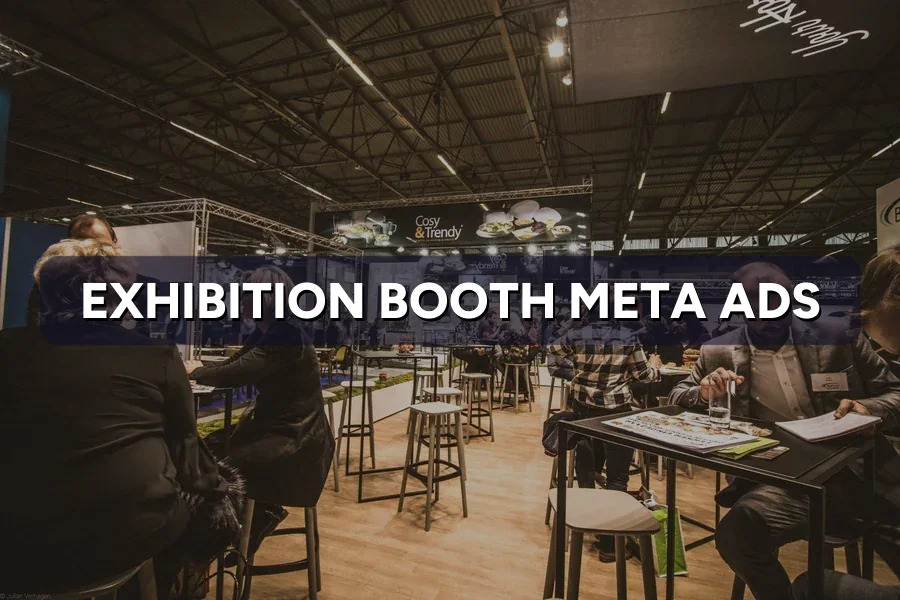
Most booth contractors run Facebook the way a restaurant does. Broad audience, RM 30 a day, a photo of last month’s booth, then quiet. The enquiries that arrive are students, bazaar stall renters and people who wanted a photo booth for a wedding.
The audience is not the problem. Booth buyers are on Meta daily. They simply become buyers on a fixed schedule, cannot be found by interest targeting, and judge you on work you have already built.
ZenWeb runs Meta Ads for booth contractors across 500+ Malaysian accounts. This guide covers structure, targeting, creative, the show-cycle ladder, and four data sets.
Getting enquiries but no drawings requested?
We fix the audience and the proof before touching the budget. Compare our Meta Ads plans →
Before the account structure, a short refresher on how lead campaigns are put together.
Source video: V.S.L Digital Marketing Hub on YouTube
Quick Answer: Your buyer is one marketing or event executive inside a company that has already paid for floor space. The pool is small and the timing is fixed by the show calendar, so Meta earns its keep on proof and recall, not on cheap lead volume.
A consumer campaign works because almost anyone scrolling could buy. Booth fabrication is the reverse. On any given day, the number of Malaysians who can commission a RM 40,000 custom stand is tiny, and most of them are not thinking about it until their space contract is signed.
So you are not filling a funnel of strangers. You are staying in front of a few hundred people, so that when their space is confirmed, your finished booths are the ones they remember.
Quick Answer: Run three campaigns and no more: an always-on portfolio campaign, a show-cycle campaign that switches on per event, and a remarketing campaign. Splitting by show or by state starves each ad set of the weekly events it needs to exit the learning phase.
Booth contractors over-segment more than almost any trade we inherit, usually one campaign per upcoming show. Six campaigns at RM 25 a day each is six accounts that never learn anything.
| Campaign | Objective | Share of budget |
|---|---|---|
| Always-on portfolio | Engagement or Video views | 30% |
| Show-cycle push | Leads | 45% |
| Remarketing | Leads | 25% |
Keep the geography as one radius covering Klang Valley plus any state your crew travels to. The show is in one hall; the head office that pays for the booth might be anywhere.
Quick Answer: Upload the exhibitor lists. Published exhibitor directories are public, so a custom audience built from those company names and your past enquiries beats every interest stack. Broad interest targeting in Malaysia will hand you wedding decorators.
Most agencies reach for job-title layers here. That is the wrong instinct on Meta, where professional targeting is thin compared to LinkedIn and gets diluted the moment the audience drops under a few hundred thousand.
The organiser’s own exhibitor directory, published before shows listed on the MITEC event calendar, is the single most useful targeting input a Malaysian booth contractor has. It names the companies. Your team supplies the rest.
Quick Answer: Show the booth, name the show, and state the size. “9m x 6m island stand, built for METALTECH at MITEC” tells an exhibition manager everything. Generic “creative booth solutions” copy tells them nothing, which is why specific creative converts better.
Exhibition managers read your ad as a portfolio slide. They are checking whether you have built at their size, in their hall, for a company at their level. Every detail you leave out is a doubt they have to resolve by asking someone else.
The copy follows the same discipline. Lead with the constraint that keeps exhibition managers awake, which is move-in day, not design flair:
Quick Answer: Send cold traffic to a portfolio page filtered by booth size, and keep click-to-WhatsApp for warm audiences. Corporate buyers want to see the work before they identify themselves, and a WhatsApp thread is where a real brief actually gets written.
Instant forms look attractive because they are cheap. For booth work they usually collect a personal Gmail address and nothing else, because the exhibition manager tapped it while queuing for lunch and never thought about you again.
A portfolio page does more work. It lets the buyer check your builds at their booth size, and it gives your remarketing something to fire on. If you do run instant forms, add two questions: which show, and how many square metres. Those answers turn a name into a brief, and they let your team reply the way a good WhatsApp enquiry process should.
Not sure whether the ad or the landing page is losing the brief?
We review the ad, the destination and the first reply as one journey. See how our Meta Ads team works →
Quick Answer: Build the ladder around the calendar, not around days since a click. Four rungs work: space-booking season, twelve weeks out, six weeks out, and post-show. Each carries a different message, which is retargeting theory applied to a fixed deadline.
A single 30-day audience makes no sense here. An exhibition manager who watched your build video in November is not cold in February; she is exactly on schedule for a March show.
Cap frequency around three impressions per week per rung. This audience is small, so frequency climbs quickly and irritation costs more than the extra reach is worth.
Quick Answer: Push three events back to Meta: enquiry received, quotation issued, and contract signed with its value. Without the last two, the algorithm optimises for whoever fills forms fastest. Start with a proper pixel and Conversions API setup.
Booth contracts close weeks after the click and rarely on the website, so the outcome has to be pushed back into the platform by hand or through a CRM connection. It is the least glamorous fix in the account and usually the highest-value one.
In practice your quotation sheet gains two columns, quotation date and contract value, uploaded weekly as offline conversions. Within about six weeks Meta stops chasing form-fillers and starts finding people who resemble companies that signed, which also makes the numbers in your Meta Ads report mean something.
Quick Answer: Broad interest targeting produces the cheapest enquiries at RM 27 and the worst quality, with only 9 percent reaching a quotation. Exhibitor-list custom audiences cost RM 143 per enquiry but reach quotation 61 percent of the time, which is the number that pays wages.
| Audience type | Cost per enquiry | Reaches quotation | Cost per won project |
|---|---|---|---|
| Broad interest stack | RM 27 | 9% | RM 3,420 |
| Job-title layering | RM 68 | 22% | RM 2,610 |
| 1% lookalike from signed jobs | RM 96 | 44% | RM 1,750 |
| Exhibitor-list custom audience | RM 143 | 61% | RM 1,180 |
| Warm remarketing pool | RM 81 | 57% | RM 940 |
Source: ZenWeb client tracking, Malaysia, 2024-2026.
Quick Answer: Time-lapse build video produces the cheapest quotation request at around RM 310, followed by the render-beside-built comparison. Static text-on-image ads cost more than three times as much, because they prove nothing about whether you can deliver.
| Creative format | Relative efficiency | Cost per quotation |
|---|---|---|
| Time-lapse build video | RM 310 | |
| Render beside built result | RM 392 | |
| Client testimonial at the stand | RM 470 | |
| Finished booth carousel | RM 574 | |
| Static text-on-image | RM 1,005 |
Source: ZenWeb client tracking, Malaysia, 2024-2026. Bars show relative efficiency.
Quick Answer: Meta mostly reaches the executive who does the research, not the director who signs. Marketing executives make up 46 percent of enquiries but hold budget authority in only 8 percent of cases, so your follow-up must arm them to sell you internally.
| Role reached | Share of enquiries | Holds budget | Approvals to signature |
|---|---|---|---|
| Marketing executive | 46% | 8% | 3 |
| Events or brand manager | 28% | 34% | 2 |
| Marketing head or director | 11% | 82% | 1 |
| Owner or general manager | 9% | 91% | 1 |
| Procurement or admin | 6% | 19% | 3 |
Source: ZenWeb client tracking, Malaysia, 2024-2026.
Quick Answer: RM 1,800 a month is the realistic floor, covering one show cycle and producing about one won project. Below that the remarketing ladder cannot be funded and the account behaves like any underfunded Malaysian campaign.
| Monthly media budget | Enquiries | Quotations | Projects won | Realistic coverage |
|---|---|---|---|---|
| RM 1,800 | 17 | 6 | 1 | One show cycle |
| RM 3,500 | 36 | 15 | 3 | Two overlapping shows |
| RM 6,500 | 71 | 33 | 7 | Full Klang Valley calendar |
| RM 11,000 | 124 | 61 | 14 | Nationwide plus overseas exhibitors |
Source: ZenWeb client tracking, Malaysia, 2024-2026.
Want these numbers matched to your own show calendar?
We model the budget against your workshop capacity first. See our Meta Ads pricing tiers →
Quick Answer: Your paperwork is an advertising asset. Registration, public liability cover and experience with venue submissions remove the exhibition manager’s biggest fear, which is a stand that fails inspection on move-in day and sits unbuilt while the hall fills.
Double-decker and raised structures need engineering endorsement and venue sign-off, and every hall runs its own rules on rigging, height limits and material fire ratings. An exhibition manager who has been burned once will read your ad looking for exactly this.
Leave completion promises out. Move-in windows are set by the organiser, and no contractor controls when the hall opens.
Quick Answer: Start with Google Ads for booth contractors because exhibitors search when their space is confirmed. Add Meta for proof and recall, and treat LinkedIn as a third channel once both are stable.
The honest answer is sequence. Search catches the exhibition manager on the day her brief lands, but the volume is capped by how many companies are exhibiting that quarter.
Meta cannot match that intent and should not try. What it does well is keep your builds in front of the same people between shows, so the search click arrives on a name they already trust. LinkedIn in Malaysia has sharper professional targeting but thinner reach and higher costs, so it earns third place. The wider comparison sits in our guide to Facebook Ads versus Google Ads.
Quick Answer: The recurring faults are switching the account off between shows, chasing cheap enquiries, hiding the portfolio behind a contact form, and replying in days rather than hours. Each one is fixable in a week, and most accounts have three at once.
Billing trips people up too. Meta charges Malaysian advertisers in a way that affects your invoicing, so read up on Meta Ads billing and SST in Malaysia before the first invoice arrives.
Quick Answer: Meta Ads for booth contractors works when the account is built around the show calendar and a nameable audience. Upload the exhibitor lists, lead with build footage, ladder the remarketing to the show date, and measure quotations on a properly structured Meta Ads account.
None of this is complicated. Exhibitor lists are public, build footage is filmed on a phone your foreman already carries, and the remarketing rungs take an afternoon. What makes it hard is keeping the account alive through the quiet weeks, when no show is imminent and cost per enquiry looks worse than a boosted post did. Contractors who hold that line are the ones already on the shortlist when the next MIFF or METALTECH space contract gets signed.
Quick Answer: Contractors ask most about starting budgets, enquiry costs, whether Meta suits B2B at all, and how it compares with search. Plan detail sits on our Meta Ads pricing page.
RM 1,800 a month is a workable floor for one show cycle, producing around seventeen enquiries and one won project. Contractors covering the full Klang Valley calendar usually need RM 6,000 to RM 8,000 once remarketing is funded.
Between RM 27 and RM 145, depending on the audience. Broad interest targeting sits at the cheap end and converts poorly. Exhibitor-list custom audiences cost the most per enquiry and produce the lowest cost per won project.
Yes, but as a proof and recall channel rather than a demand source. Exhibition managers scroll Facebook and Instagram daily, so the job of the ad is to keep your finished builds visible until their space booking makes them a buyer.
Google Ads first, because exhibitors search once their floor space is confirmed. Add Meta afterwards to build the shortlist position that makes those search clicks convert.
Ready to turn booth enquiries into signed builds?
Book a free 30-minute strategy session. We review your audiences, portfolio creative and reply speed, then give you a show-cycle plan with realistic cost per project targets.
Complete the form and our team will contact you to discuss your goals. Let’s grow your business.



Meowketing Specialist
Online


























