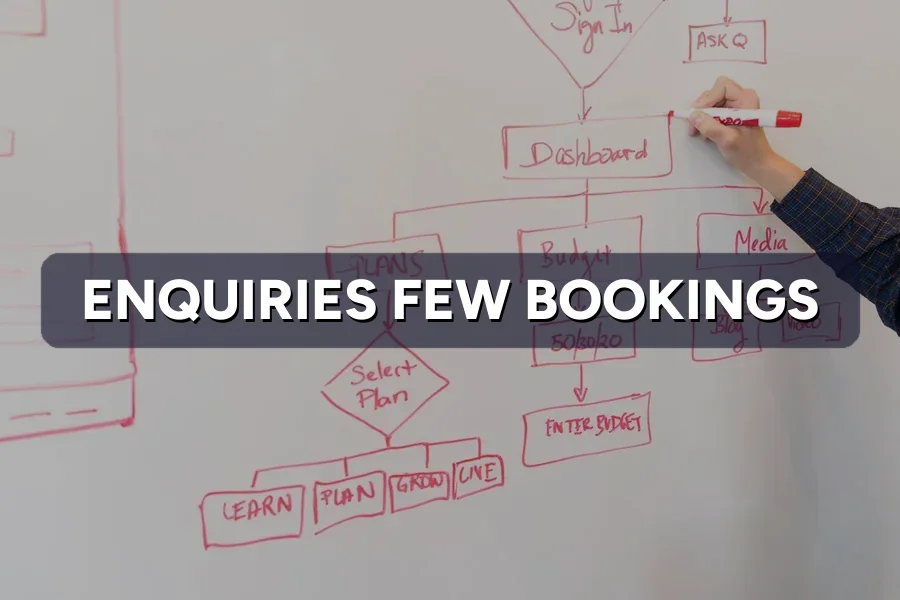
Few things sting more than a steady stream of enquiries that never fills the booking sheet. The messages come in — a WhatsApp, a form, a DM — then most just fade. You did the hard part and got someone interested, yet the calendar stays quiet.
Here’s the good news in that frustration: enquiries but few bookings is a follow-up problem, not a demand problem. The demand is proven — these people found you and reached out. When they don’t book, they rarely lost interest; they hit a gap between “I’m interested” and “I’m booked,” and slipped through it.
This guide from the ZenWeb digital marketing agency team explains why enquiries stall before booking, where Malaysian businesses lose them, and what that gap costs. Then it lays out the exact order to close it, so more of the enquiries you already get turn into paying jobs.
Enquiries coming in but bookings falling short?
We build the follow-up that turns messages into booked jobs, then keep it converting. See how we turn enquiries into bookings →
Most enquiries in Malaysia arrive by phone — a WhatsApp message, a form on a mobile screen, a social DM — so speed and a clear next step matter more than a polished pitch. This short video sets up the fundamentals before we get into the detail.
Source video: "How To Increase Sales With A Lead Follow-up System" on YouTube
Quick Answer: Enquiries but few bookings means real people reach out — and then most never become a confirmed job. The interest is genuine; the path from message to booking breaks somewhere. It shows up as a busy inbox, plenty of “just checking price” chats, and a booking sheet that stays far emptier than the enquiry count suggests.
A booking is different from an enquiry. An enquiry is someone raising their hand — a question, a price check, a “are you free?” A booking is a confirmed commitment: a slot taken, a deposit paid, a job booked. So enquiries but few bookings means the first step happens often and the second rarely follows.
Before you blame your prices, rule out two look-alikes. First, check the enquiries are genuine. A wave of low-quality or spam messages inflates your count and dooms your booking rate — that’s a lead-quality issue, and a landing page that isn’t converting often sits behind it. Second, make sure enquiries even reach you: if your homepage isn’t converting or messages vanish into an unwatched inbox, the problem is capture, not closing.
Quick Answer: Enquiries but few bookings usually fails on a few things: a slow first reply, no structured follow-up, an answer that misses the real question, price shown with no value, and no easy way to actually book. Speed and a clear next step are the two that move the needle most — fix those first.
Enquiries but few bookings is rarely one big mistake. It’s the same handful of gaps showing up together. Across the enquiry flows our digital marketing team rebuilds, based on ZenWeb’s client sample of 500+ Malaysian SME accounts (2024–2026), the lead causes cluster tightly — and most are about speed and clarity, not price.
| Main blocker | Share of cases | Scale |
|---|---|---|
| Slow first reply — hours or days | 28% | |
| No structured follow-up after the first reply | 22% | |
| Reply misses the real question or next step | 18% | |
| Price shown with no value framing | 14% | |
| Enquiry lands in a channel no one watches | 10% | |
| No easy way to book — no slot, no link | 8% |
Source: ZenWeb enquiry-flow rebuilds, Malaysian SME accounts, 2024–2026. Typical breakdown, not guaranteed. Licence.
The pattern is clear: the top blockers are speed and structure. Enquiries went cold while they waited, or got one reply and then silence. That silence is expensive — when a warm enquiry stops hearing from you, it drifts, exactly the way leads go cold and start ghosting.
Quick Answer: Enquiries leak at four points: the first reply, the qualifying reply, the quote or price step, and the booking step. The biggest loss is speed at the first reply — a message left for hours often books with whoever answered sooner. Knowing which point loses the most tells you what to fix first.
Turning enquiries into bookings starts with finding where people drop off. Most enquiries here happen on a phone and expect a fast reply — even an hour’s delay can lose them to a rival who answered in five minutes. Here’s where the flows we rebuild lose people, and the quick fix for each.
| Stage | Share of drop-offs | Why they leave | Usual fix |
|---|---|---|---|
| The first reply | 35% | Waited too long, booked elsewhere | Reply in minutes; auto-acknowledge instantly |
| The qualifying reply | 26% | Answer didn’t match their question | Answer the real question; give one next step |
| The quote or price step | 24% | Price landed with no value around it | Frame value; offer a couple of options |
| The booking step | 15% | No simple way to lock in a slot | Send a booking link or confirm a time |
Source: ZenWeb enquiry-flow rebuilds, Malaysian SME accounts, 2024–2026. Typical breakdown, not guaranteed. Licence.
The first reply and the qualifying reply lose most enquiries — the two moments where a person decides whether you’re responsive and whether you understood them. Slow channels make it worse: enquiries stuck in social DMs that pile up or a live chat answered too slowly are often gone before anyone opens them.
Quick Answer: A weak follow-up doesn’t cost you enquiries — it costs you the bookings those enquiries should have made. Lifting your booking rate from 10% to 30% on the same enquiries can triple your booked revenue without a single extra lead, so every ringgit you spend getting enquiries works far harder.
Enquiries but few bookings hides its true cost, because the enquiries still show up in your inbox. To see the cost, hold the enquiry count and average job value steady and change only the booking rate. Here’s the difference for a business at 60 enquiries a month and an RM1,200 average job value.
| Booking rate | Bookings/month | Booked revenue | Scale |
|---|---|---|---|
| 10% (leaking) | 6 | RM7,200 | |
| 20% (average) | 12 | RM14,400 | |
| 30% (tuned) | 18 | RM21,600 | |
| 40% (strong) | 24 | RM28,800 |
Illustrative scenario for a Malaysian SME at 60 monthly enquiries and RM1,200 average job value, 2024–2026. Modelled example, not guaranteed. Licence.
Moving from 10% to 30% on the same 60 enquiries turns 6 bookings into 18, and lifts booked revenue from RM7,200 to RM21,600 — without a single extra enquiry. If you pay for those enquiries, weak follow-up stings twice: every click you paid for lands on a flow that can’t close, the same wasted spend as when your Google Ads get disapproved and never run. It also inflates your true cost per lead across channels, because you’re paying for enquiries you never convert.
Want to know how much your enquiries are leaving on the table?
We audit your enquiry flow and show you the bookings hiding behind a low booking rate. Get a free enquiry-flow audit →
Quick Answer: Close more enquiries in order of impact: reply within minutes, answer the real question, frame the price with value, offer one easy way to book, then follow up two or three more times before you give up. Fix reply speed first — it lifts the booking rate more than anything else.
Fixing enquiries but few bookings works best one change at a time — overhaul everything at once and you’ll never know what worked. Change one thing, give it a couple of weeks, and watch how many book. Here’s the order that closes the most for the least effort.
If enquiries still won’t book after all five, the problem may sit earlier — the traffic or a landing page that isn’t converting. Or let our digital marketing team build the follow-up system and test each step for you.
No time to chase every enquiry within minutes?
We set up fast auto-replies, structured follow-up, and easy booking so nothing slips. Set up a follow-up system that books →
Quick Answer: Fixing follow-up pays back fast, because the demand is already there — people asked and then waited. Once replies are quick and structured, the booking rate climbs, ghosting drops, and enquiries convert within days instead of drifting. The change usually shows within weeks, not months.
Unlike a new campaign, fixing enquiries but few bookings doesn’t create new demand — you’re capturing demand you already have, which is why recovery shows up quickly. Here’s the before-and-after our team sees after rebuilding a weak enquiry flow into a fast one.
| Metric | Before fix | After fix | Change |
|---|---|---|---|
| Median first-reply time | 9 hours | 12 minutes | -98% |
| Enquiry-to-booking rate | 14% | 31% | +17 pts |
| Follow-up touches per enquiry | 1.2 | 4.0 | +233% |
| Ghost / no-reply rate | 38% | 19% | -19 pts |
Source: ZenWeb enquiry-flow rebuilds, Malaysian SME accounts, 2024–2026. Typical results, not guaranteed. Licence.
The lift is quick because nothing new had to be invented — the interest was already there. Cut the reply time, add a few structured follow-ups, and enquiries that used to drift now book. It’s the same reason fixing a homepage that isn’t converting pays back faster than most marketing: you’re unlocking demand you already earned.
Quick Answer: Keep your booking rate high by tracking reply speed and booking rate every month, testing your own enquiry flow as a mystery shopper, keeping follow-up templates fresh, watching every channel, and reviewing lost enquiries for patterns. A flow that books today can quietly slip tomorrow.
Enquiries but few bookings often creeps back after a business fixes it once and moves on. Staff change, new channels open, and one busy week undoes the habit. A few simple routines keep the bookings coming:
Enquiries but few bookings is one of the most fixable problems in marketing, because the hard part — getting people to reach out — is already done. The interest is there. It just hit a gap: a slow reply, an answer that missed the point, a bare price, or no easy way to book.
Work the fixes in order — reply in minutes, answer the real question, frame the price, make booking one tap, and follow up a few more times before you give up. Change one thing at a time, watch your booking rate, and mystery-shop your own flow now and then. Do that and the enquiries you already get become the bookings they should have been. If you’d rather not guess, an experienced team can pinpoint why your leads don’t convert and fix it faster.
Getting enquiries but not enough bookings?
Book a free 30-minute session — we’ll review how you reply to enquiries, find exactly where bookings leak, and give you a clear plan to turn more messages into booked jobs.
Enquiries but few bookings almost always means the follow-up leaks, not the demand. Usually a reply came too slowly, missed the real question, quoted a bare price, or gave no easy way to book. The interest was real — it just hit a gap. Reply faster, answer clearly, frame the price, and offer one simple booking step, and more enquiries convert.
As fast as you can, ideally within a few minutes. Most enquiries here come by WhatsApp or a mobile form and expect a quick, human reply. The business that answers first often wins the job, even over a cheaper rival. An instant auto-acknowledge buys you time, but a real answer within minutes is what lifts the booking rate most.
Most Malaysian SMEs book somewhere around 20% of genuine enquiries, and well-run flows reach 30–40% or higher. If you’re under about 10%, the follow-up has fixable gaps rather than a demand problem. Track your own rate month to month rather than chasing one benchmark — a steady climb matters more than the exact number.
Two or three more times after the first reply, spaced a few days apart, is a sensible default. Most bookings need several touches, yet most businesses stop after one message. Keep each follow-up short, friendly, and useful — a new detail, a gentle reminder, a simple question — so it helps rather than nags, and stop once they clearly say no.
Check quality first. If the enquiries are vague, mismatched, or spammy, the problem is upstream — the traffic or a landing page that isn’t converting the right people. If the enquiries are genuine but still don’t book, it’s the follow-up: reply speed, relevance, or the booking step. Mystery-shop your own flow to tell which one is leaking.
Complete the form and our team will contact you to discuss your goals. Let’s grow your business.



Meowketing Specialist
Online