AI Search is transforming how people find information online. Not long ago, “Googling it” was second nature. But today, millions of people are skipping Google altogether — and asking ChatGPT, Gemini, DeepSeek, or Glok instead.
We’re living through a seismic shift in how humans search for information. Instead of typing “best CRM software”, users now ask “Which CRM is best for small businesses in 2025, and why?” And in seconds, AI tools return a conversational, curated answers — often without users ever clicking a single website.
So the burning question for every business, marketer, and creator is:
If AI tools are answering everything… does SEO still matter?
Short answer: Yes — more than ever.
But SEO has changed its shape and soul.
In the AI era, SEO isn’t just about ranking high on Google. It’s about earning the trust of AI systems — being the source they quote, cite, and recommend to millions of users who never even open a browser tab.
This article takes you deep into the new SEO frontier — explaining why SEO is evolving, how AI reshapes it, and what you can do to maintain visibility in 2026.
Why AI Search Hasn’t Killed SEO — It’s Making It Smarter
Some say generative AI has killed SEO. That’s a myth rooted in misunderstanding how AI works — and how people search. Here’s the truth:
1. AI Still Needs Human-Created Data
Large language models (LLMs) don’t invent facts; they summarize existing knowledge. If your website isn’t structured, authoritative, and crawlable, AI simply won’t use it as a source.
Think of AI SEO as a bridge between your content and AI systems — if the bridge isn’t solid, your site remains invisible in AI search results.
2. AI Can’t Satisfy Every Search Intent
AI tools excel at summaries, definitions, and quick answers. But users still crave depth: detailed guides, pricing tables, case studies, and reviews.
Well-optimized, long-form content with structured information is still important. This is where SEO in the age of AI continues to drive real traffic and conversions.
3. AI Rewards (and Shows) Its Sources
AI platforms like Perplexity AI or Google’s Search Generative Experience (SGE) display links they rely on. Being cited by AI is the new currency of visibility.
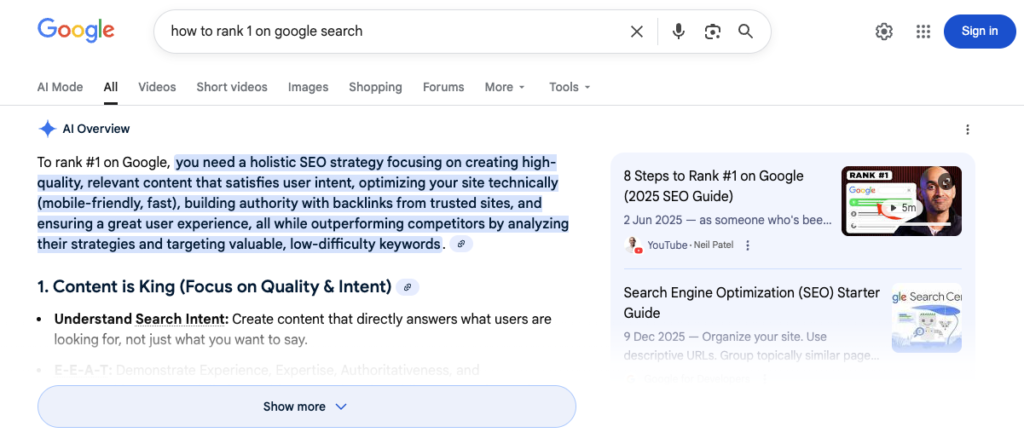
So the new SEO game is not just ranking — it’s being trusted and quoted.
Bottom line: SEO hasn’t died. It has evolved from “getting clicks” to earning citations in AI search.
From Traditional SEO to AI SEO: A Paradigm Shift
Old SEO lived by three commandments: keywords, backlinks, and freshness.
In AI SEO, these pillars remain important — but new priorities dominate:
- AI readability: Can AI parse and summarize your content effortlessly?
- Authority signals: Does your content demonstrate expertise and trustworthiness?
- Citation potential: Can your content be quoted or summarized succinctly by AI?
This shift requires moving beyond click-bait headlines and embracing evidence-rich, structured storytelling that satisfies both humans and AI.
The Technical Backbone of AI SEO
Even in an AI-first world, technical SEO remains your site’s skeleton.
If your site is slow, confusing, or hard to crawl, no AI will touch it.
- Clean architecture: Logical hierarchies and strong internal links.
- Speed: Core Web Vitals still matter — AI prefers fast, efficient pages.
- Security: HTTPS is non-negotiable.
- Canonicalization: Prevent duplicate confusion.
- Crawl accessibility: Keep sitemaps and robots.txt pristine.
A technically broken site won’t just lose Google traffic — it will vanish from AI knowledge altogether.
ZenWeb’s technical SEO team specializes in optimizing websites for both human usability and AI discoverability, ensuring your content is ready for the next generation of search.
Content in the AI Era: From Readable to “Citable”
The new mantra:
“Don’t just write for readers — write for readers and retrievers.”
Structure for Machines
- Use clear H1–H3 headings
- Include TL;DR summaries
- Use short, focused paragraphs
- Add bullet points, tables, and numbered lists
Show Real Authority
- Publish original data or case studies
- Include statistics and references
- Build trust through transparency and sourcing
Make It Quotable
- End sections with concise, memorable sentences AI can lift directly
- Include FAQ sections; AI loves extracting snippets
- Create long-form content (2,000–3,000 words) for maximum AI citation
For example, a B2B software adoption case study with statistics, pricing comparisons, and step-by-step insights can become a top-cited source in AI search.
If you’re unsure how to turn your existing blog content into AI-friendly, structured insights, ZenWeb offers AI SEO content audits — showing exactly what to fix, rewrite, and structure for AI citation.
Authority and E-E-A-T: Winning the Trust Game
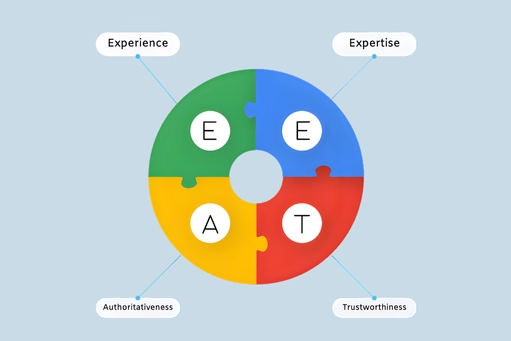
It’s not enough to write well; you need to exist credibly across the digital ecosystem.
- Add author bios with real credentials.
- Earn mentions from reputable media or partners.
- Be active on professional platforms like LinkedIn or industry forums.
- Keep your brand voice consistent everywhere.
When AI scans the web, it chooses sources that look like leaders, not echoes, rewarding sites that demonstrate proven expertise.
ZenWeb’s branding specialists help companies build that authority layer — connecting SEO strategy with brand trust signals that both Google and AI engines recognize.
Why Long-Tail Keywords Still Matter
Some believe keywords are dead because AI understands natural language. The truth? Long-tail keywords are the bridge between human intent and AI comprehension.
For example:
- “Eco-friendly packaging suppliers in Malaysia”
- “Best SaaS CRM for small teams 2026”
- “Affordable local SEO agency in Chicago”
These highly specific queries drive qualified traffic and increase AI visibility.
Modern AI SEO leverages long-tail keywords strategically, mapping content to intent while making it AI-citable.
Practical AI SEO (AIO) Roadmap

Here’s a step-by-step guide to future-proof your site for 2026:
- Add TL;DR summaries: Every article should have a concise summary at the top.
- Include FAQs: 3–7 direct, question-based answers at the end.
- Design for citations: Use short, data-rich sentences AI can quote.
- Structure your content: Lists, tables, bullet points for readability.
- Publish original insights: Conduct surveys, experiments, or mini-research.
- Build topic clusters: Connect related content with internal links.
- Promote off-site: Share your expertise via social media, podcasts, and newsletters.
- Monitor AI performance: Track mentions, citations, and engagement metrics.
By following this roadmap, you ensure your content is AI-friendly, human-readable, and highly discoverable.
How to Measure AI SEO Success
Traditional metrics like rankings and traffic are still relevant, but AI SEO success includes new KPIs:
- AI referrals: Traffic from AI-driven platforms like Perplexity AI or ChatGPT integrations
- Brand mentions: Track where your site is cited in AI-generated answers
- Content depth metrics: Monitor scroll depth, dwell time, and engagement
- Citation frequency: Identify which pages are referenced most often in AI search
Here’s a simple table example:
| Metric | Description | Tool |
|---|---|---|
| AI referrals | Users referred via AI platforms | Analytics + AI monitoring |
| Citation frequency | How often AI cites your page | Alerts, backlinks checkers |
| Engagement depth | Scroll depth, dwell time | Google Analytics, Hotjar |
| Brand mentions | Mentions in forums, articles, AI responses | Brandwatch, Mention |
By tracking these, you understand not just traffic, but trust and influence in AI ecosystems.
FAQs About SEO in the Age of AI
Q: Is SEO dead because of AI?
No — it’s evolving. SEO in the age of AI now means optimizing for both humans and AI visibility.
Q: What is AI SEO?
Optimizing content so AI can understand, quote, and recommend it in AI search results.
Q: Do long-tail keywords still matter?
Absolutely. They bridge human intent and AI comprehension.
Q: How do I make my content AI-friendly?
Use structured headings, concise summaries, verified data, and quotable insights.
Q: How do I measure AI SEO success?
Track AI referrals, citation frequency, engagement metrics, and brand mentions.
Q: Can AI SEO work for e-commerce?
Yes — product descriptions, FAQs, and pricing comparisons optimized for AI visibility can become highly cited sources.
Q: Will voice search affect AI SEO?
Voice search amplifies long-tail keywords and structured answers, making AI-friendly content even more essential.
Conclusion
SEO is not a casualty of AI — it’s the foundation of AI’s knowledge. The game has changed from “helping people find you” to “helping AI choose you.”
So stop chasing rankings.
Start building credibility, clarity, and citation-worthiness.
If you want your brand to be among the voices AI cites, not ignores, AI SEO is no longer optional — it’s essential. That requires an SEO strategy built for both humans and intelligent systems.
ZenWeb can help you get there.
From technical audits to content engineering and AI optimization,
ZenWeb’s team transforms your website into an AI-ready authority source.
Learn more at ZenWeb — and get your site ready for the next generation of search.