Share this post:
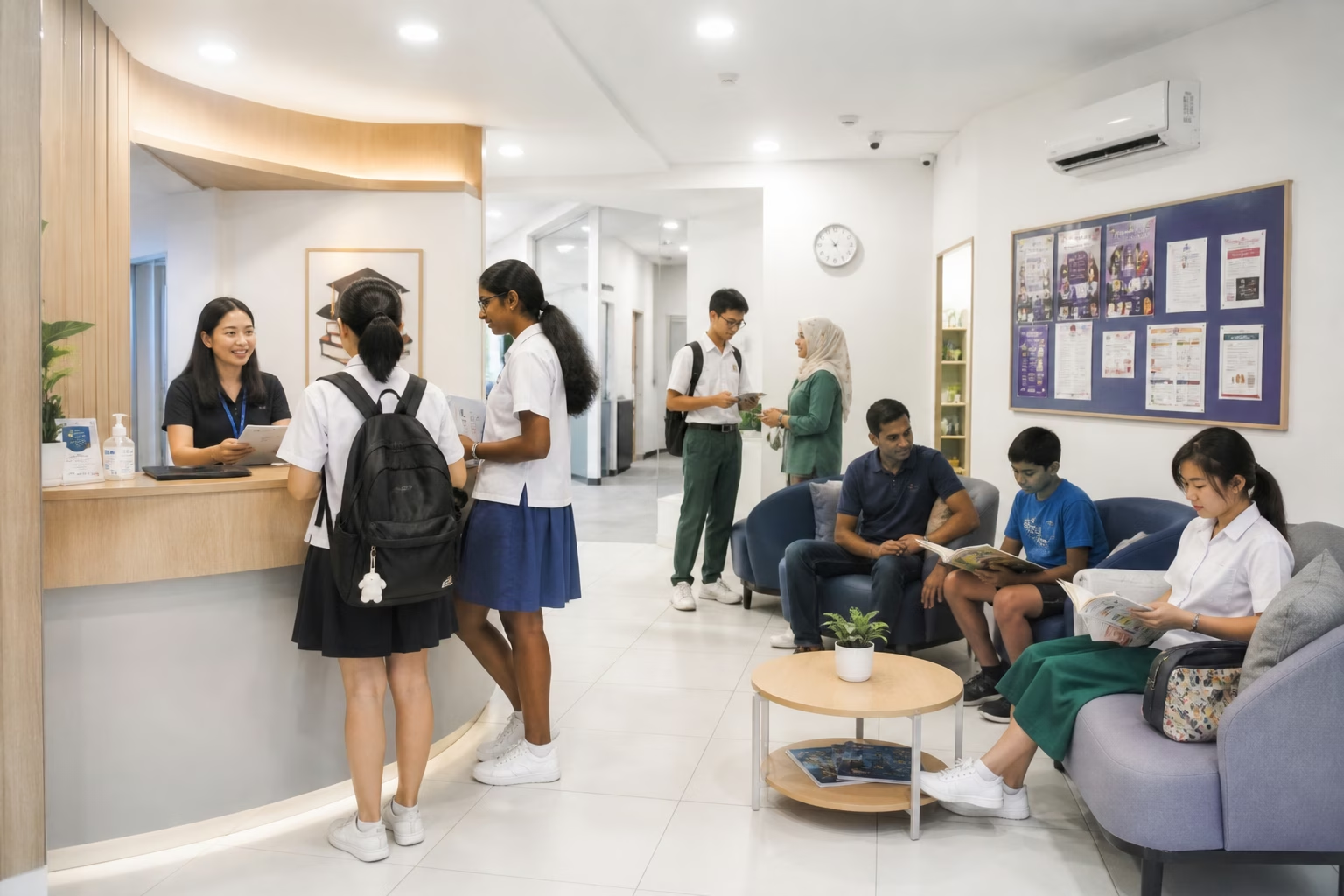
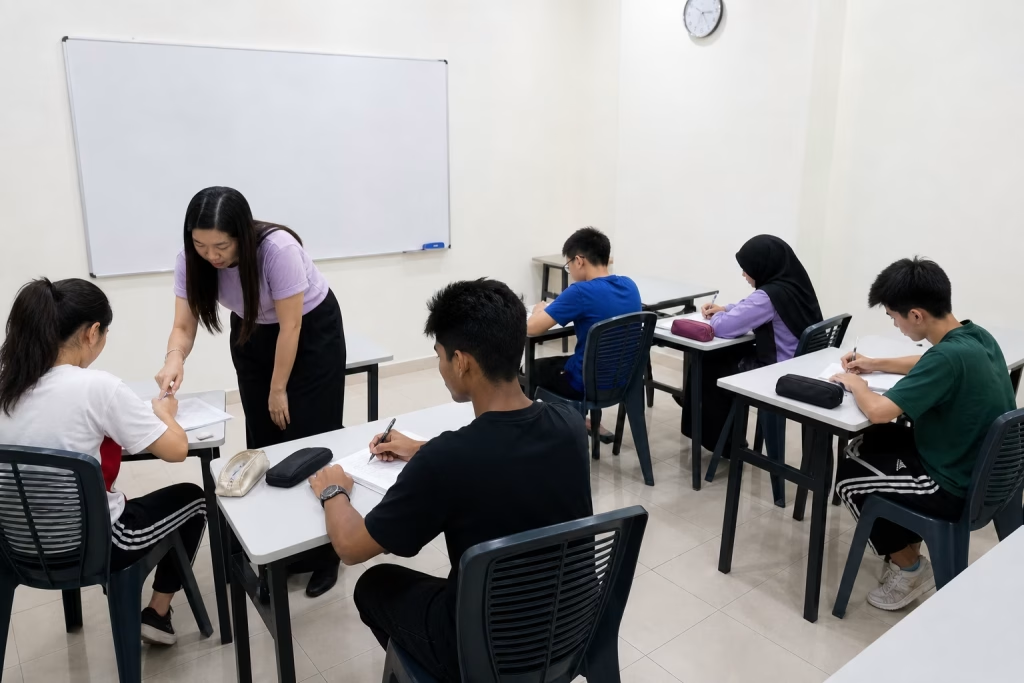
Most Malaysian parents don’t compare tuition centres on a desktop. They tap “tuition centre near me” on Google Maps in a school carpark, then scroll Instagram for parent reviews. According to DataReportal’s Digital 2025 Malaysia report, 97.4% of Malaysians use the internet and 89% search via mobile. For a tuition centre, SEO is mostly about being the right answer at the moment a parent finishes school pickup.
This sub-pillar of our Digital Marketing Guide for Tuition Centres covers Google Business Profile, on-page subject-and-level pages, suburb pages, technical SEO and link earning. The video below frames the parent-search context.
Source video: Get More Tutoring Clients Fast Without Feeling Salesy on YouTube
Quick Answer: SEO and Google Business Profile deliver the lowest cost per enrolled student for tuition centres because parent search is local and recurring. ZenWeb data shows SEO CPL at RM 9–28 versus RM 32–95 on paid ads.
Parents search for tuition the same way each term — by suburb, by school, by subject and by level. That repeating intent makes SEO the most defensible channel. A centre that ranks for “SPM Add Maths tuition Subang Jaya” once tends to rank for the same query the following year, and renewals compound the gain. ZenWeb client tracking, Malaysian tuition centre accounts, 2024–2026, shows SEO-sourced leads convert to enrolment at 28–34% versus 18–22% for paid leads — partly because the parent who arrives via search has already made a buying decision.
Quick Answer: Three pillars carry tuition SEO — Google Business Profile, subject-and-level landing pages, and suburb pages. Skip any one and the funnel leaks at that stage.
Pillar one is Google Business Profile (GBP) — the Map listing parents see first. Pillar two is on-page: each subject and level your centre teaches gets its own page with the named teacher, syllabus, fee and schedule. Pillar three is the suburb page network — one page per neighbourhood you serve, optimised for “tuition centre [suburb]” and “pusat tuisyen [suburb]” queries. Sections 3, 5 and 7 cover each pillar.
Quick Answer: A fully built GBP with 50+ recent reviews, weekly photo posts and accurate term-time hours typically delivers more enquiries than a RM 3,000/month Google Ads budget.
The GBP basics: register the centre’s exact business name, the JPN-registered address, term-time opening hours, primary category “Tutoring service” and secondary categories matching subjects taught. Add photos of the classroom, the teacher line-up board and the building entrance every week. Respond to every review within 48 hours, in the same language the parent used. Push every parent who renews for a new term into the review queue — Tuesdays after a result release work best.
Quick Answer: Proximity, category match, review count, review recency and Google Posts frequency drive Malaysian tuition centre Map rankings. Distance is set; the other four are operational.
Google’s local pack picks the top three Map listings on a mix of proximity, prominence and relevance. Proximity is fixed by your branch address. Prominence rises with review count, review recency, photo volume and external mentions on Malaysian directories (FindGuru, ChampionTutor, school Facebook groups). Relevance rises when your category, services menu and posts mention the exact subjects and levels you teach. A centre that posts a weekly “this week’s class highlight” and asks for two reviews a week will out-rank a centre with twice the ad budget within six months.
Quick Answer: One page per subject-and-level combination — SPM Add Maths, PT3 Mathematics, IGCSE Chemistry — with the teacher’s name, syllabus, class size, schedule and fee. This is non-negotiable for Malaysian tuition SEO.
A “Subjects” page that lumps every level together cannot rank because Google’s algorithm needs page-level intent match. Each subject and level needs its own URL — for example /spm-add-maths-tuition/, /pt3-bahasa-melayu/, /igcse-chemistry/. Each page should carry an H1 with the subject-level-location pattern, a 300–500-word intro covering syllabus coverage and exam alignment (KSSM for SPM, Cambridge for IGCSE), a teacher bio with credentials, a class-schedule grid, a transparent fee table and a WhatsApp CTA.
Quick Answer: Cluster keywords by subject, level and suburb. Mix English and Bahasa — “SPM Add Maths tuition” and “tuisyen Add Maths SPM” are different SERPs.
Tuition keyword clusters in Malaysia split four ways.
Brand-and-competitor intent protects share. Build one page or article per cluster, not one mega-page.
Quick Answer: One unique suburb page per neighbourhood within the centre’s 5–8 km catchment, with a local landmark map, schools served and the closest branch’s WhatsApp.
Suburb pages convert because parents search “tuition centre Cheras” before “tuition centre Malaysia”. Each suburb page needs a unique 400–600-word body covering the schools served (SK Cheras Indah, SMK Seri Bintang Utara, etc.), local landmarks (the closest LRT station, mall or sports complex), and a Google Maps embed. Avoid spinning the same content across 30 suburbs — Google’s helpful-content systems will demote duplicates. The branch finder on the homepage should link to every live suburb page.
Quick Answer: Hit Core Web Vitals “good” thresholds, deploy LocalBusiness, EducationalOrganization, Course and FAQPage schema, and run a mobile-first build. Anything else is secondary.
Tuition centre sites lose ranking from heavy hero sliders, unoptimised teacher photos and tracking-script bloat. Aim for Largest Contentful Paint under 2.5 seconds, Interaction to Next Paint under 200 ms and Cumulative Layout Shift under 0.1. Add LocalBusiness and EducationalOrganization schema on the homepage, Course schema on each subject-and-level page, and FAQPage schema on Q&A blocks. Set canonical URLs per page and submit a clean XML sitemap to Google Search Console.
Quick Answer: Publish two parent-focused blog posts a month — exam tips, syllabus changes, study schedules — and tag each to a subject-and-level landing page.
The content angles that earn ranking and links for tuition centres in Malaysia: subject-and-level study tips (“How to Score A+ in SPM Add Maths Paper 2”), syllabus updates (“KSSM Sains Tingkatan 4 — what changed in 2026”), parent guides (“How to choose a tuition centre in Klang Valley”), and exam timetable round-ups. Cite the MOE syllabus document, link out to the Lembaga Peperiksaan PDF and link internally to the matching subject page.
Quick Answer: Earn links from school PIBG newsletters, parent forums, MoneyParent-style listicles and education-aggregator directories. Avoid paid PBN packages — Google will demote you.
Achievable links for Malaysian tuition centres: school PIBG (parent association) newsletters that list community vendors, parent-forum threads on KL-area parenting groups, education aggregators (FindGuru, ChampionTutor, EduAdvisor), and guest contributions to local news outlets like Malay Mail’s lifestyle column. The bar for tuition links is low — most competitors have under 30 referring domains. Twenty quality links over a year typically lifts a centre from page two to top three.
Quick Answer: SEO undercuts paid ads by 3–4x at every level. SPM Add Maths SEO leads cost RM 28 vs RM 95 on Google Ads.
| Subject / Level | SEO + GBP CPL | Paid CPL | Saving |
|---|---|---|---|
| Primary general | RM 9 | RM 32 | 72% |
| PT3 core | RM 14 | RM 45 | 69% |
| SPM core | RM 19 | RM 58 | 67% |
| SPM Add Maths / Sciences | RM 28 | RM 95 | 71% |
| IGCSE / A-Level | RM 24 | RM 88 | 73% |
Source: ZenWeb client tracking, Malaysian tuition centre accounts, 2024–2026.
Quick Answer: GBP impact lands in 4–6 weeks. Subject pages rank in 8–14 weeks. Suburb pages rank in 12–20 weeks. Plan accordingly.
| SEO Activity | Time to Impact | Index vs GBP |
|---|---|---|
| Google Business Profile setup + reviews | 4–6 weeks | 100 |
| Subject-and-level pages (10–15 pages) | 8–14 weeks | 170 |
| Suburb landing pages (5–10 pages) | 12–20 weeks | 240 |
| Blog content + link earning | 4–9 months | 320 |
Source: ZenWeb operational data, Malaysian tuition centre client campaigns, 2024–2026.
Quick Answer: RM 1,500/month SEO retains drive 18–28 organic enrolments per term once mature. RM 3,000 drives 38–58. Returns flatten past RM 5,500 for a single branch.
| SEO Spend (RM/mo) | Organic Enrolments / Term | Visualisation |
|---|---|---|
| RM 800 | 8–14 | |
| RM 1,500 | 18–28 | |
| RM 3,000 | 38–58 | |
| RM 5,500 | 62–85 | |
| RM 8,000+ | 75–95 (flattens) |
Source: ZenWeb operational data, Malaysian tuition centre client campaigns, 2024–2026.
Quick Answer: SEO CPL has stayed nearly flat (RM 12 → RM 17) while paid CPL nearly doubled. Centres that started SEO in 2023–2024 hold the lowest blended CPL today.
| Year | SEO + GBP CPL | Paid CPL (blended) |
|---|---|---|
| 2022 | RM 12 | RM 21 |
| 2023 | RM 13 | RM 27 |
| 2024 | RM 14 | RM 33 |
| 2025 | RM 15 | RM 36 |
| 2026 YTD | RM 16 | RM 39 |
| 2027 (projected) | RM 17 | RM 44 |
Source: ZenWeb operational data, Malaysian tuition centre client campaigns, 2022–2026 actual + 2027 projection.
Quick Answer: Add a quotable Quick Answer block at the top of every page, mark it with FAQPage and speakable schema, and write factual, source-backed paragraphs. AI Overviews cite the cleanest answers.
AI Overviews and ChatGPT search both lift answers from pages with clear question-answer structure, embedded schema and named sources. For tuition centres, the winning pattern is a 35–50-word Quick Answer at the top of each page, followed by the longer explanation, with FAQPage schema on Q&A blocks and “speakable” markup pointing to the Quick Answer. ZenWeb’s AEO playbook on the SEO service page covers this in detail.
Quick Answer: The five mistakes — one big “Subjects” page, no GBP, fake reviews, hidden fees and duplicate suburb pages. Each tanks ranking in a single Google update.
One mega “Subjects” page cannot rank because it dilutes intent. No claimed GBP means no Map presence at all. Fake reviews trigger Google’s review-spam filter and can wipe a profile. Hidden fees push parents to bounce, lifting the page’s “low-quality” signal. Duplicate suburb pages spun from the same template trip the helpful-content classifier and demote the whole domain.
Quick Answer: One domain, one branch finder, one location page per branch with its own GBP. Avoid one site per branch — backlink equity splinters.
The standard architecture: one domain (yourcentre.com), a /branches/ directory with one page per branch, a homepage branch finder map, and one Google Business Profile per branch with the exact branch address. Each branch page links to that branch’s relevant subject-and-level pages and lists the local team. Avoid spinning up a separate website per branch — it’s a backlink-dilution and duplicate-content trap that costs months of recovery.
Quick Answer: Track six SEO KPIs — GBP profile views, GBP direction-clicks, organic clicks per subject page, top-three rankings per suburb, organic-sourced WhatsApp enquiries, and cost per organic enrolment.
GBP profile views and direction-clicks predict next-term enrolment three to four weeks ahead. Organic clicks per subject page show whether the on-page engine is working. Top-three suburb-keyword count shows the suburb-page network is maturing. Organic WhatsApp enquiries and cost per organic enrolment close the loop. Track in Google Search Console plus a Looker Studio dashboard fed by GBP and the CRM.
Quick Answer: Hire an agency that owns GBP, on-page and content as one engagement. Avoid SEO sold by ranking promises — Google bans those tactics.
The brief: GBP optimisation, the subject-and-level page set, the suburb page set, content publishing and link earning under one roof. Reports should lead with organic-sourced WhatsApp enquiries and cost per organic enrolment. ZenWeb runs SEO as an integrated track for tuition centres — see the ZenWeb SEO service and SEO pricing, or message us via the contact page.
Tuition SEO in Malaysia is decided in three places — Google Maps, the subject-and-level landing page and the suburb page network. Centres that fund GBP, build subject-and-level pages, and publish helpful content under a clean technical floor capture next-term enrolments at a quarter the cost of paid ads. Read the parent pillar guide for the full DM stack, or our Google Ads, Meta Ads and Web Design sub-pillars.
GBP impact lands inside 4–6 weeks. Subject-and-level pages rank in 8–14 weeks. Suburb pages rank in 12–20 weeks. Most ZenWeb tuition clients see organic enrolments climb meaningfully from term three onwards.
One domain with a /branches/ directory, one page per branch and one GBP per branch. Separate sites split your backlink equity and trigger duplicate content issues.
Aim for 50+ recent reviews per branch. Centres above that count consistently appear in the top three Map listings within their 5–8 km catchment, especially when paired with weekly Google Posts.
No. Each subject-and-level combination needs its own page — SPM Add Maths, PT3 Mathematics, IGCSE Chemistry. A mega-page dilutes intent and rarely ranks for any specific search.
No. Google’s spam systems penalise PBN and paid-link networks. Earn links through PIBG newsletters, parent forums, education aggregators and guest contributions instead.
Single-branch centres see strong ROI at RM 1,500–3,000 a month for GBP, on-page and content. Multi-branch chains scale to RM 5,500–8,000. Spend over RM 8,000 only if expanding to a new state.
Complete the form and our team will contact you to discuss your goals. Let’s grow your business.